

2 Deniers – France
France
Context
Years: 1616–1620
Issuer: France 
Ruler: Louis XIII
Currency:
(1204—1795)
Demonetized: Yes
Total mintage: 1,588,614
Material
References
KM: #Click to copy to clipboard43.4
Numista: #52152
Obverse
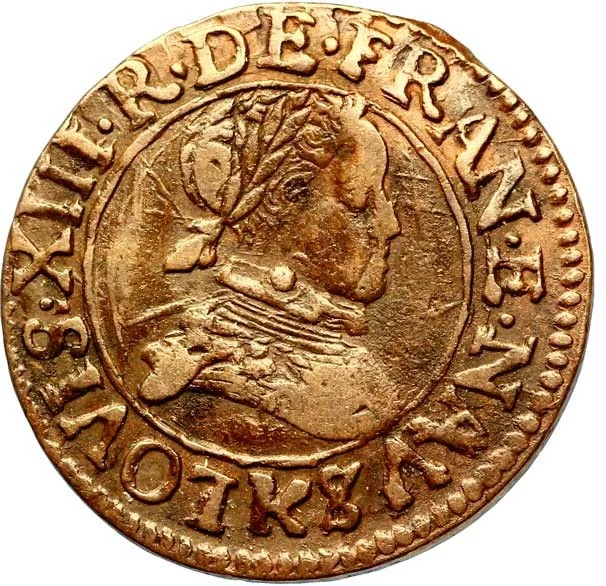
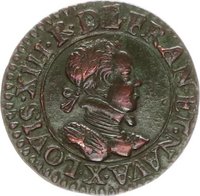
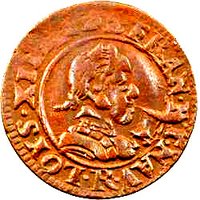
Description:
Bust right.
Inscription:
LOVIS.XIII.R.DE.FRAN.ET.NAV.K. (a)
LOVIS.XIII.R.DE.FRAN.ET.NAV K. (b)
LOVIS.XIII.R.DE.FRAN.ET.NAV.$.K (c)
LOVIS.XIII.R.DE.FRAN.E.NAV $ K (d)
LOVIS.XIII.R.DE.FRAN.ET.NA.$.K. (e)
LOVIS.XIII.R.DE.FRAN.ET.NA $ K (f)
LOVIS.XIII.R.DE.FRAN.ET.NA.K. (g)
LOVIS.XIII.R.DE.FRAN.ET.NAV $ K (h)
LOVIS.XIII.R.DE.FRAN.ET.NA $ K. (i)
LOVIS.XIII.R.DE.FRAN.ET.NA.$.K (j)
LOVIS.XIII.R.DE.FRAN.E.NA $ K (k)
LOVIS.XIII.R.DE.FRAN.ET.NA.$ K. (l)
LOVIS.XIII.R.DE.FRAN.ET.NAV K. (b)
LOVIS.XIII.R.DE.FRAN.ET.NAV.$.K (c)
LOVIS.XIII.R.DE.FRAN.E.NAV $ K (d)
LOVIS.XIII.R.DE.FRAN.ET.NA.$.K. (e)
LOVIS.XIII.R.DE.FRAN.ET.NA $ K (f)
LOVIS.XIII.R.DE.FRAN.ET.NA.K. (g)
LOVIS.XIII.R.DE.FRAN.ET.NAV $ K (h)
LOVIS.XIII.R.DE.FRAN.ET.NA $ K. (i)
LOVIS.XIII.R.DE.FRAN.ET.NA.$.K (j)
LOVIS.XIII.R.DE.FRAN.E.NA $ K (k)
LOVIS.XIII.R.DE.FRAN.ET.NA.$ K. (l)
Script: Latin
Reverse
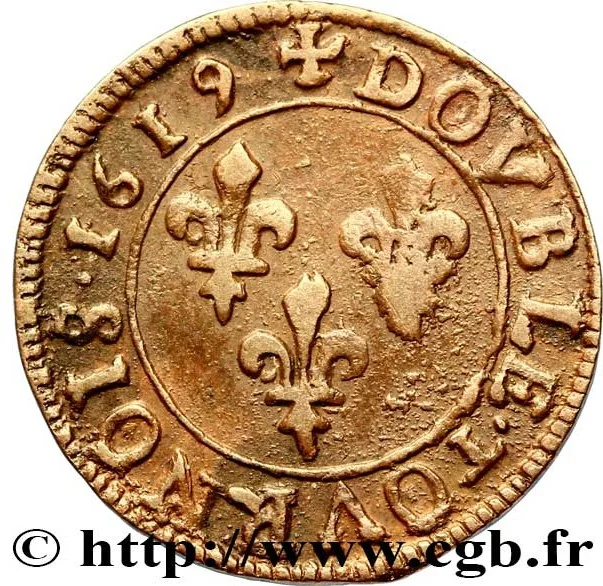
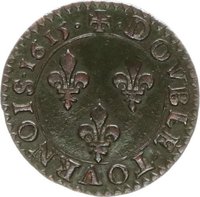
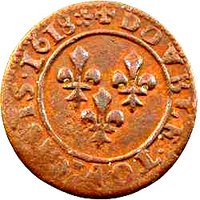
Description:
Three lilies.
Inscription:
+ DOVBLE.TOVRNOIS.(millésime) (1)
+ DOVBLE.TOVRNOIS.(millésime). (2)
+ DOVBLE.TOVRNOIS.(millésime). (2)
Script: Latin
Edge
Plain
Mints
| Name | Mark |
|---|---|
| Bordeaux | K |
Historical background
In 1616, France's currency was in a state of profound instability, a legacy of the prolonged Wars of Religion and the fiscal mismanagement of the late Valois and early Bourbon monarchs. The primary unit was the livre tournois, a money of account, while actual circulating coinage included gold écus, silver francs and testons, and copper liards. The critical problem was repeated royal edicts that altered the official value (the cours) of coins, often devaluing the livre to generate seigniorage profits for the treasury. This practice created a chaotic monetary landscape where the intrinsic metal value of a coin frequently differed from its mandated face value, leading to hoarding, speculation, and widespread economic uncertainty.
The situation was exacerbated by the political context of the Regency of Marie de' Medici, who governed for her young son, Louis XIII. Her court was riven by factional strife between powerful nobles, and currency manipulation became a tool for financing government expenses and rewarding political allies without calling the Estates-General to approve new taxes. In the years leading up to 1616, the government had repeatedly cried up (increased the face value of) certain coins, then suddenly cried them down (decreased their value), causing ruin for creditors and windfalls for debtors. This unpredictability severely disrupted trade and agriculture, as contracts and rents became subject to the crown's next monetary decree.
Consequently, the monetary chaos of 1616 was not merely a technical financial issue but a source of significant social unrest and a symptom of weak central authority. It eroded public trust in the monarchy's most basic function: guaranteeing a stable medium of exchange. The instability would persist until Cardinal Richelieu, later in Louis XIII's reign, implemented stronger central controls. The period thus stands as a stark example of how currency debasement was used as a desperate fiscal instrument, ultimately undermining economic confidence and highlighting the need for more robust state financial management in 17th-century France.
The situation was exacerbated by the political context of the Regency of Marie de' Medici, who governed for her young son, Louis XIII. Her court was riven by factional strife between powerful nobles, and currency manipulation became a tool for financing government expenses and rewarding political allies without calling the Estates-General to approve new taxes. In the years leading up to 1616, the government had repeatedly cried up (increased the face value of) certain coins, then suddenly cried them down (decreased their value), causing ruin for creditors and windfalls for debtors. This unpredictability severely disrupted trade and agriculture, as contracts and rents became subject to the crown's next monetary decree.
Consequently, the monetary chaos of 1616 was not merely a technical financial issue but a source of significant social unrest and a symptom of weak central authority. It eroded public trust in the monarchy's most basic function: guaranteeing a stable medium of exchange. The instability would persist until Cardinal Richelieu, later in Louis XIII's reign, implemented stronger central controls. The period thus stands as a stark example of how currency debasement was used as a desperate fiscal instrument, ultimately undermining economic confidence and highlighting the need for more robust state financial management in 17th-century France.
💎 Very Rare