

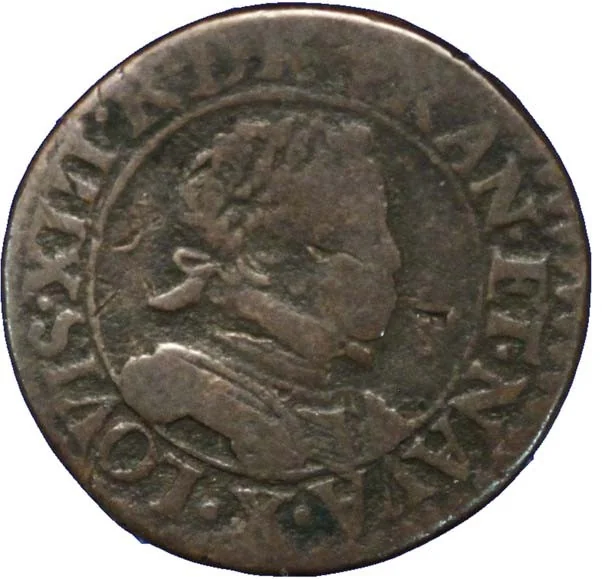
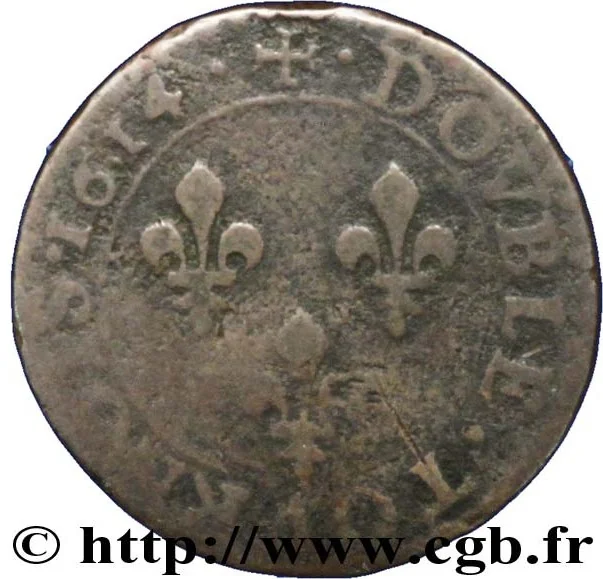
2 deniers – France
Add to wishlist
France
Context
Years: 1614–1615
Issuer: France
Ruler: Louis XIII
Currency:
(1204—1795)
Demonetized: Yes
Total mintage: 2,925,582
Material
References
KM: #
Numista: #52142
Obverse
Description:
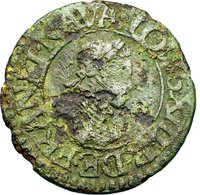
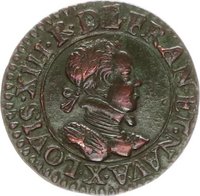
Childish bust of Louis XIII, laureate and draped, with right-side armor and a small flat collar; workshop letter at 6 o'clock.
Inscription:
LOVIS.XIII.R.DE.FRAN.ET.NAVA.X.
Script: Latin
Reverse
Description:
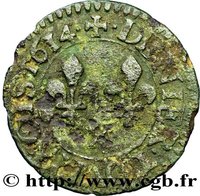
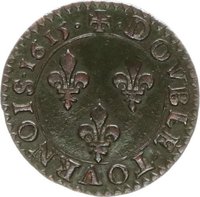
Three lilies arranged two and one.
Inscription:
+.DOVBLE.TOVRNOIS.(millésime).
Script: Latin
Edge
Plain
Mints
| Name | Mark |
|---|---|
| Amiens | X |
Historical background
In 1614, France’s currency situation was characterized by profound instability and manipulation, a legacy of the prolonged Wars of Religion and the weak regency government of Marie de Médicis, ruling for the young Louis XIII. The French monetary system was bimetallic, based on both gold (the écu) and silver (the livre tournois, a unit of account, and the franc), but the royal government frequently engaged in devaluations. These "augmentations" (lowering the metal content) and "diminutions" (raising it) were a crude form of fiscal policy, allowing the crown to instantly increase its nominal revenue from taxes or to re-mint coins at a profit, but at devastating cost to economic confidence.
This manipulation created chaos in everyday commerce and eroded trust. Prices and contracts became unpredictable, as the real value of coins could change abruptly by royal decree. The practice heavily favored speculators and financiers close to the treasury who could anticipate changes, while crippling peasants, wage-earners, and merchants who found their purchasing power arbitrarily diminished. The Estates General of 1614, convened in a rare moment of political crisis, directly reflected this turmoil, with the Third Estate submitting vehement cahiers de doléances (grievance lists) that specifically condemned monetary instability as a primary cause of public suffering.
Ultimately, the currency crisis of 1614 was a symptom of a deeper ailment: a crown trapped by inadequate administrative structures and chronic debt, resorting to short-term expedients that undermined the kingdom's long-term economic health. While the Estates General demanded reform and a return to stable, strong money, the assembly was dissolved without achieving concrete results. True monetary stability would only begin a generation later under the rigorous administration of Cardinal Richelieu and, more definitively, under Louis XIV’s minister Jean-Baptiste Colbert, who imposed a much-needed standardization.
This manipulation created chaos in everyday commerce and eroded trust. Prices and contracts became unpredictable, as the real value of coins could change abruptly by royal decree. The practice heavily favored speculators and financiers close to the treasury who could anticipate changes, while crippling peasants, wage-earners, and merchants who found their purchasing power arbitrarily diminished. The Estates General of 1614, convened in a rare moment of political crisis, directly reflected this turmoil, with the Third Estate submitting vehement cahiers de doléances (grievance lists) that specifically condemned monetary instability as a primary cause of public suffering.
Ultimately, the currency crisis of 1614 was a symptom of a deeper ailment: a crown trapped by inadequate administrative structures and chronic debt, resorting to short-term expedients that undermined the kingdom's long-term economic health. While the Estates General demanded reform and a return to stable, strong money, the assembly was dissolved without achieving concrete results. True monetary stability would only begin a generation later under the rigorous administration of Cardinal Richelieu and, more definitively, under Louis XIV’s minister Jean-Baptiste Colbert, who imposed a much-needed standardization.
💎 Very Rare