

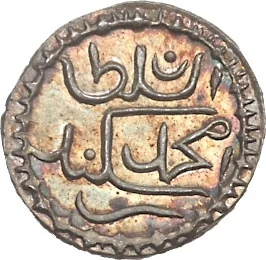
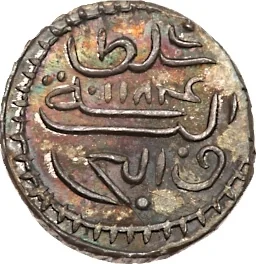
½ larin – Maldives
Add to wishlist
Maldives
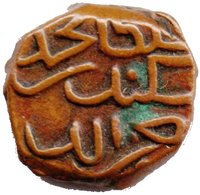
Obverse
Description:
Sultan's title
Inscription:
السلطان
محمد سكندر
محمد سكندر
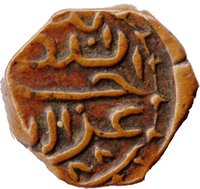
Reverse
Description:
Sultan, [date]
Inscription:
سلطان
١١٨۴
سنة
البر
والبحر
١١٨۴
سنة
البر
والبحر
Edge
Mintings
| Year | Mint Mark | Mintage | Quality | Collection |
|---|---|---|---|---|
| 1771 | — | — | ||
| 1773 | — | — |
Historical background
In 1771, the Maldives operated under a unique and self-contained monetary system, largely isolated from the global trade in precious metals. The primary currency in circulation was the larin, a distinctive horseshoe-shaped piece of silver wire, often stamped with markings. Originally of Persian origin, the larin had become the dominant medium of exchange throughout the Indian Ocean region and was well-suited to the Maldives' role as a hub in regional trade networks. However, the archipelago's most significant export and de facto currency backbone was the cowrie shell, specifically the Monetaria moneta species harvested from the Maldives' abundant lagoons.
The economy was fundamentally a cowrie-shell economy. These shells, meticulously gathered, processed, and bundled, were exported in vast quantities to Bengal, Ceylon (Sri Lanka), and other parts of Asia and Africa, where they served as a widely accepted form of money. Internally, lower-value transactions were conducted with cowries, while higher-value trade used larin. The state, under the Sultanate, held a monopoly on the cowrie harvest and its export, making it the central pillar of both the monetary system and the treasury's revenue. This system required minimal minting of coinage, as the shells themselves were the commodity-money.
This period, however, represented the twilight of the cowrie's dominance. By 1771, European colonial powers, particularly the Dutch and the British, were increasing their influence in the Indian Ocean. The influx of cowries from the Maldives and other sources was beginning to cause inflation in foreign markets like Bengal. Furthermore, European silver coins—Spanish dollars and Dutch rijksdaalders—were starting to penetrate regional trade. While not yet displacing the larin and cowrie domestically, their presence signaled the coming erosion of the traditional system, as global trade patterns and colonial economies would eventually force the Maldives to adapt its centuries-old currency practices.
The economy was fundamentally a cowrie-shell economy. These shells, meticulously gathered, processed, and bundled, were exported in vast quantities to Bengal, Ceylon (Sri Lanka), and other parts of Asia and Africa, where they served as a widely accepted form of money. Internally, lower-value transactions were conducted with cowries, while higher-value trade used larin. The state, under the Sultanate, held a monopoly on the cowrie harvest and its export, making it the central pillar of both the monetary system and the treasury's revenue. This system required minimal minting of coinage, as the shells themselves were the commodity-money.
This period, however, represented the twilight of the cowrie's dominance. By 1771, European colonial powers, particularly the Dutch and the British, were increasing their influence in the Indian Ocean. The influx of cowries from the Maldives and other sources was beginning to cause inflation in foreign markets like Bengal. Furthermore, European silver coins—Spanish dollars and Dutch rijksdaalders—were starting to penetrate regional trade. While not yet displacing the larin and cowrie domestically, their presence signaled the coming erosion of the traditional system, as global trade patterns and colonial economies would eventually force the Maldives to adapt its centuries-old currency practices.
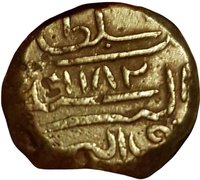
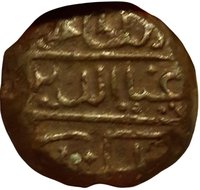
💎 Extremely Rare