

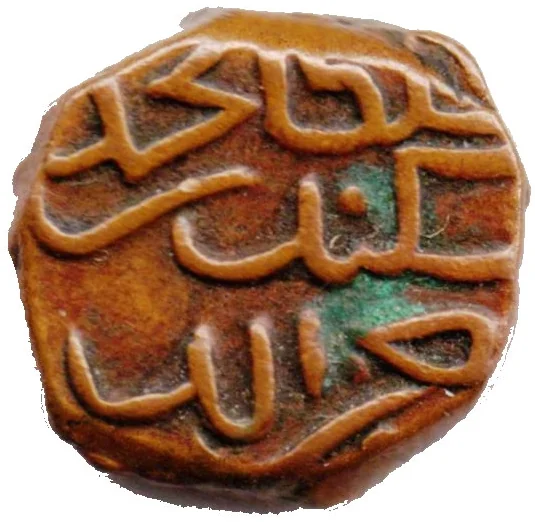
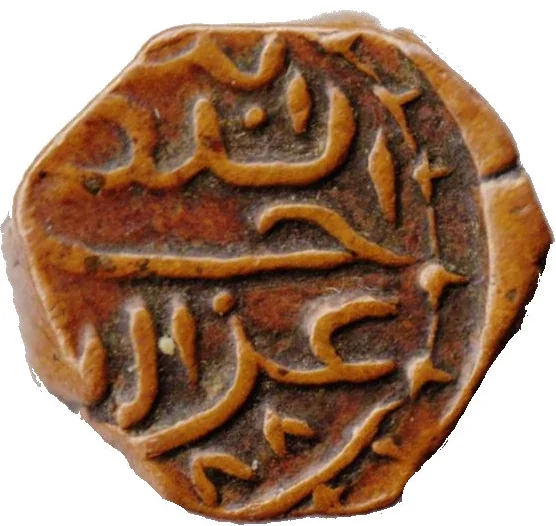
½ larin – Maldives
Add to wishlist
Maldives
Context
Year: 1774
Islamic (Hijri) Year:: 1188
Issuer: Maldives
Ruler: Muhammad Mu'iz ud-din
Currency:
(1660—1947)
Demonetized: Yes
Material
Diameter: 11.32 mm
Weight: 1.86 g
Thickness: 2.64 mm
Shape: Irregular round
Composition: Copper
Magnetic: No
References
KM: #
Numista: #50923
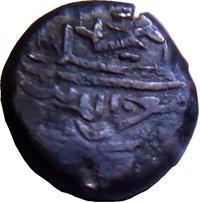
Obverse
Description:
Sultan's title
Inscription:
محمد
سكندر
سكندر
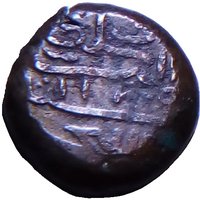
Reverse
Description:
Engraved with date
Inscription:
١١٨٨
Edge
Plain
Mintings
| Year | Mint Mark | Mintage | Quality | Collection |
|---|---|---|---|---|
| 1774 | — | — | ||
| 1774 | — | — |
Historical background
In 1774, the Maldives operated under a traditional barter and commodity-based economy, with the primary medium of exchange being the cowrie shell (Cypraea moneta). These small, white shells, imported in vast quantities from the Maldives' own lagoons and from East Africa, were the lifeblood of local and regional trade. Their value was deeply embedded in the social and economic fabric, used for everything from purchasing daily goods to paying taxes and fines to the Sultan's administration. The system was self-contained and had functioned for centuries, with the state carefully controlling the supply and quality of shells to maintain their value.
However, this system existed within a wider context of international trade dominated by precious metals. The Maldives' strategic location along Indian Ocean trade routes meant it was regularly visited by merchants from Arabia, India, and later European powers. These traders dealt in silver rupees (particularly the Larín, a silver wire currency, and various Indian and Maria Theresa thalers**) and gold coins, which were used for high-value and foreign transactions. Consequently, a dual monetary system was in effect: cowries for the internal, local economy and silver for external trade and state reserves. The Sultanate's treasury in Malé would have held wealth in both forms, with precious metals being crucial for procuring luxury imports and asserting political authority.
The year 1774 falls within a period of political consolidation under Sultan Hasan 'Izz ud-din (reigned 1759-1766 and 1766-1773), though he had died the previous year. His reign focused on restoring stability and central control after a period of conflict. While no major currency reform is specifically documented for 1774, the stability of the cowrie system was increasingly precarious. The massive importation of cowries into West Africa by European companies was beginning to inflate their value globally, a pressure that would eventually destabilize the Maldivian economy in the coming century. Therefore, the currency situation in 1774 represents the tail end of an ancient, functioning system, operating in parallel with hard currency but facing unseen vulnerabilities from global economic shifts.
However, this system existed within a wider context of international trade dominated by precious metals. The Maldives' strategic location along Indian Ocean trade routes meant it was regularly visited by merchants from Arabia, India, and later European powers. These traders dealt in silver rupees (particularly the Larín, a silver wire currency, and various Indian and Maria Theresa thalers**) and gold coins, which were used for high-value and foreign transactions. Consequently, a dual monetary system was in effect: cowries for the internal, local economy and silver for external trade and state reserves. The Sultanate's treasury in Malé would have held wealth in both forms, with precious metals being crucial for procuring luxury imports and asserting political authority.
The year 1774 falls within a period of political consolidation under Sultan Hasan 'Izz ud-din (reigned 1759-1766 and 1766-1773), though he had died the previous year. His reign focused on restoring stability and central control after a period of conflict. While no major currency reform is specifically documented for 1774, the stability of the cowrie system was increasingly precarious. The massive importation of cowries into West Africa by European companies was beginning to inflate their value globally, a pressure that would eventually destabilize the Maldivian economy in the coming century. Therefore, the currency situation in 1774 represents the tail end of an ancient, functioning system, operating in parallel with hard currency but facing unseen vulnerabilities from global economic shifts.
💎 Extremely Rare