

¼ Larin – Maldives
Maldives
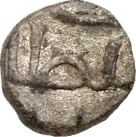
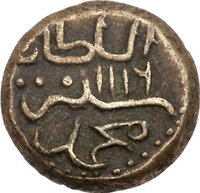
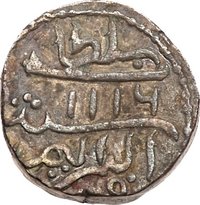
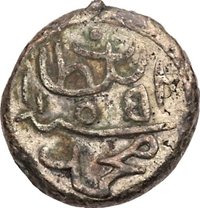
Obverse
Description:
Sultan's name and reign dates.
Inscription:
السلطان
١١٢٩
سنة
محمد
١١٢٩
سنة
محمد
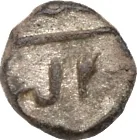
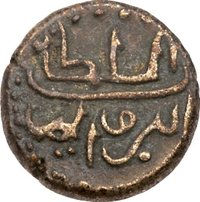
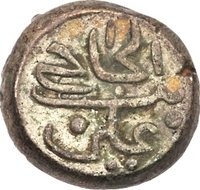
Reverse
Description:
Sultan: a Muslim ruler's title.
Inscription:
سلطان
البر والبحر
البر والبحر
Edge
Mintings
| Year | Mint Mark | Mintage | Quality | Collection |
|---|---|---|---|---|
| 1705 | — | — | ||
| 1717 | — | — | ||
| 1719 | — | — |
Historical background
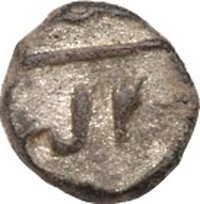
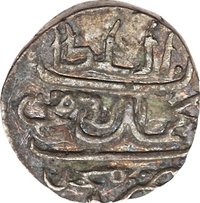
The currency situation in the Maldives in 1705 was not one of a formal, state-issued monetary system, but rather a complex web of foreign coinage and traditional exchange. The Maldivian archipelago, strategically located along major Indian Ocean trade routes, served as a hub where currencies from across the world converged. The most dominant circulating medium was the Larín, a silver wire coin often bent into a hook or "fishhook" shape. These were not minted in the Maldives but were imported in large quantities, primarily from the Persian Gulf and South India, and their value was tied to their silver content.
Alongside Larins, a variety of other coins were in use, reflecting the breadth of Maldivian trade. Cowrie shells (Cypraea moneta), harvested from the Maldives' own lagoons, remained a vital form of money for local small-scale transactions and were famously exported in bulk to Bengal and other regions where they served as currency. Additionally, gold Pagodas from South India, silver Rupees from the Mughal Empire, and even Spanish Reales (pieces of eight) from the Americas could be found in the hands of merchants and the elite in Malé and other trading ports.
This monetary landscape existed under the Huraa Dynasty, which had just been established in 1752. There was no central Maldivian mint; the state's revenue, collected as taxes, largely came in the form of these foreign coins, cowries, and in-kind goods like dried fish (Maldive fish) and coir rope. The system was therefore decentralized and commodity-based, with exchange rates fluctuating based on the purity and origin of the coins, the volume of trade, and the seasonal arrival of merchant ships. The currency situation was thus a direct reflection of the Maldives' position as a permeable node in a vast oceanic economy, rather than a sovereign issuer of its own money.
Alongside Larins, a variety of other coins were in use, reflecting the breadth of Maldivian trade. Cowrie shells (Cypraea moneta), harvested from the Maldives' own lagoons, remained a vital form of money for local small-scale transactions and were famously exported in bulk to Bengal and other regions where they served as currency. Additionally, gold Pagodas from South India, silver Rupees from the Mughal Empire, and even Spanish Reales (pieces of eight) from the Americas could be found in the hands of merchants and the elite in Malé and other trading ports.
This monetary landscape existed under the Huraa Dynasty, which had just been established in 1752. There was no central Maldivian mint; the state's revenue, collected as taxes, largely came in the form of these foreign coins, cowries, and in-kind goods like dried fish (Maldive fish) and coir rope. The system was therefore decentralized and commodity-based, with exchange rates fluctuating based on the purity and origin of the coins, the volume of trade, and the seasonal arrival of merchant ships. The currency situation was thus a direct reflection of the Maldives' position as a permeable node in a vast oceanic economy, rather than a sovereign issuer of its own money.
✨ Legendary