

1 larin – Maldives
Add to wishlist
Maldives
Context
Year: 1685
Islamic (Hijri) Year:: 1096
Issuer: Maldives
Ruler: Ibrahim Iskandar I
Currency:
(1660—1947)
Demonetized: Yes
References
KM: #
Numista: #117820
Value
Bullion value: $12.17
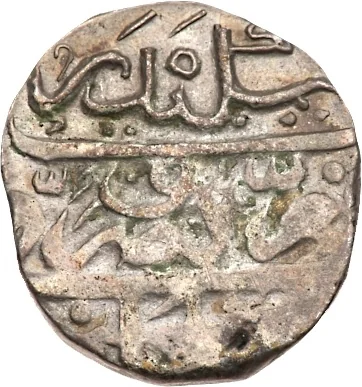
Obverse
Description:
Sultan and mint.
Inscription:
اسكندر
ضرب في
المحلى
ضرب في
المحلى
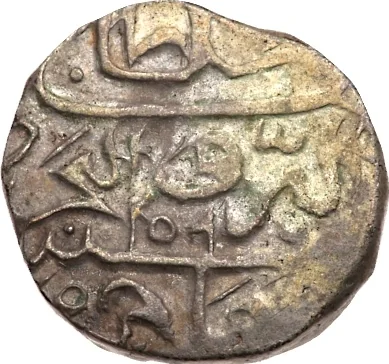
Reverse
Description:
Sultan [Name], [Title], [Date]
Inscription:
سلطان
البر والبحر
٦ ١٠٩
سنة
ابراهيم
السلطان
البر والبحر
٦ ١٠٩
سنة
ابراهيم
السلطان
Edge
Mintings
| Year | Mint Mark | Mintage | Quality | Collection |
|---|---|---|---|---|
| 1685 | — | — |
Historical background
While no specific historical records detail the currency situation in the Maldives in the year 1685, a general background can be constructed from the archipelago's known economic and political context of the 17th century. During this period, the Maldives was a sultanate with a subsistence economy based primarily on coconut palm cultivation, fishing, and the production of coir (coconut fibre rope) and dried fish. The primary medium of exchange for local, small-scale transactions was the cowrie shell, specifically the Monetaria moneta species, which had been used as currency for centuries. These shells, imported in bulk from the Maldives' own shores and later from East Africa, formed a stable, low-denomination system integral to the daily life of Maldivians.
Internationally, the Maldives' strategic location along Indian Ocean trade routes meant it engaged with broader monetary systems. The archipelago's main exports—cowries, coir, and dried bonito (Maldive fish)—were traded for essential imports like rice, textiles, and metals. This foreign trade, conducted largely with merchants from the Indian subcontinent (particularly Bengal and Gujarat) and later with European powers like the Dutch and Portuguese, would have brought foreign coinage into the country. Silver coins, such as the Portuguese tanga or various Indian rupees and fanams, likely circulated in the capital, Malé, and among merchants for significant commercial transactions and state finances, existing alongside the ubiquitous cowrie shell.
Politically, the late 17th century was a turbulent time for the Maldives, marked by intermittent Portuguese and Dutch influence and internal power struggles. This instability would have impacted economic and monetary policy. There is no evidence of a formal, centralized minting of coinage by the Maldivian state in this era. Therefore, the currency situation in 1685 was almost certainly a dual-system: a domestic economy running on a shell-currency base, and an external trade economy reliant on the influx of foreign silver and copper coins, with the sultanate's authority exercised through the control of trade and taxation rather than the issuance of money.
Internationally, the Maldives' strategic location along Indian Ocean trade routes meant it engaged with broader monetary systems. The archipelago's main exports—cowries, coir, and dried bonito (Maldive fish)—were traded for essential imports like rice, textiles, and metals. This foreign trade, conducted largely with merchants from the Indian subcontinent (particularly Bengal and Gujarat) and later with European powers like the Dutch and Portuguese, would have brought foreign coinage into the country. Silver coins, such as the Portuguese tanga or various Indian rupees and fanams, likely circulated in the capital, Malé, and among merchants for significant commercial transactions and state finances, existing alongside the ubiquitous cowrie shell.
Politically, the late 17th century was a turbulent time for the Maldives, marked by intermittent Portuguese and Dutch influence and internal power struggles. This instability would have impacted economic and monetary policy. There is no evidence of a formal, centralized minting of coinage by the Maldivian state in this era. Therefore, the currency situation in 1685 was almost certainly a dual-system: a domestic economy running on a shell-currency base, and an external trade economy reliant on the influx of foreign silver and copper coins, with the sultanate's authority exercised through the control of trade and taxation rather than the issuance of money.

✨ Legendary