

20 Bolognini – Bologna
Italy
Context
Years: 1662–1665
Country: Italy 
Issuer: Bologna
Ruler: Alexander VII
Currency:
(1534—1835)
Demonetized: Yes
Material
References
KM: #Click to copy to clipboard65
Numista: #117315
Value
Bullion value: $17.32
Obverse
Description:
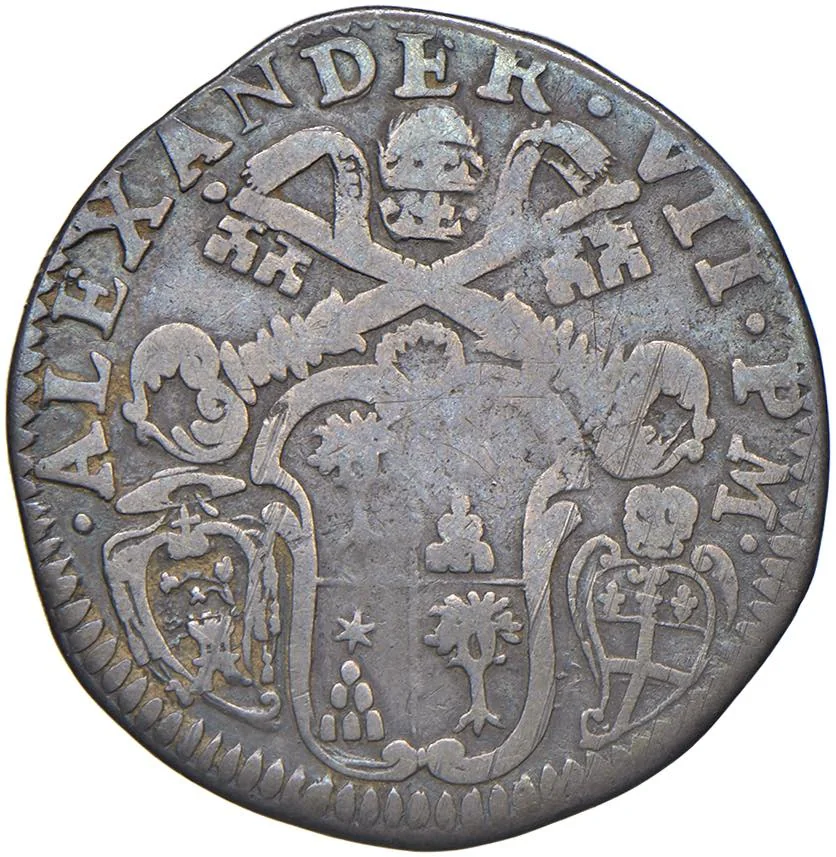
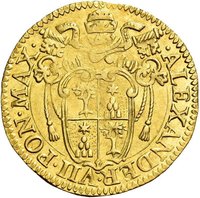
Papal arms center, flanked by Cardinal Vidoni's arms left and City arms right.
Inscription:
·ALEXANDER·VII·P·M·
Script: Latin
Reverse
Description:
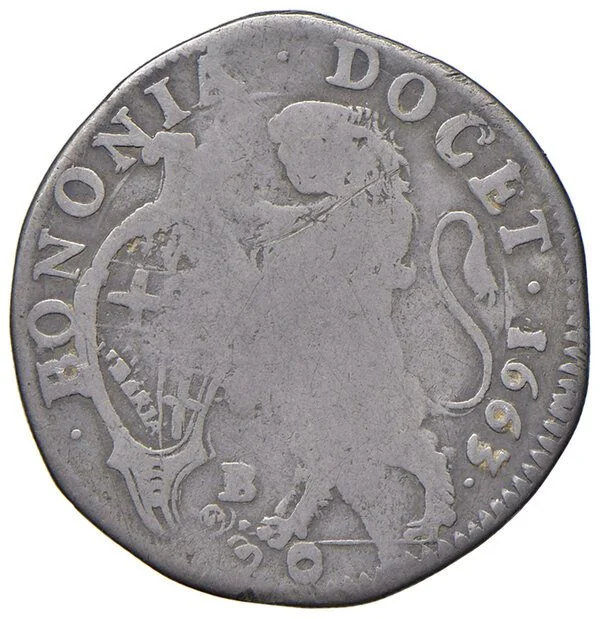
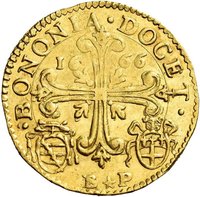
Rampant left-facing lion with shield, value below, lettering around.
Inscription:
BONONIA·DOCET·1665·
B P
·20·
B P
·20·
Script: Latin
Edge
Mints
| Name | Mark |
|---|---|
| Bologna | — |
Mintings
| Year | Mint Mark | Mintage | Quality | Collection |
|---|---|---|---|---|
| 1662 | — | — | ||
| 1663 | — | — | ||
| 1664 | — | — | ||
| 1665 | — | — |
Historical background
In 1662, Bologna’s currency situation was a complex tapestry of local, regional, and foreign coins, reflecting its position as a major city within the Papal States. Officially, the city used the papal monetary system, centred on the scudo (a gold coin) and the giulio (a silver coin), with a plethora of subsidiary copper baiocchi and quattrini for everyday small trade. However, the practical reality was one of significant monetary confusion. A vast array of coins from other Italian states, such as Venetian ducats and Florentine florins, as well as Spanish silver pieces from the New World, circulated freely, their values constantly fluctuating against the official papal standards.
This chaos was exacerbated by two persistent problems: the physical degradation of coins through clipping and wear, and the intentional debasement of coinage by various authorities. The Papal Mint in Bologna itself often struggled to maintain consistent silver content in its issues, leading to a loss of public trust. Consequently, merchants and bankers relied on published "tariffe" (exchange lists) that updated the accepted value of dozens of different coin types in circulation, a necessary tool for any significant transaction to avoid loss.
The situation created chronic economic friction, hindering commerce and complicating tax collection for the city's government. While not unique in 17th-century Europe, Bologna’s monetary fragmentation was particularly acute due to its vibrant university and mercantile economy, which attracted currency from across the continent. The year 1662 thus represents a point within a long period of monetary instability, where the theoretical authority of papal currency was constantly challenged by the practical realities of a heterogeneous and unreliable coinage in the marketplace.
This chaos was exacerbated by two persistent problems: the physical degradation of coins through clipping and wear, and the intentional debasement of coinage by various authorities. The Papal Mint in Bologna itself often struggled to maintain consistent silver content in its issues, leading to a loss of public trust. Consequently, merchants and bankers relied on published "tariffe" (exchange lists) that updated the accepted value of dozens of different coin types in circulation, a necessary tool for any significant transaction to avoid loss.
The situation created chronic economic friction, hindering commerce and complicating tax collection for the city's government. While not unique in 17th-century Europe, Bologna’s monetary fragmentation was particularly acute due to its vibrant university and mercantile economy, which attracted currency from across the continent. The year 1662 thus represents a point within a long period of monetary instability, where the theoretical authority of papal currency was constantly challenged by the practical realities of a heterogeneous and unreliable coinage in the marketplace.
✨ Legendary