


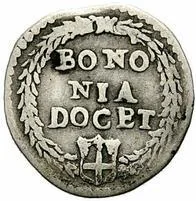

Obverse
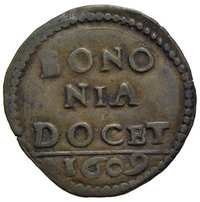
Reverse
Edge
Mintings
| Year | Mint Mark | Mintage | Quality | Collection |
|---|---|---|---|---|
| — | — | — |
Historical background
In 1605, Bologna operated within the complex monetary landscape of the Papal States, to which it belonged. The city did not mint its own coins but used a mixture of papal currency and foreign coins that circulated widely due to trade. The primary unit of account was the Bolognese lira (L), divided into 20 soldi, each of 12 denari. However, actual physical coins included the papal scudo (gold) and giulio (silver), alongside Spanish silver reales and other Italian state coins, creating a system where "money of account" and "physical coin" were distinct and often frustratingly inconsistent.
This period was marked by significant currency instability and debasement. The Papal State, under financial strain, frequently reduced the silver content in its coins, such as the giulio. This led to a phenomenon where older, fuller-weight coins were hoarded or exported (following Gresham's Law), while newer, poorer coins flooded local markets. For Bolognese merchants, artisans, and laborers, this meant prices quoted in stable lire and soldi had to be constantly reconciled with the fluctuating real value of the physical coins they received, causing uncertainty in contracts, wages, and trade.
The situation prompted local authorities to publish official "tariffe" (valuation tables), which fixed the exchange rates between various circulating physical coins and the Bolognese lira of account. These lists, updated periodically, were essential for daily commerce and legal agreements, attempting to impose order on the chaotic reality. Thus, in 1605, a Bolognese citizen lived in a world of monetary duality, navigating between the theoretical stability of their local lira and the tangible instability of a pocketful of mixed, degraded coins.
This period was marked by significant currency instability and debasement. The Papal State, under financial strain, frequently reduced the silver content in its coins, such as the giulio. This led to a phenomenon where older, fuller-weight coins were hoarded or exported (following Gresham's Law), while newer, poorer coins flooded local markets. For Bolognese merchants, artisans, and laborers, this meant prices quoted in stable lire and soldi had to be constantly reconciled with the fluctuating real value of the physical coins they received, causing uncertainty in contracts, wages, and trade.
The situation prompted local authorities to publish official "tariffe" (valuation tables), which fixed the exchange rates between various circulating physical coins and the Bolognese lira of account. These lists, updated periodically, were essential for daily commerce and legal agreements, attempting to impose order on the chaotic reality. Thus, in 1605, a Bolognese citizen lived in a world of monetary duality, navigating between the theoretical stability of their local lira and the tangible instability of a pocketful of mixed, degraded coins.
✨ Legendary