

1 Quattrino – Bologna
Italy
Context
Year: 1604
Country: Italy 
Issuer: Bologna
Ruler: Clement VIII
Currency:
(1534—1835)
Demonetized: Yes
Material
References
KM: #Click to copy to clipboard5
Numista: #16966
Obverse
Description:
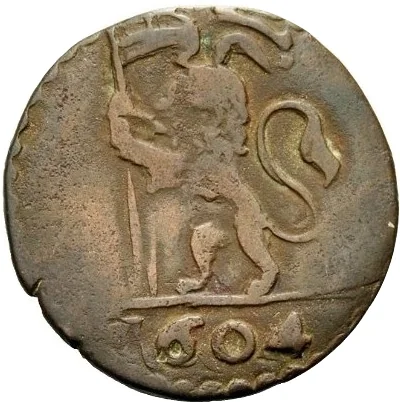
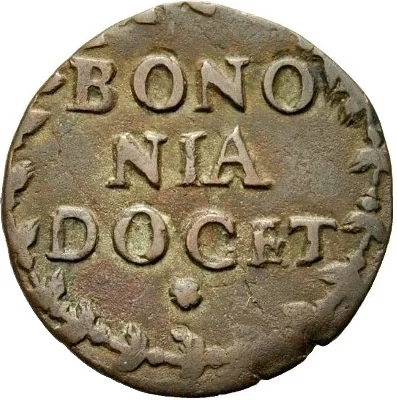
Clement VIII's crest: crowned lion rampant left, holding banner.
Script: Latin
Reverse
Edge
Mints
| Name | Mark |
|---|---|
| Bologna | — |
Mintings
| Year | Mint Mark | Mintage | Quality | Collection |
|---|---|---|---|---|
| 1604 | — | — |
Historical background
In 1604, Bologna operated within the complex monetary landscape of the Italian Peninsula, which was fragmented into various city-states and territories, each with its own coinage. Officially, Bologna was part of the Papal States, and the theoretical standard was the Papal scudo, a gold coin. However, the city's daily economic life was dominated by a plethora of silver and billon (debased silver) coins from neighbouring minting authorities, such as the lira and soldo from Milan or Venetian ducats. This created a persistent problem of currency confusion, where the values of coins fluctuated based on their metallic content and the reputation of the issuing authority, requiring money-changers (banchi) to constantly publish exchange rates.
The local authorities, notably the Senato di Bologna, struggled to maintain monetary stability. A key issue was the chronic shortage of high-value gold and full-weight silver coins, which tended to be hoarded or exported. This led to a practical circulation dominated by lower-value, often worn or clipped, subsidiary coins, causing inflation and hardship for the poor. Furthermore, the Papal government in Rome periodically issued edicts to re-tariff coins across its territories, often attempting to extract seigniorage revenue by officially overvaluing its own currency, which frequently disrupted local commerce and was met with resistance in Bologna.
Consequently, the monetary situation in 1604 was one of fragile tension. Bologna’s economy functioned through a daily negotiated reality between official papal decrees, the practical circulation of diverse foreign coins, and the defensive measures of local merchants and bankers. This instability underscored the conflict between local economic needs and the centralizing fiscal policies of the Papacy, a theme that defined much of Bologna's political and economic life in the early 17th century.
The local authorities, notably the Senato di Bologna, struggled to maintain monetary stability. A key issue was the chronic shortage of high-value gold and full-weight silver coins, which tended to be hoarded or exported. This led to a practical circulation dominated by lower-value, often worn or clipped, subsidiary coins, causing inflation and hardship for the poor. Furthermore, the Papal government in Rome periodically issued edicts to re-tariff coins across its territories, often attempting to extract seigniorage revenue by officially overvaluing its own currency, which frequently disrupted local commerce and was met with resistance in Bologna.
Consequently, the monetary situation in 1604 was one of fragile tension. Bologna’s economy functioned through a daily negotiated reality between official papal decrees, the practical circulation of diverse foreign coins, and the defensive measures of local merchants and bankers. This instability underscored the conflict between local economic needs and the centralizing fiscal policies of the Papacy, a theme that defined much of Bologna's political and economic life in the early 17th century.
💎 Extremely Rare