

10 lire – San Marino
Add to wishlist
Circulating commemorative coins
Commemoration: The ancient land
San Marino
Context
Year: 1999
Issuer: San Marino
Period:
(since 301)
Currency:
(1864—2001)
Demonetization: 1 March 2002
Material
References
KM: #
Numista: #11896
Value
Exchange value: 10 SML
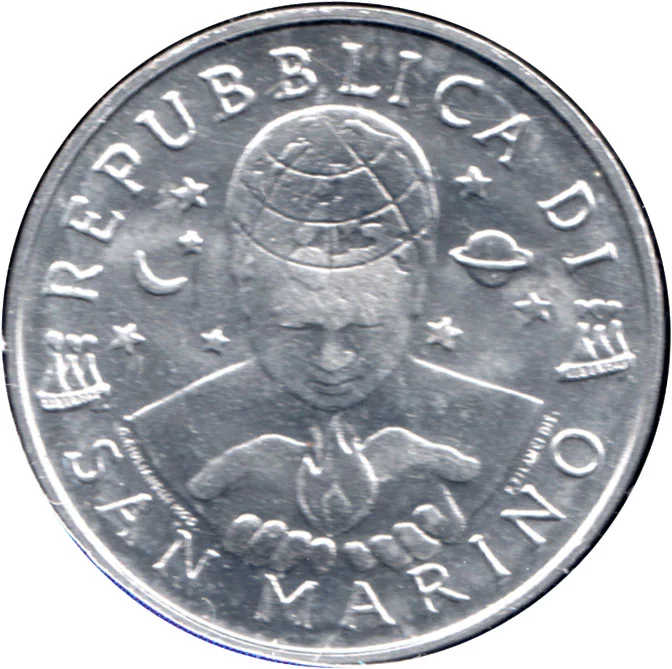
Obverse
Description:
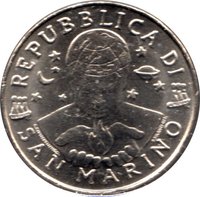
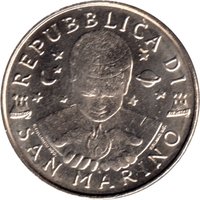
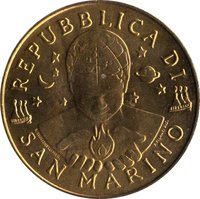
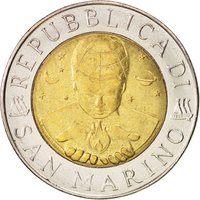
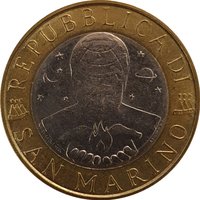
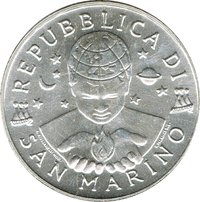
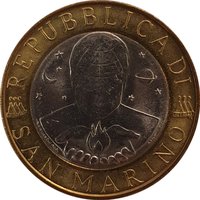
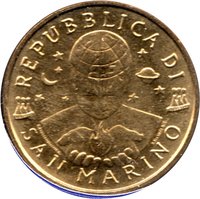
Bust holding a celestial flame, surrounded by stars.
Inscription:
REPUBBLICA DI
SAN MARINO
SAN MARINO
Translation:
REPUBLIC OF
SAN MARINO
SAN MARINO
Script: Latin
Language: Italian
Engraver: Claudia Momoni
Designers: Franco Filanci, Giovanni Giulianelli
Reverse
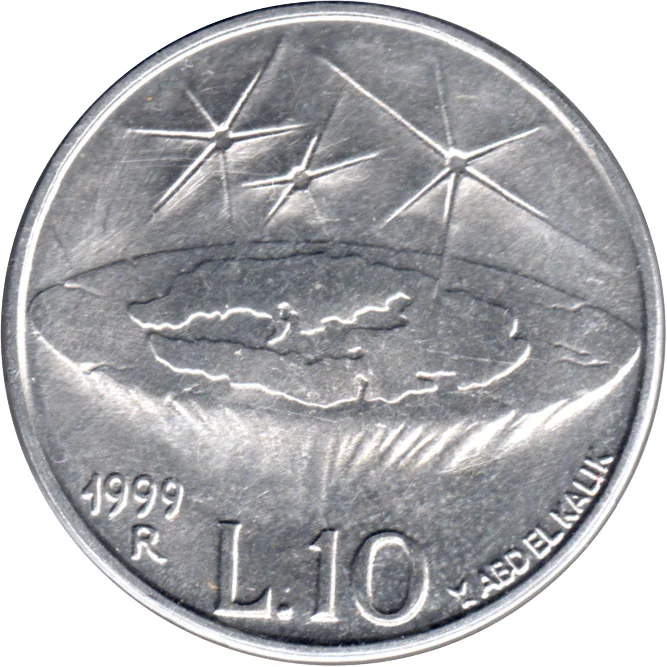
Description:
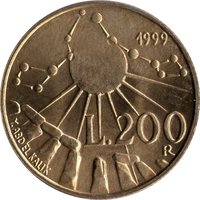
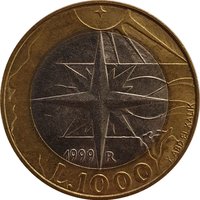
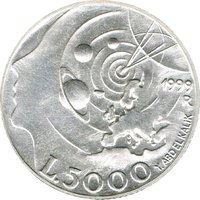
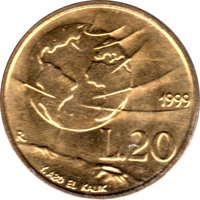
Flat earth model with three stars above, value and date below.
Inscription:
1999
R
L.10
Y.ABDEL KALIK
R
L.10
Y.ABDEL KALIK
Script: Latin
Engraver: Claudia Momoni
Designer: Abd El Kalik Yhia
Edge
Plain
Mints
| Name | Mark |
|---|---|
| Rome | R |
Mintings
| Year | Mint Mark | Mintage | Quality | Collection |
|---|---|---|---|---|
| 1999 | R | — |
Historical background
In 1999, San Marino's currency situation was intrinsically linked to its relationship with Italy and the broader European integration process. As a microstate entirely surrounded by Italian territory, San Marino had a long-standing monetary convention with Italy, dating back to 1939 and reaffirmed in 1991. This agreement made the Italian Lira legal tender within San Marino and granted the republic limited rights to mint its own Sammarinese Lira coins, which were pegged at par with the Italian Lira and circulated alongside it. The country's economy was deeply integrated with Italy's, and its monetary policy was effectively set by the Banca d'Italia.
The pivotal event of 1999 was the launch of the European single currency, the euro, on January 1st. While Italy adopted the euro as its scriptural (electronic) currency from that date, San Marino found itself in a period of legal and diplomatic limbo. The existing bilateral agreements with Italy did not automatically extend to the new European currency. Consequently, while the Italian Lira remained in physical circulation until 2002, the legal foundation for San Marino to use the euro was not yet established, creating uncertainty for its banking sector and cross-border economic activity.
Recognizing the existential need to formalize its status, San Marino's government engaged in intensive negotiations with the European Union and Italy throughout 1999. The goal was to secure a new monetary agreement that would replace the lira-based conventions and permit the use of the euro. These successful negotiations would culminate in an agreement signed in 2000, allowing the euro to become legal tender in 2002 and granting San Marino the unique right to issue its own limited quantities of euro coins with national designs, a key element of its monetary sovereignty within the Eurozone framework.
The pivotal event of 1999 was the launch of the European single currency, the euro, on January 1st. While Italy adopted the euro as its scriptural (electronic) currency from that date, San Marino found itself in a period of legal and diplomatic limbo. The existing bilateral agreements with Italy did not automatically extend to the new European currency. Consequently, while the Italian Lira remained in physical circulation until 2002, the legal foundation for San Marino to use the euro was not yet established, creating uncertainty for its banking sector and cross-border economic activity.
Recognizing the existential need to formalize its status, San Marino's government engaged in intensive negotiations with the European Union and Italy throughout 1999. The goal was to secure a new monetary agreement that would replace the lira-based conventions and permit the use of the euro. These successful negotiations would culminate in an agreement signed in 2000, allowing the euro to become legal tender in 2002 and granting San Marino the unique right to issue its own limited quantities of euro coins with national designs, a key element of its monetary sovereignty within the Eurozone framework.
🌟 Uncommon