

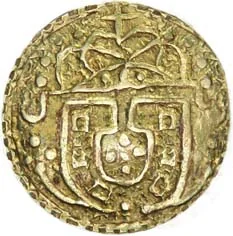
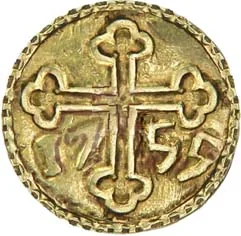
10 Xerafins – Portuguese India
India
Context
Years: 1753–1755
Country: India 
Issuer: Portuguese India
Ruler: Joseph I
Currency:
(1706—1880)
Demonetized: Yes
Material
References
KM: #Click to copy to clipboard17
Numista: #50889
Value
Bullion value: $952.29
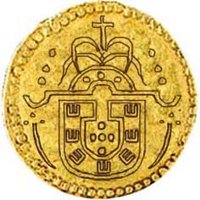
Obverse
Description:
Damão's Coat of Arms
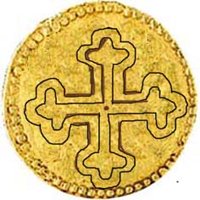
Reverse
Description:
St. Thomas cross with date.
Inscription:
17-55
Edge
Mintings
| Year | Mint Mark | Mintage | Quality | Collection |
|---|---|---|---|---|
| 1753 | — | — | ||
| 1755 | — | — |
Historical background
In 1753, the currency situation in Portuguese India was a complex tapestry of official and unofficial systems, reflecting the colony's diminished economic power and its integration into wider Indian Ocean trade networks. The official currency, minted by the Estado da Índia in Goa, was the Xerafim (plural: Xerafins), a silver coin. However, its value and circulation were under severe strain. Decades of declining Portuguese political and military fortunes, combined with massive debt and revenue shortfalls, led to frequent debasement of the coinage. The intrinsic silver content of the Xerafim had been reduced, undermining public trust and its acceptance in international markets, particularly against the dominant and reliably pure silver Rupia issued by various Indian powers.
Practically, the day-to-day economy operated on a multi-currency standard. Alongside the debased official coinage, a plethora of foreign currencies circulated freely and were often preferred. These included gold Mohans from Mughal India, silver Rupias from the Maratha Confederacy and other regional mints, and even older Portuguese coins like the Cruzado. The Portuguese administration was forced to publish official exchange rates (the "tábuas de câmbio") between the Xerafim and these other currencies, a clear admission that they could not control the monetary environment. This situation created a confusing and inefficient system for trade and taxation, with constant arbitrage and uncertainty.
This monetary fragmentation was a direct symptom of Goa's changed role. No longer the dominant commercial hub of the 16th century, it was now a minor player amidst rising regional powers. The widespread use of Maratha and Mughal currency underscored the colony's economic dependency and the permeability of its borders. For the Portuguese authorities in 1753, managing this currency chaos was a persistent administrative and fiscal headache, as they struggled to extract reliable revenue in a system where the most trusted money was not their own.
Practically, the day-to-day economy operated on a multi-currency standard. Alongside the debased official coinage, a plethora of foreign currencies circulated freely and were often preferred. These included gold Mohans from Mughal India, silver Rupias from the Maratha Confederacy and other regional mints, and even older Portuguese coins like the Cruzado. The Portuguese administration was forced to publish official exchange rates (the "tábuas de câmbio") between the Xerafim and these other currencies, a clear admission that they could not control the monetary environment. This situation created a confusing and inefficient system for trade and taxation, with constant arbitrage and uncertainty.
This monetary fragmentation was a direct symptom of Goa's changed role. No longer the dominant commercial hub of the 16th century, it was now a minor player amidst rising regional powers. The widespread use of Maratha and Mughal currency underscored the colony's economic dependency and the permeability of its borders. For the Portuguese authorities in 1753, managing this currency chaos was a persistent administrative and fiscal headache, as they struggled to extract reliable revenue in a system where the most trusted money was not their own.
✨ Legendary