

2 Xerafins – Portuguese India
India
Context
Year: 1755
Country: India 
Issuer: Portuguese India
Ruler: Joseph I
Currency:
(1706—1880)
Subdivision: 2 Xerafins = 1 Rupia
Demonetized: Yes
Material
References
KM: #Click to copy to clipboard13
Numista: #49293
Value
Bullion value: $133.39
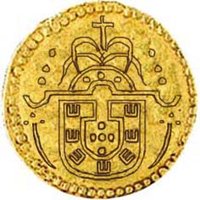
Obverse
Description:
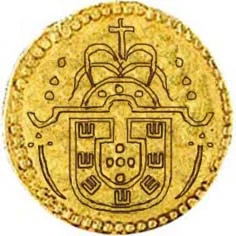
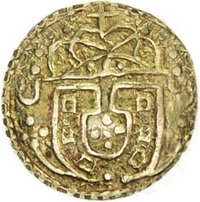
Damão's Coat of Arms
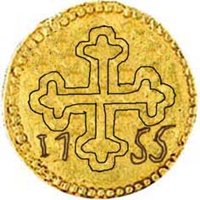
Reverse
Description:
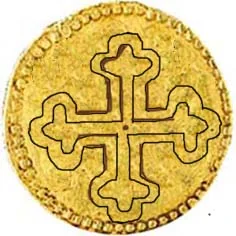
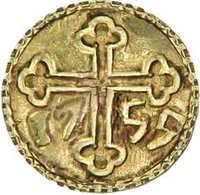
Mar Thoma Cross
Edge
Mintings
| Year | Mint Mark | Mintage | Quality | Collection |
|---|---|---|---|---|
| 1755 | — | — |
Historical background
In 1755, the currency situation in Portuguese India, centered at Goa, was a complex tapestry of local, regional, and international coins, reflecting its role as a declining but still active node in global trade. The official currency was the Portuguese xerafim (divided into tangas and reis), but its circulation was limited. The real day-to-day economic life was dominated by a multitude of foreign coins, a testament to Goa's integration into Indian Ocean commerce. The most important of these was the gold Mohur and the silver Rupia (Rupee) from the neighbouring Maratha Empire, alongside a flood of other silver coins like the Spanish Peso (Piece of Eight) and the Dutch Rijksdaalder. This created a chaotic monetary environment with fluctuating exchange rates.
This pluralism was a result of necessity and policy. The Portuguese crown struggled to supply sufficient official coinage to its eastern possessions, and what little arrived was often hoarded or exported. Furthermore, Goa's economy was deeply entwined with the hinterland, requiring acceptance of Maratha currency for trade in essential goods. The Portuguese administration did not try to suppress this; instead, it officially recognised these foreign coins, setting periodic taxas (exchange rates) for them against the xerafim. This practice essentially legitimised a de facto multi-currency system, where the state's own currency was just one among many mediums of exchange.
Underlying this monetary mosaic was a serious problem of debasement and scarcity. The financial strain of maintaining its empire had led Portugal to repeatedly debase its own coinage in the metropole, a practice that eroded confidence in the xerafim even in Goa. Concurrently, a chronic shortage of precious metals, especially silver, plagued the territory. This scarcity drove up the value of sound foreign silver coins and encouraged the use of smaller, low-value copper coins, called bazarucos, for local petty trade. Thus, by 1755, the currency situation was one of pragmatic adaptation to imperial weakness, characterised by a reliance on stronger foreign currencies and a fragmented system that mirrored the diminished yet resilient state of Portuguese power in India.
This pluralism was a result of necessity and policy. The Portuguese crown struggled to supply sufficient official coinage to its eastern possessions, and what little arrived was often hoarded or exported. Furthermore, Goa's economy was deeply entwined with the hinterland, requiring acceptance of Maratha currency for trade in essential goods. The Portuguese administration did not try to suppress this; instead, it officially recognised these foreign coins, setting periodic taxas (exchange rates) for them against the xerafim. This practice essentially legitimised a de facto multi-currency system, where the state's own currency was just one among many mediums of exchange.
Underlying this monetary mosaic was a serious problem of debasement and scarcity. The financial strain of maintaining its empire had led Portugal to repeatedly debase its own coinage in the metropole, a practice that eroded confidence in the xerafim even in Goa. Concurrently, a chronic shortage of precious metals, especially silver, plagued the territory. This scarcity drove up the value of sound foreign silver coins and encouraged the use of smaller, low-value copper coins, called bazarucos, for local petty trade. Thus, by 1755, the currency situation was one of pragmatic adaptation to imperial weakness, characterised by a reliance on stronger foreign currencies and a fragmented system that mirrored the diminished yet resilient state of Portuguese power in India.
✨ Legendary