

1⁄12 silver ecu – France
Add to wishlist
France
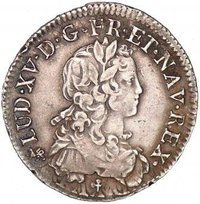
Obverse
Description:
Young Louis XV, laureate and draped bust in armor.
Inscription:
LUD • XV • D • G • FR • ET • NA • RE • BD
Script: Latin
Engraver: Norbert Roettiers
Reverse
Description:
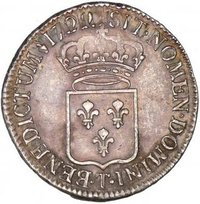
France's crowned shield.
Inscription:
SIT • NOMEN • DOMINI • BENEDICTUM • 1721
Script: Latin
Engraver: Norbert Roettiers
Edge
Corded
Mints
| Name | Mark |
|---|---|
| Pau | 🐄 |
Mintings
| Year | Mint Mark | Mintage | Quality | Collection |
|---|---|---|---|---|
| 1721 | 🐄 | — |
Historical background
In 1721, France was grappling with the severe economic and monetary aftermath of the Sun King's final wars. The War of the Spanish Succession (1701-1714) had left the royal treasury depleted and the nation burdened with colossal debt. To finance the conflict, the state, under the control of Finance Minister Michel Chamillart, had resorted to drastic measures including repeated currency manipulations—devaluing the silver livre by ordering old coins to be reminted at a lower weight and higher face value. This practice, combined with the issuance of increasingly discredited paper money and government bonds (billets de monnaie), led to rampant inflation, a loss of public confidence, and a chaotic monetary system with wildly fluctuating values.
The situation fell to the renowned Scottish economist John Law to resolve. Appointed Controller General of Finances in 1720, Law attempted a radical restructuring by merging the royal debt with his Mississippi Company and backing the currency with shares of the company rather than precious metals. His "System" initially boomed but collapsed spectacularly in 1720 due to over-issue of paper notes and a loss of faith in the company's purported American wealth. By 1721, Law had fled the country, and France was left with a catastrophic hangover: worthless paper money, a ruined investor class, and a deep public distrust of financial innovation and paper currency.
Consequently, the monetary landscape of 1721 was one of painful retrenchment and a return to metallic currency. The regent, Philippe d'Orléans, and the new financial administrators were forced to undertake a long and complex liquidation of Law's System, gradually recalling and burning the discredited paper notes. The focus returned to stabilizing the silver livre tournois, though its value was now fundamentally weakened. The experience left a profound and lasting scar on the French financial psyche, fostering a deep-seated preference for hard currency over paper and contributing to the state's fiscal rigidities that would culminate in the crisis of the French Revolution later in the century.
The situation fell to the renowned Scottish economist John Law to resolve. Appointed Controller General of Finances in 1720, Law attempted a radical restructuring by merging the royal debt with his Mississippi Company and backing the currency with shares of the company rather than precious metals. His "System" initially boomed but collapsed spectacularly in 1720 due to over-issue of paper notes and a loss of faith in the company's purported American wealth. By 1721, Law had fled the country, and France was left with a catastrophic hangover: worthless paper money, a ruined investor class, and a deep public distrust of financial innovation and paper currency.
Consequently, the monetary landscape of 1721 was one of painful retrenchment and a return to metallic currency. The regent, Philippe d'Orléans, and the new financial administrators were forced to undertake a long and complex liquidation of Law's System, gradually recalling and burning the discredited paper notes. The focus returned to stabilizing the silver livre tournois, though its value was now fundamentally weakened. The experience left a profound and lasting scar on the French financial psyche, fostering a deep-seated preference for hard currency over paper and contributing to the state's fiscal rigidities that would culminate in the crisis of the French Revolution later in the century.

✨ Legendary