

2 gold louis – France
Add to wishlist
France
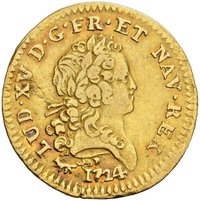
Obverse
Description:
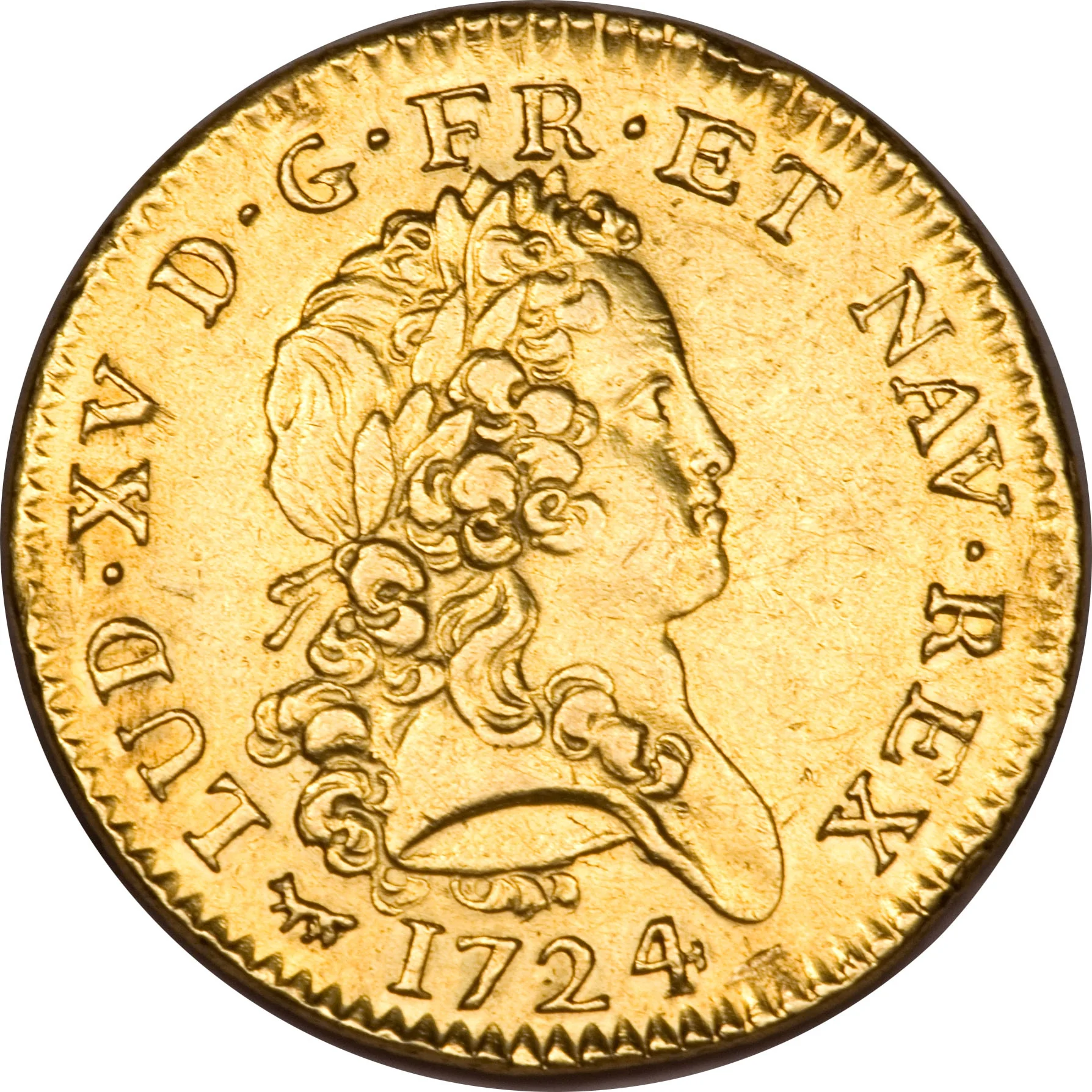
Louis XV laureate bust. Circular caption: "Louis XV, by the grace of God, King of France and Navarre".
Inscription:
LUD.XV.D.G.FR.ET NAV.REX
1724
1724
Script: Latin
Engraver: Norbert Roettiers
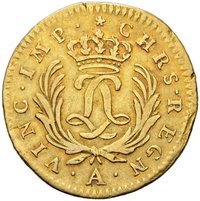
Reverse
Description:
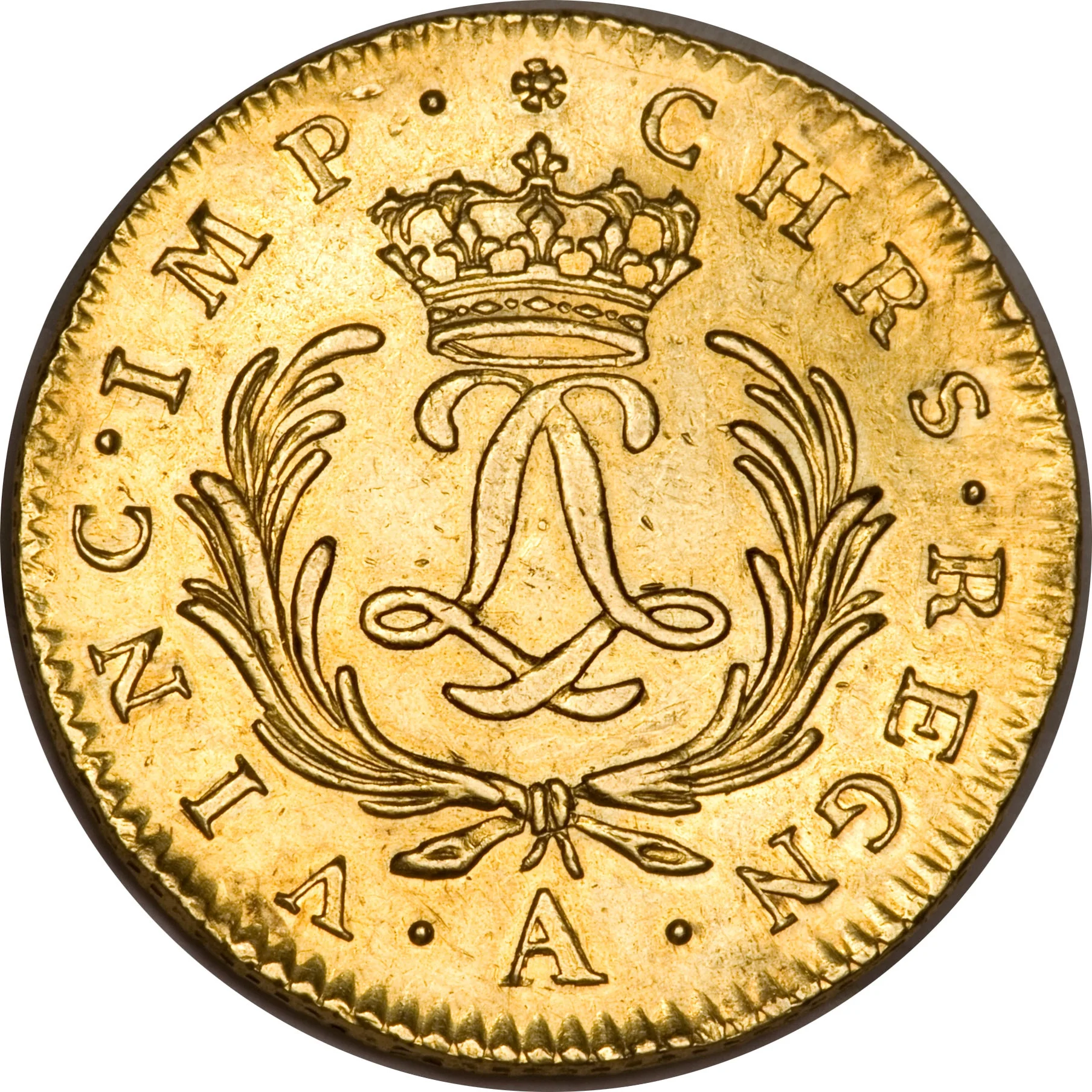
Two cursive, crowned Ls entwined within palms. Circular motto: "Christ reigns, conquers, commands," and a rose.
Inscription:
CHRS.REGN.VINC.IMP.
A
A
Script: Latin
Engraver: Norbert Roettiers
Edge
Mints
| Name | Mark |
|---|---|
| Monnaie de Paris | A |
Historical background
In 1723, France was navigating the complex aftermath of the financial experiments and crises of the late Sun King's reign. The War of the Spanish Succession (1701-1714) had left the treasury depleted, leading to a severe shortage of precious metal coinage—the foundation of the monetary system. This scarcity of écus, louis d'or, and livres tournois (the unit of account) in circulation crippled everyday commerce and state finances, creating a deflationary environment where the value of money was high, but its physical absence stifled economic activity.
The situation was directly inherited from the policies of Controller-General Michel Chamillart and the desperate measures of the final years of Louis XIV. To fund the war, the government had repeatedly devalued the currency by officially raising the nominal value of coins, a practice that led to confusion, loss of public confidence, and Gresham's Law in action, where "bad" overvalued money drove "good" undervalued money out of circulation and into hoarding or foreign lands. Although the regent, Philippe d'Orléans, and his finance minister, John Law, had attempted a radical solution with the "System" (1716-1720)—replacing metal currency with paper banknotes—its spectacular collapse in 1720 had left a deep trauma and a renewed, profound distrust of paper money and financial innovation.
Therefore, by 1723, France was in a period of painful return to orthodoxy. The regency government, now under the guidance of Cardinal Dubois and later the Duke of Bourbon, was forced to stabilize the currency on a metallic basis. The livre tournois had been officially stabilized in 1720, but the practical challenge was to restore sufficient quantities of reliable gold and silver coinage to the economy. This meant managing debt, rebuilding confidence, and encouraging the flow of bullion, setting the stage for the more cautious fiscal management that would characterize the early years of Louis XV's personal rule, which began that same year upon the regent's death.
The situation was directly inherited from the policies of Controller-General Michel Chamillart and the desperate measures of the final years of Louis XIV. To fund the war, the government had repeatedly devalued the currency by officially raising the nominal value of coins, a practice that led to confusion, loss of public confidence, and Gresham's Law in action, where "bad" overvalued money drove "good" undervalued money out of circulation and into hoarding or foreign lands. Although the regent, Philippe d'Orléans, and his finance minister, John Law, had attempted a radical solution with the "System" (1716-1720)—replacing metal currency with paper banknotes—its spectacular collapse in 1720 had left a deep trauma and a renewed, profound distrust of paper money and financial innovation.
Therefore, by 1723, France was in a period of painful return to orthodoxy. The regency government, now under the guidance of Cardinal Dubois and later the Duke of Bourbon, was forced to stabilize the currency on a metallic basis. The livre tournois had been officially stabilized in 1720, but the practical challenge was to restore sufficient quantities of reliable gold and silver coinage to the economy. This meant managing debt, rebuilding confidence, and encouraging the flow of bullion, setting the stage for the more cautious fiscal management that would characterize the early years of Louis XV's personal rule, which began that same year upon the regent's death.

✨ Legendary