

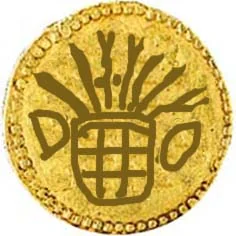
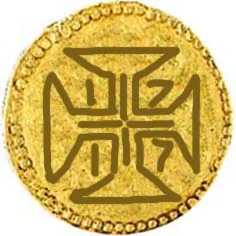
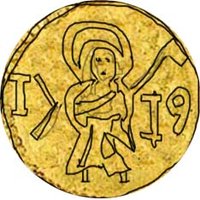
1 Xerafim – Portuguese India
India
Context
Years: 1717–1724
Country: India 
Issuer: Portuguese India
Issuing organization: Casa da Moeda de Diu
Ruler: João V
Currency:
(1706—1880)
Demonetized: Yes
Material
Diameter: 10 mm
Weight: 0.6 g
Gold weight: 0.60 g
Shape: Irregular round
Composition: Gold
Magnetic: No
Technique: Hammered
References
KM: #Click to copy to clipboard14
Numista: #50615
Value
Bullion value: $99.75
Mintings
| Year | Mint Mark | Mintage | Quality | Collection |
|---|---|---|---|---|
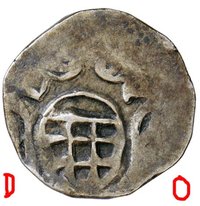
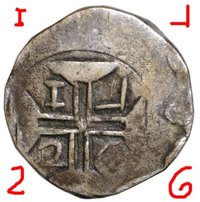
| 1717 | D-O | — | ||
| 1724 | O-D | — |
Historical background
In 1717, the currency situation in Portuguese India was a complex reflection of the Estado da Índia's diminished economic power and its integration into wider Indian Ocean trade networks. The official Portuguese currency, the cruzado, remained the unit of account for government and ecclesiastical transactions, but its physical circulation was limited and its value unstable. The real economic lifeblood of Goa, Damão, and Diu was a diverse mix of foreign coins, with the silver Spanish 8-reales piece (the "piece of eight") and various gold Mughal mohurs dominating high-value trade. This reliance on external specie underscored Portugal's loss of control over regional bullion flows and its transition from a monopolistic power to a participant in a polycentric commercial system.
The Portuguese administration attempted to manage this system through official exchange rates (tabelas) fixed periodically by the Viceroy and the Treasury Council. These rates dictated the value of foreign coins against the cruzado, but they often failed to reflect market realities, leading to widespread currency speculation, smuggling, and arbitrage by merchants and money changers (sarrafos). Furthermore, the chronic shortage of circulating coinage, especially small-denomination money for daily wages and market purchases, was a persistent problem. This often necessitated the use of damaged or clipped coins, and even commodity money like cowry shells in smaller transactions, creating a multi-tiered and inefficient monetary environment.
This chaotic situation was symptomatic of deeper issues: the decline of Portuguese crown revenues, competition from European rivals (especially the Dutch and English), and the overwhelming economic dominance of the neighboring Mughal Empire. While the Portuguese mint in Goa occasionally struck limited issues of tangas and reis, they were insufficient to establish monetary sovereignty. Consequently, the currency scenario of 1717 was one of pragmatic adaptation to economic weakness, where the state's fiscal authority was constantly challenged by the realities of a globalized bazaar, setting the stage for further financial reforms later in the 18th century.
The Portuguese administration attempted to manage this system through official exchange rates (tabelas) fixed periodically by the Viceroy and the Treasury Council. These rates dictated the value of foreign coins against the cruzado, but they often failed to reflect market realities, leading to widespread currency speculation, smuggling, and arbitrage by merchants and money changers (sarrafos). Furthermore, the chronic shortage of circulating coinage, especially small-denomination money for daily wages and market purchases, was a persistent problem. This often necessitated the use of damaged or clipped coins, and even commodity money like cowry shells in smaller transactions, creating a multi-tiered and inefficient monetary environment.
This chaotic situation was symptomatic of deeper issues: the decline of Portuguese crown revenues, competition from European rivals (especially the Dutch and English), and the overwhelming economic dominance of the neighboring Mughal Empire. While the Portuguese mint in Goa occasionally struck limited issues of tangas and reis, they were insufficient to establish monetary sovereignty. Consequently, the currency scenario of 1717 was one of pragmatic adaptation to economic weakness, where the state's fiscal authority was constantly challenged by the realities of a globalized bazaar, setting the stage for further financial reforms later in the 18th century.

✨ Legendary