

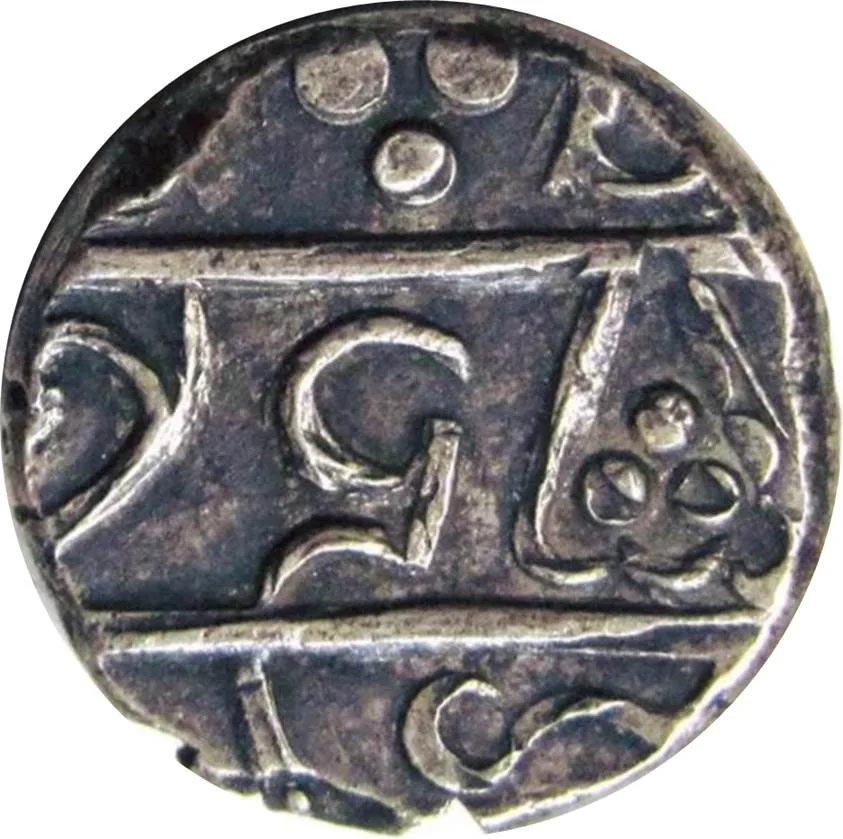
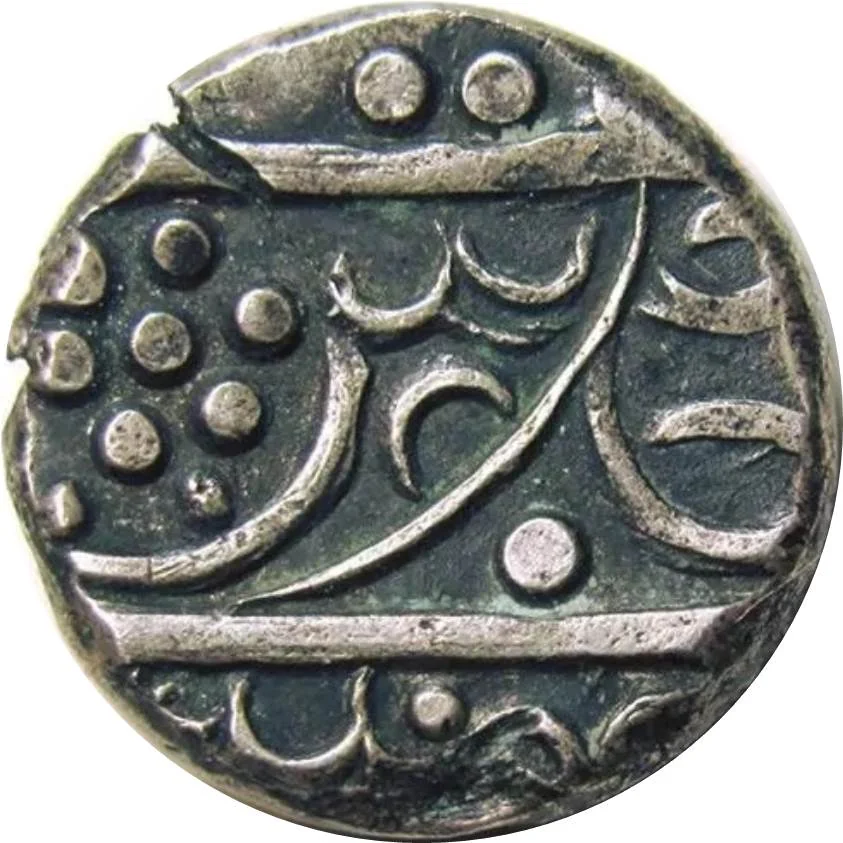
⅕ Rupee – Bombay Presidency
India
Context

Material
References
KM: #Click to copy to clipboard273
Numista: #50419
Value
Bullion value: $6.56
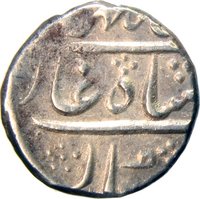
Obverse
Description:
Shah 5, Victorious Emperor.
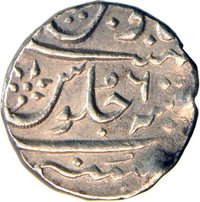
Reverse
Description:
Zarb Mumbai, minted for a prosperous reign.
Edge
Plain
Mintings
| Year | Mint Mark | Mintage | Quality | Collection |
|---|---|---|---|---|
| — | — | — |
Historical background
In 1730, the currency situation within the Bombay Presidency was complex and transitional, reflecting its position as a growing English East India Company enclave within the wider Mughal monetary system. The dominant circulating medium across the subcontinent was the Mughal silver rupee, a relatively stable and high-purity coin minted in various provincial capitals. Bombay itself, however, lacked a formal mint of its own until 1672, and even thereafter its output was limited. Consequently, a vast array of rupees from Mughal mints like Surat, Ahmedabad, and even those of regional powers like the Marathas, circulated freely. Their value was determined not just by silver content but by the reputation of the mint and the year of issue, leading to a bustling business for money-changers (shroffs) who assessed and exchanged these coins.
The Company administration grappled with the challenges of this heterogeneous system, which complicated revenue collection and trade settlements. To impose order, the Presidency officially valued foreign rupees in terms of its own Bombay rupee, but these exchange rates (called batta) fluctuated based on supply, demand, and the perceived reliability of the coins. Furthermore, the monetary landscape was not solely silver-based. Lower-value transactions relied heavily on copper coins (pice or dammas), and gold mohurs were used for high-value trade and hoarding. This multi-metallic system, without fixed legal ratios, added another layer of complexity and arbitrage.
Underlying this daily circulation was a period of growing political instability that would soon directly impact the currency. The Maratha Empire, under the Peshwas, was expanding its influence, challenging Mughal authority and, by extension, the Mughal monetary hegemony. While the full disruption was still ahead, the pressures were mounting. Thus, in 1730, Bombay's currency situation was one of pragmatic adaptation to a diverse and externally controlled coinage, managed through the essential services of shroffs and Company regulations, but poised on the brink of more profound change as regional powers reshaped the subcontinent's political and economic fabric.
The Company administration grappled with the challenges of this heterogeneous system, which complicated revenue collection and trade settlements. To impose order, the Presidency officially valued foreign rupees in terms of its own Bombay rupee, but these exchange rates (called batta) fluctuated based on supply, demand, and the perceived reliability of the coins. Furthermore, the monetary landscape was not solely silver-based. Lower-value transactions relied heavily on copper coins (pice or dammas), and gold mohurs were used for high-value trade and hoarding. This multi-metallic system, without fixed legal ratios, added another layer of complexity and arbitrage.
Underlying this daily circulation was a period of growing political instability that would soon directly impact the currency. The Maratha Empire, under the Peshwas, was expanding its influence, challenging Mughal authority and, by extension, the Mughal monetary hegemony. While the full disruption was still ahead, the pressures were mounting. Thus, in 1730, Bombay's currency situation was one of pragmatic adaptation to a diverse and externally controlled coinage, managed through the essential services of shroffs and Company regulations, but poised on the brink of more profound change as regional powers reshaped the subcontinent's political and economic fabric.
💎 Extremely Rare