

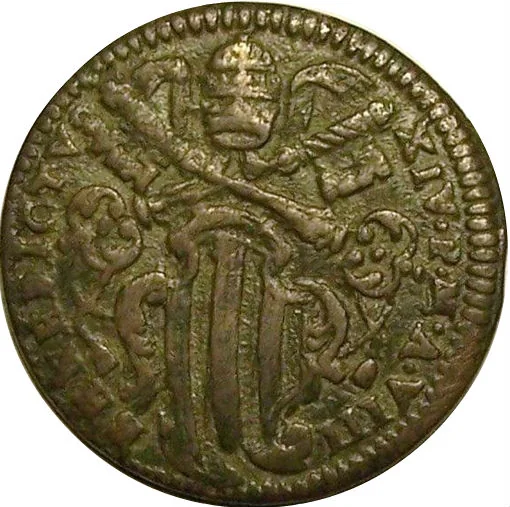
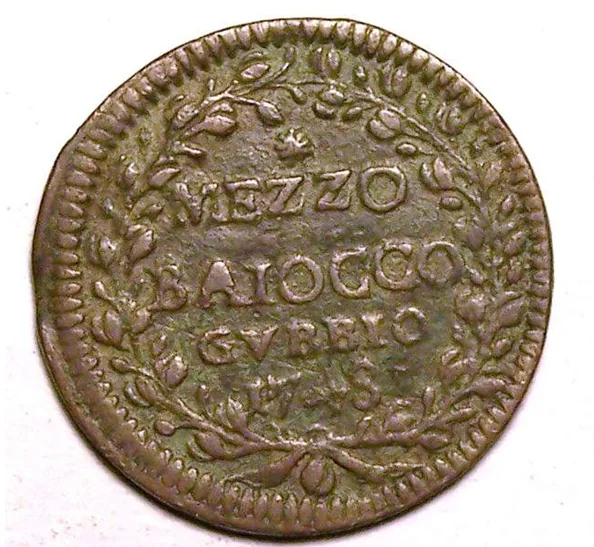
½ Baiocco – Gubbio
Italy
Context
Years: 1743–1751
Country: Italy 
Issuer: Gubbio
Ruler: Benedict XIV
Currency:
(1534—1835)
Demonetized: Yes
Material
References
KM: #Click to copy to clipboard144
Numista: #50377
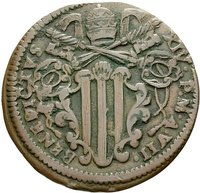
Obverse
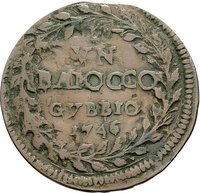
Reverse
Edge
Mints
| Name | Mark |
|---|---|
| Gubbio | — |
Mintings
| Year | Mint Mark | Mintage | Quality | Collection |
|---|---|---|---|---|
| 1743 | IV | — | ||
| 1744 | IV | — | ||
| 1745 | IV | — | ||
| 1745 | VI | — | ||
| 1746 | VII | — | ||
| 1747 | VIII | — | ||
| 1748 | VIII | — | ||
| 1749 | VIIII | — | ||
| 1750 | — | — | ||
| 1751 | — | — |
Historical background
In 1743, the currency situation in the Italian city-state of Gubbio was complex and strained, reflecting its political subordination and the broader monetary fragmentation of the Italian peninsula. As part of the Papal States since the 1630s, Gubbio did not mint its own independent coinage. Instead, its economy relied on a chaotic mix of circulating specie, primarily papal scudi, giuli, and baiocchi, alongside a plethora of older regional coins and foreign currencies from neighboring states like Tuscany and the Republic of Venice. This proliferation of coins of varying weight, purity, and value created constant difficulties in trade and daily transactions, requiring money-changers to assess and convert between units.
The year itself fell within a period of particular economic pressure. The War of the Austrian Succession (1740-1748) disrupted trade routes and strained the finances of the Papal States, leading to inflationary pressures and occasional debasements of coinage. For the merchants and citizens of Gubbio, this meant uncertainty; the real value of the coins in their purses could be eroded by papal fiscal policy decided in distant Rome. Furthermore, the scarcity of small-denomination coins (baiocchi) for everyday market purchases was a persistent aggravation, often forcing the use of cut or worn coins and hindering the local agrarian economy.
Ultimately, Gubbio’s monetary landscape was one of imposed dependency and practical disorder. While the city’s authorities dealt with local weights and measures, they had no control over the fundamental currency supply. This situation underscored Gubbio’s loss of medieval autonomy and its integration into a larger, but inefficient, monetary system. The circulation of so many foreign and ancient coins testified to both the enduring legacy of Italy’s pre-unification patchwork of states and the practical resilience of its people in navigating a cumbersome and unreliable monetary environment.
The year itself fell within a period of particular economic pressure. The War of the Austrian Succession (1740-1748) disrupted trade routes and strained the finances of the Papal States, leading to inflationary pressures and occasional debasements of coinage. For the merchants and citizens of Gubbio, this meant uncertainty; the real value of the coins in their purses could be eroded by papal fiscal policy decided in distant Rome. Furthermore, the scarcity of small-denomination coins (baiocchi) for everyday market purchases was a persistent aggravation, often forcing the use of cut or worn coins and hindering the local agrarian economy.
Ultimately, Gubbio’s monetary landscape was one of imposed dependency and practical disorder. While the city’s authorities dealt with local weights and measures, they had no control over the fundamental currency supply. This situation underscored Gubbio’s loss of medieval autonomy and its integration into a larger, but inefficient, monetary system. The circulation of so many foreign and ancient coins testified to both the enduring legacy of Italy’s pre-unification patchwork of states and the practical resilience of its people in navigating a cumbersome and unreliable monetary environment.
✨ Legendary