

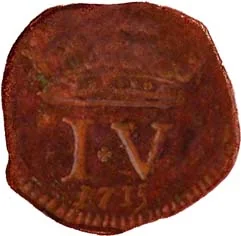
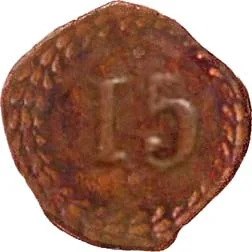
1 Atiá – Portuguese India
India
Context
Years: 1715–1717
Country: India 
Issuer: Portuguese India
Ruler: João V
Currency:
(1706—1880)
Subdivision: 1 Atiá = ¼ Tanga= 15 Réis
Demonetized: Yes
Material
Diameter: 35 mm
Weight: 20 g
Shape: Irregular round
Composition: Copper
Magnetic: No
Technique: Hammered
References
KM: #Click to copy to clipboard91
Numista: #50365
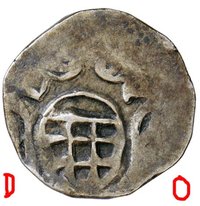
Obverse
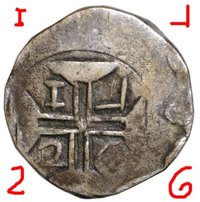
Reverse
Edge
Mints
| Name | Mark |
|---|---|
| Goa | — |
Mintings
| Year | Mint Mark | Mintage | Quality | Collection |
|---|---|---|---|---|
| 1715 | — | — | ||
| 1717 | — | — |
Historical background
In 1715, the currency situation in Portuguese India, centered at Goa, was characterized by a complex and often chaotic multiplicity of circulating coins, reflecting the territory's role as a commercial hub. The official Portuguese currency, the xerafim, competed with a plethora of foreign coins that were essential for regional trade. Most prominent were the gold mohur and silver rupia from the Mughal Empire, along with various European coins like Spanish pieces of eight and Venetian ducats. This created a constant challenge of exchange rates and valuation, as the intrinsic silver or gold content of each coin dictated its actual market worth, often overriding official Portuguese proclamations.
The Portuguese administration struggled to assert monetary sovereignty. Attempts to mint local silver coins, such as the pataca or tanga, frequently failed due to a lack of precious metal and the overwhelming preference of merchants for well-established Mughal currencies in everyday commerce. Furthermore, the financial health of the Estado da Índia was severely strained. Chronic deficits, military expenses, and declining revenues from the once-lucrative trade monopolies led to repeated debasements of coinage and the issuance of low-value copper bazarucos for local small-scale transactions, which often caused inflation and public discontent.
Ultimately, the monetary landscape of 1715 was one of de facto hybridity. While Portuguese authorities kept accounts in xerafins, the real economy operated on a dual system: high-value inter-Asian and international trade was conducted in stable foreign gold and silver coins, while the local Goan economy relied on a flood of official and unofficial copper coinage. This situation underscored the wider decline of Portuguese power, as they could not control the monetary standard in their own capital and were instead subject to the economic currents of the Indian Ocean world.
The Portuguese administration struggled to assert monetary sovereignty. Attempts to mint local silver coins, such as the pataca or tanga, frequently failed due to a lack of precious metal and the overwhelming preference of merchants for well-established Mughal currencies in everyday commerce. Furthermore, the financial health of the Estado da Índia was severely strained. Chronic deficits, military expenses, and declining revenues from the once-lucrative trade monopolies led to repeated debasements of coinage and the issuance of low-value copper bazarucos for local small-scale transactions, which often caused inflation and public discontent.
Ultimately, the monetary landscape of 1715 was one of de facto hybridity. While Portuguese authorities kept accounts in xerafins, the real economy operated on a dual system: high-value inter-Asian and international trade was conducted in stable foreign gold and silver coins, while the local Goan economy relied on a flood of official and unofficial copper coinage. This situation underscored the wider decline of Portuguese power, as they could not control the monetary standard in their own capital and were instead subject to the economic currents of the Indian Ocean world.
✨ Legendary