

¼ Thaler – Brunswick-Lüneburg-Calenberg
Germany
Context
Year: 1673
Country: Germany 
Issuer: Brunswick-Lüneburg-Calenberg
Ruler: John Frederick
Currency:
Demonetized: Yes
References
KM: #Click to copy to clipboard144
Numista: #498262
Obverse
Description:
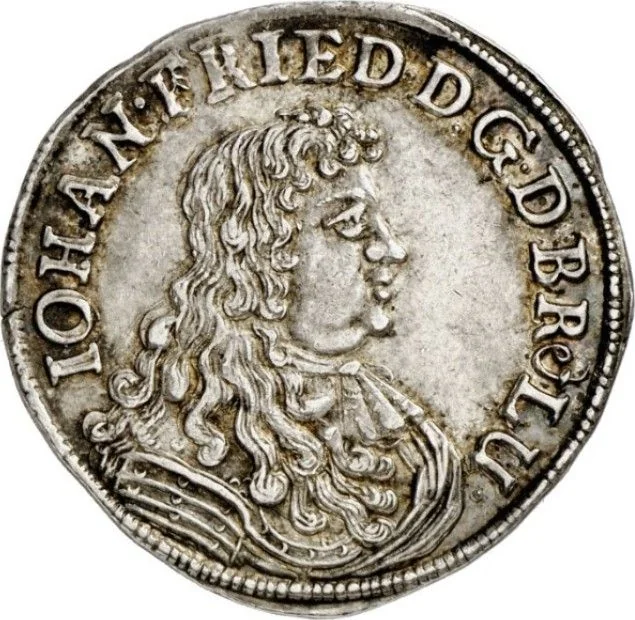
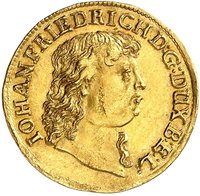
Armoured right-facing bust, legend surrounding.
Inscription:
IOHAN.FRIED.D.G.D BR & LU.
Script: Latin
Reverse
Description:
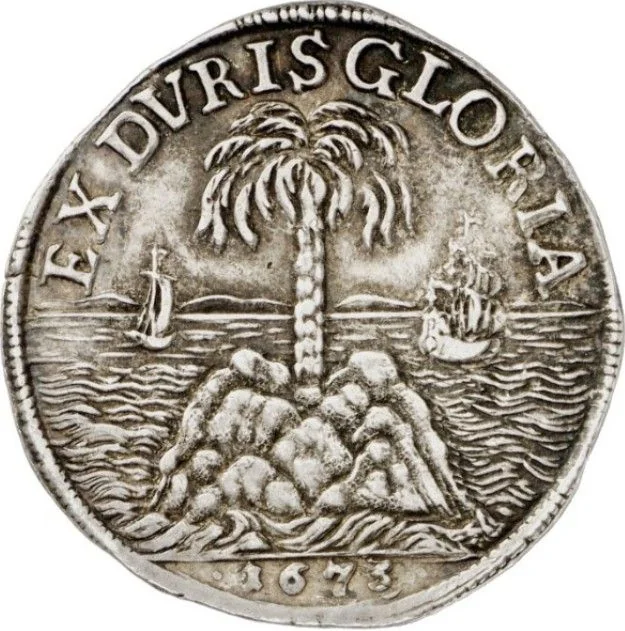
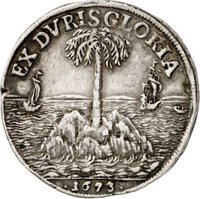
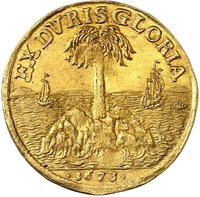
Island with palm tree, two distant ships, date below, legend above.
Inscription:
EX DVRIS GLORIA
.1673
.1673
Script: Latin
Edge
Plain
Mintings
| Year | Mint Mark | Mintage | Quality | Collection |
|---|---|---|---|---|
| 1673 | — | — |
Historical background
In 1673, the Duchy of Brunswick-Lüneburg, specifically the Principality of Calenberg under Duke Johann Friedrich, was entangled in the complex and debased monetary landscape of the Holy Roman Empire. The period was defined by the Kipper- und Wipperzeit, an era of rampant currency manipulation that had peaked earlier in the century but left a lasting legacy of instability. Individual states, including the various Brunswick-Lüneburg territories, frequently debased their coinage to finance local expenditures, leading to a proliferation of coins of varying silver content and value, which severely disrupted trade and eroded public trust.
The situation in Calenberg was further complicated by its political ties. Duke Johann Friedrich was a close ally of France, receiving substantial subsidies from King Louis XIV, which were often paid in French silver écus. This influx of foreign specie provided a temporary boost to the treasury but did not resolve the underlying structural issues. Locally, the monetary system was a patchwork of Reichsthaler (Imperial Thalers), Gutegroschen, and Mariengroschen, with their values constantly fluctuating against each other and the currencies of neighboring states like Brandenburg and the Electorate of Hanover.
Consequently, the primary challenge in 1673 was not a shortage of coin but a crisis of confidence and uniformity. Trade required cumbersome exchange calculations, and the ducal government struggled to assert control over the circulating medium. This environment hindered economic development and state-building, pushing Johann Friedrich and his officials toward considerations of monetary reform to standardize and stabilize the currency, a process that would gradually gain momentum in the subsequent decades.
The situation in Calenberg was further complicated by its political ties. Duke Johann Friedrich was a close ally of France, receiving substantial subsidies from King Louis XIV, which were often paid in French silver écus. This influx of foreign specie provided a temporary boost to the treasury but did not resolve the underlying structural issues. Locally, the monetary system was a patchwork of Reichsthaler (Imperial Thalers), Gutegroschen, and Mariengroschen, with their values constantly fluctuating against each other and the currencies of neighboring states like Brandenburg and the Electorate of Hanover.
Consequently, the primary challenge in 1673 was not a shortage of coin but a crisis of confidence and uniformity. Trade required cumbersome exchange calculations, and the ducal government struggled to assert control over the circulating medium. This environment hindered economic development and state-building, pushing Johann Friedrich and his officials toward considerations of monetary reform to standardize and stabilize the currency, a process that would gradually gain momentum in the subsequent decades.

✨ Legendary