

1 tanga – Portuguese India
Add to wishlist
India
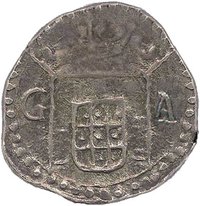
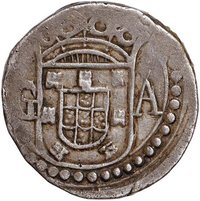
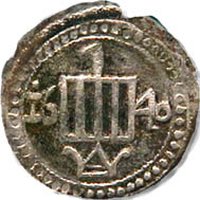
Obverse
Description:
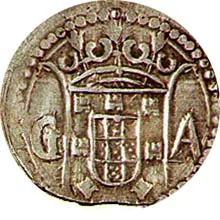
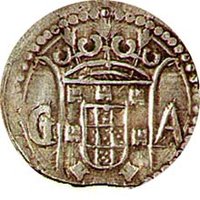
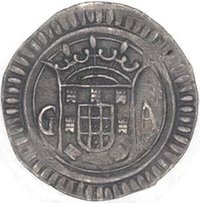
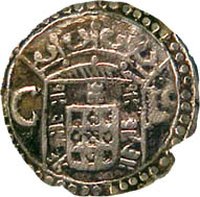
Crowned coat of arms splits the encircled G and A.
Inscription:
G - A
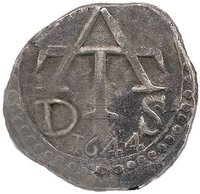
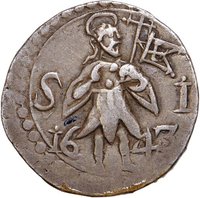
Reverse
Description:
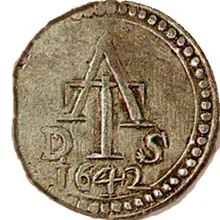
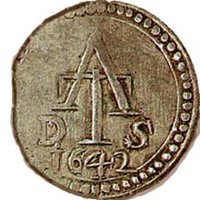
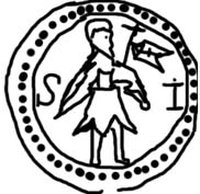
TA labels D and S with the date below.
Inscription:
AT
DS
1642
DS
1642
Edge
Mintings
| Year | Mint Mark | Mintage | Quality | Collection |
|---|---|---|---|---|
| — | G-A | — | ||
| 1642 | G-A | — | ||
| 1643 | G-A | — | ||
| 1647 | G-A | — |
Historical background
In 1641, the currency situation in Portuguese India was a complex reflection of the Estado da Índia's declining economic power and its position within a dynamic Asian trading world. The official currency remained the Portuguese cruzado, but its circulation and authority were increasingly challenged. Decades of competition from the Dutch and English East India Companies, combined with military losses and a shrinking trade network, had severely strained Lisbon's ability to supply sufficient and reliable specie to its Asian capital at Goa. This scarcity of official coinage created a chronic monetary shortage that hampered both administration and commerce.
Consequently, the daily economic life of Portuguese India operated on a de facto multi-currency system dominated by foreign coins. The most important of these was the Spanish piece of eight, or real de a ocho, a silver coin that had become the dominant global trade currency following Spain's union with Portugal (1580-1640). Alongside it, a plethora of other coins circulated freely, including Venetian ducats, Ottoman sequins, and various Indian and Persian issues. The Mughal silver rupia (rupee) was particularly vital for trade in the subcontinent's hinterland. The Portuguese authorities, unable to suppress this reality, were forced to recognize and periodically revalue these foreign coins through official proclamations, attempting to fix their exchange rates against the struggling cruzado.
This fragmented system led to significant confusion, arbitrage, and economic instability. The constant need for official taxas (valuation tables) to set exchange rates between dozens of different coins, each with fluctuating silver content and market value, created opportunities for fraud and exacerbated price volatility. The situation underscored a fundamental shift: by 1641, Portuguese India was no longer a monetary sovereign but a participant in a broader Asian monetary zone, its fiscal health dependent on currencies minted by its rivals and neighbors, symbolizing its transition from a dominant naval empire to a beleaguered coastal entity struggling to maintain its commercial relevance.
Consequently, the daily economic life of Portuguese India operated on a de facto multi-currency system dominated by foreign coins. The most important of these was the Spanish piece of eight, or real de a ocho, a silver coin that had become the dominant global trade currency following Spain's union with Portugal (1580-1640). Alongside it, a plethora of other coins circulated freely, including Venetian ducats, Ottoman sequins, and various Indian and Persian issues. The Mughal silver rupia (rupee) was particularly vital for trade in the subcontinent's hinterland. The Portuguese authorities, unable to suppress this reality, were forced to recognize and periodically revalue these foreign coins through official proclamations, attempting to fix their exchange rates against the struggling cruzado.
This fragmented system led to significant confusion, arbitrage, and economic instability. The constant need for official taxas (valuation tables) to set exchange rates between dozens of different coins, each with fluctuating silver content and market value, created opportunities for fraud and exacerbated price volatility. The situation underscored a fundamental shift: by 1641, Portuguese India was no longer a monetary sovereign but a participant in a broader Asian monetary zone, its fiscal health dependent on currencies minted by its rivals and neighbors, symbolizing its transition from a dominant naval empire to a beleaguered coastal entity struggling to maintain its commercial relevance.

✨ Legendary