

1 rupee – Maratha Empire
Add to wishlist
India
Context
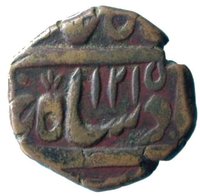
Years: 1797–1798
Islamic (Hijri) Year:: 1212
Country: India
Issuer: Maratha Empire
Currency:
(1674—1818)
Demonetized: Yes
Material
References
KM: #
Numista: #49677
Value
Bullion value: $29.66
Obverse
Description:
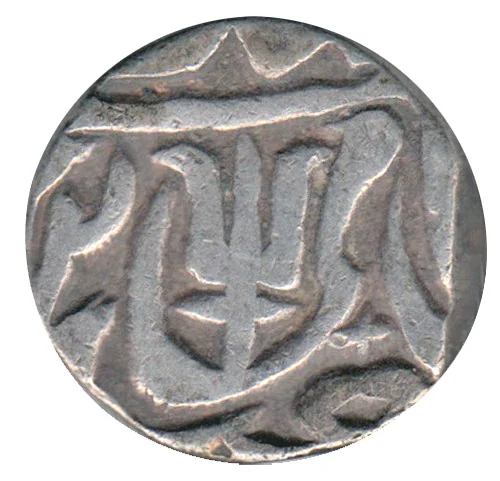
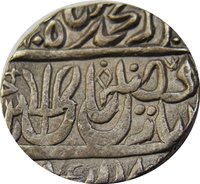
Trishul Maratha Confederacy under Shah Alam II (1759-1806).
Reverse
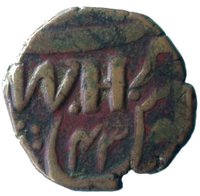
Inscription:
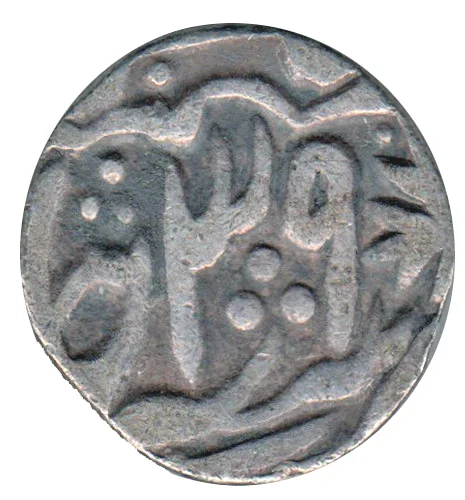
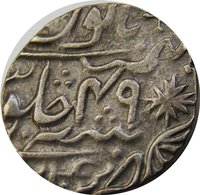
39
Edge
Plain
Mintings
| Year | Mint Mark | Mintage | Quality | Collection |
|---|---|---|---|---|
| 1797 | — | — | ||
| 1798 | — | — |
Historical background
By 1797, the currency situation within the Maratha Empire was one of profound complexity and fragmentation, reflecting the empire's decentralized political structure. The central authority of the Peshwa in Pune coexisted with powerful semi-autonomous chiefs like the Gaekwads in Baroda, the Holkars in Indore, and the Scindias in Gwalior, each issuing their own coins in their respective territories. While the iconic Shivrai copper coin and the Hon gold coin served as widely recognized standards, in practice a bewildering variety of rupees, pagodas, and other coins circulated, each with differing weights, metallic purity, and exchange rates. This lack of uniform imperial currency created significant hurdles for trade and revenue administration across the vast Maratha dominions.
The period was further strained by acute financial pressures. The empire was still recovering from the massive indemnity of 3.2 million rupees paid to the British after the Treaty of Salbai (1782), and was now embroiled in costly internal conflicts and preparations for renewed confrontation with external powers. This fiscal strain directly impacted the currency, leading to debasement—the reduction of precious metal content in coins—as a means to increase short-term revenue. The practice eroded public trust in the coinage and spurred inflation, harming the wider economy. Furthermore, the growing influence of European trading companies, particularly the British East India Company with its standardized rupees, began to establish alternative, more reliable currency zones on the peripheries of Maratha influence.
Consequently, the monetary landscape of 1797 was one of transition and instability. The traditional system, characterized by local minting rights and hereditary money-changers (shroffs) who navigated the complex exchange networks, was struggling under the weight of political fragmentation and fiscal exigency. Meanwhile, the expanding use of financial instruments like hundis (bills of exchange) highlighted attempts to facilitate commerce despite the chaotic coinage. This unstable foundation would prove a significant vulnerability in the coming decades, as the Maratha Confederacy faced its final, decisive wars against a British adversary that wielded both military force and a more unified fiscal and monetary system.
The period was further strained by acute financial pressures. The empire was still recovering from the massive indemnity of 3.2 million rupees paid to the British after the Treaty of Salbai (1782), and was now embroiled in costly internal conflicts and preparations for renewed confrontation with external powers. This fiscal strain directly impacted the currency, leading to debasement—the reduction of precious metal content in coins—as a means to increase short-term revenue. The practice eroded public trust in the coinage and spurred inflation, harming the wider economy. Furthermore, the growing influence of European trading companies, particularly the British East India Company with its standardized rupees, began to establish alternative, more reliable currency zones on the peripheries of Maratha influence.
Consequently, the monetary landscape of 1797 was one of transition and instability. The traditional system, characterized by local minting rights and hereditary money-changers (shroffs) who navigated the complex exchange networks, was struggling under the weight of political fragmentation and fiscal exigency. Meanwhile, the expanding use of financial instruments like hundis (bills of exchange) highlighted attempts to facilitate commerce despite the chaotic coinage. This unstable foundation would prove a significant vulnerability in the coming decades, as the Maratha Confederacy faced its final, decisive wars against a British adversary that wielded both military force and a more unified fiscal and monetary system.
💎 Extremely Rare