

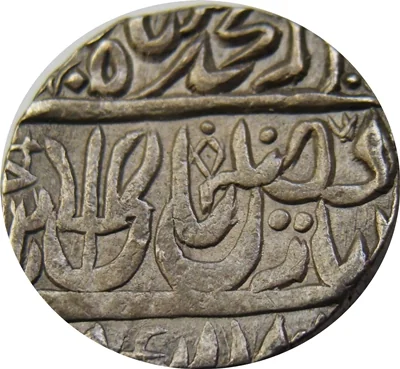
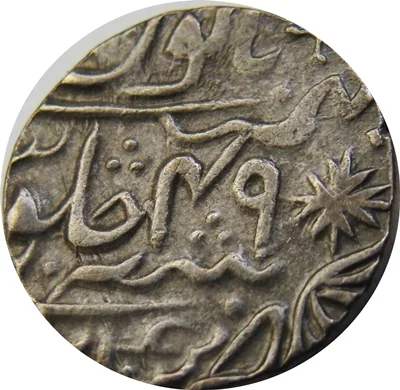
1 Rupee – Maratha Empire
India
Context

Material
Diameter: 20.08 mm
Weight: 11 g
Silver weight: 11.00 g
Shape: Irregular round
Composition: Silver
Magnetic: No
References
KM: #Click to copy to clipboard321
Numista: #69971
Value
Bullion value: $31.48
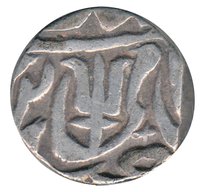
Obverse
Description:
Pataka and trishul are second type.
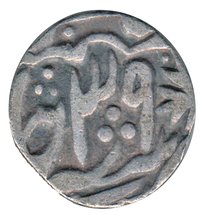
Reverse
Description:
Text, mint, year
Edge
Mintings
| Year | Mint Mark | Mintage | Quality | Collection |
|---|---|---|---|---|
| — | — | — | ||
| 1793 | — | — | ||
| 1802 | — | — | ||
| 1804 | — | — | ||
| 1805 | — | — | ||
| 1806 | — | — | ||
| 1807 | — | — | ||
| 1808 | — | — | ||
| 1809 | — | — |
Historical background
By 1793, the Maratha Empire's currency system reflected its complex political reality, being a decentralized confederacy under the nominal leadership of the Peshwa in Pune. There was no single, unified imperial currency. Instead, the major Maratha chiefs—the Gaekwads in Baroda, the Scindias in Gwalior, the Holkars in Indore, and the Bhonsles in Nagpur—along with the Peshwa himself, all minted their own coins in their respective territories. These were primarily silver rupees, but their weight, purity (fineness), and design varied from one mint to another, leading to a multiplicity of circulating currencies within the empire's borders.
This period was one of significant financial strain and transition. The empire was still recovering from the massive indemnity of ₹2.5 crore imposed by the Treaty of Salbai (1782) and was engaged in continuous military campaigns, which drained the treasury. The Peshwa's government, facing revenue shortfalls, began to debase its coinage, reducing the silver content in its rupees to increase seigniorage revenue. This practice, however, eroded public trust in the currency and complicated trade, as merchants had to constantly assess the value of coins from different mints.
Furthermore, the year 1793 sits on the precipice of greater change. The British East India Company, having just enacted the Permanent Settlement in Bengal, was becoming an increasingly dominant economic and political force in the subcontinent. While the Maratha currency zones remained independent, the Company's standardized silver rupee would soon begin to exert gravitational pull on regional trade. Internally, the lack of monetary uniformity hindered centralized fiscal policy and became a symbol of the growing disunity among the Maratha chiefs, a weakness that would be exploited by the British in the coming decades.
This period was one of significant financial strain and transition. The empire was still recovering from the massive indemnity of ₹2.5 crore imposed by the Treaty of Salbai (1782) and was engaged in continuous military campaigns, which drained the treasury. The Peshwa's government, facing revenue shortfalls, began to debase its coinage, reducing the silver content in its rupees to increase seigniorage revenue. This practice, however, eroded public trust in the currency and complicated trade, as merchants had to constantly assess the value of coins from different mints.
Furthermore, the year 1793 sits on the precipice of greater change. The British East India Company, having just enacted the Permanent Settlement in Bengal, was becoming an increasingly dominant economic and political force in the subcontinent. While the Maratha currency zones remained independent, the Company's standardized silver rupee would soon begin to exert gravitational pull on regional trade. Internally, the lack of monetary uniformity hindered centralized fiscal policy and became a symbol of the growing disunity among the Maratha chiefs, a weakness that would be exploited by the British in the coming decades.
💎 Extremely Rare