

1 bazaruco – Portuguese India
Add to wishlist
India
Context
Years: 1538–1557
Country: India
Issuer: Portuguese India
Ruler: João III
Currency:
(1509—1580)
Demonetized: Yes
Material
References
KM: #
Numista: #49508
Obverse
Description:
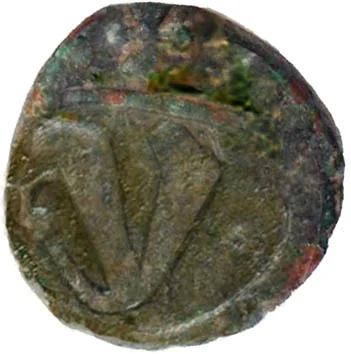
Y in circle, flanked by dots.
Inscription:
ºYº
Reverse
Description:
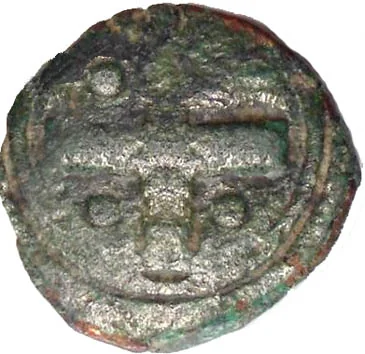
Saint George's cross in a circle, one dot per corner.
Edge
Mintings
| Year | Mint Mark | Mintage | Quality | Collection |
|---|---|---|---|---|
| — | — | — |
Historical background
In 1538, the currency situation in Portuguese India was a complex tapestry of local and imported systems, reflecting the Estado da India's role as a commercial intermediary rather than a territorial power. The Portuguese administration in Goa, the capital, officially minted its own silver coin, the tanga (or português), and its fractional coins like bazarucos and reis. However, these were not the dominant media of exchange. The real economic lifeblood of the region was a flood of pre-existing gold and silver currencies from across the Indian Ocean and beyond, including Venetian ducats, Ottoman sequins, and various Indian and Persian issues.
The Portuguese crown struggled to control this monetary chaos. A key policy was the attempt to centralize all bullion and high-value coinage at the Casa da Moeda (Royal Mint) in Goa, where foreign coins were to be reminted into Portuguese currency. In practice, this was widely circumvented by merchants. The most ubiquitous and trusted currency for everyday trade, especially in the bazaars, remained the Xerafim, a silver coin originally from the Bijapur Sultanate. Its stability and recognition made it the de facto accounting unit for most transactions, forcing the Portuguese to tacitly accept its circulation alongside their own issues.
Thus, the monetary landscape was one of pragmatic coexistence and crown frustration. While Portuguese coins held official status for government payments and salaries, the economy functioned on a multi-currency system driven by merchant preference. This situation underscored a fundamental reality of 16th-century Portuguese India: its power was anchored in trade networks and naval supremacy, not in the imposition of a unified economic system. The state's fiscal authority was constantly negotiated in the markets of Goa, Diu, and Cochin, where the Xerafim and gold huns often spoke louder than the royal tanga.
The Portuguese crown struggled to control this monetary chaos. A key policy was the attempt to centralize all bullion and high-value coinage at the Casa da Moeda (Royal Mint) in Goa, where foreign coins were to be reminted into Portuguese currency. In practice, this was widely circumvented by merchants. The most ubiquitous and trusted currency for everyday trade, especially in the bazaars, remained the Xerafim, a silver coin originally from the Bijapur Sultanate. Its stability and recognition made it the de facto accounting unit for most transactions, forcing the Portuguese to tacitly accept its circulation alongside their own issues.
Thus, the monetary landscape was one of pragmatic coexistence and crown frustration. While Portuguese coins held official status for government payments and salaries, the economy functioned on a multi-currency system driven by merchant preference. This situation underscored a fundamental reality of 16th-century Portuguese India: its power was anchored in trade networks and naval supremacy, not in the imposition of a unified economic system. The state's fiscal authority was constantly negotiated in the markets of Goa, Diu, and Cochin, where the Xerafim and gold huns often spoke louder than the royal tanga.
✨ Legendary