

1 escudo – Portuguese India
Add to wishlist
India
Context
Years: 1554–1557
Country: India
Issuer: Portuguese India
Ruler: João III
Currency:
(1509—1580)
Subdivision: 1 escudo = 1000 Reais
Demonetized: Yes
Material
References
KM: #
Numista: #49400
Value
Bullion value: $1276.38
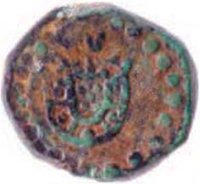
Obverse
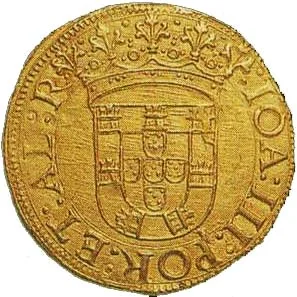
Description:
Gomes/2013: 15.xx. Minted by royal decree, 26 Oct 1544.
Inscription:
IOA:III:POR:ET:AL:R
Script: Latin
Engraver: Francisco de Holanda
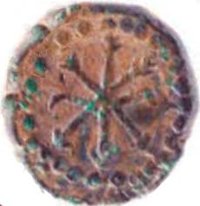
Reverse
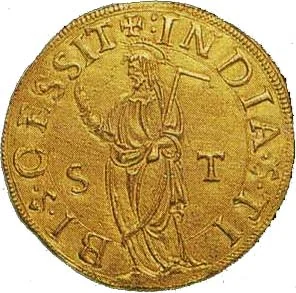
Inscription:
INDIA.:.TIBI.:.CESSIT
S / T
S / T
Script: Latin
Edge
Mintings
| Year | Mint Mark | Mintage | Quality | Collection |
|---|---|---|---|---|
| — | — | — |
Historical background
In 1554, the currency situation in Portuguese India was a complex tapestry of local and imported coinage, reflecting the Estado da India's role as a commercial hub rather than a fully sovereign territorial power. The Portuguese administration in Goa, the capital, did not impose a single, unified currency but rather operated within and tried to regulate the pre-existing vibrant monetary ecosystem of the Indian Ocean. The most important coins in daily circulation were indigenous: the silver rupia (the precursor to the rupee) and the gold hūn or pagoda, alongside a plethora of smaller copper and billon coins used for local trade. The Portuguese crown's primary objective was to facilitate and tax the lucrative trade in spices, textiles, and horses, which required engaging with these established systems.
To this end, the Portuguese introduced their own official coinage from the Goa mint, established in 1510. The most significant of these were the cruzado in gold and the tanga in silver, with the tanga becoming a fundamental unit of account. However, their output was often insufficient to meet economic demands, and their value was explicitly pegged to the dominant local currencies—for instance, the cruzado's value was defined in terms of tangas, which were themselves valued against the silver rupia. Furthermore, a vast array of foreign coins circulated freely, including Venetian ducats, Mamluk dinars, and most importantly, the Spanish real of eight (the famous "piece of eight"), which was beginning to arrive via trade links from the New World and would later become a global currency.
This multi-currency environment created constant challenges for the Portuguese authorities, including issues of currency debasement, counterfeiting, and complex exchange calculations. The situation in 1554 was one of pragmatic coexistence and managed competition. The Estado's fiscal system, including tax collection and official payments, was conducted using its own tanga-based accounting, while the bustling markets of Goa, Cochin, and Diu operated on a de facto bimetallic (gold and silver) standard dictated by regional trade networks. Thus, the currency landscape was less a symbol of Portuguese imperial control and more a testament to their adaptive, intermediary role within the larger Asian economy.
To this end, the Portuguese introduced their own official coinage from the Goa mint, established in 1510. The most significant of these were the cruzado in gold and the tanga in silver, with the tanga becoming a fundamental unit of account. However, their output was often insufficient to meet economic demands, and their value was explicitly pegged to the dominant local currencies—for instance, the cruzado's value was defined in terms of tangas, which were themselves valued against the silver rupia. Furthermore, a vast array of foreign coins circulated freely, including Venetian ducats, Mamluk dinars, and most importantly, the Spanish real of eight (the famous "piece of eight"), which was beginning to arrive via trade links from the New World and would later become a global currency.
This multi-currency environment created constant challenges for the Portuguese authorities, including issues of currency debasement, counterfeiting, and complex exchange calculations. The situation in 1554 was one of pragmatic coexistence and managed competition. The Estado's fiscal system, including tax collection and official payments, was conducted using its own tanga-based accounting, while the bustling markets of Goa, Cochin, and Diu operated on a de facto bimetallic (gold and silver) standard dictated by regional trade networks. Thus, the currency landscape was less a symbol of Portuguese imperial control and more a testament to their adaptive, intermediary role within the larger Asian economy.
✨ Legendary