

1 Rupia – Portuguese India
India
Context
Years: 1758–1771
Country: India 
Issuer: Portuguese India
Ruler: Joseph I
Currency:
(1706—1880)
Demonetized: Yes
Material
References
KM: #Click to copy to clipboard5
Numista: #49290
Value
Bullion value: $31.71
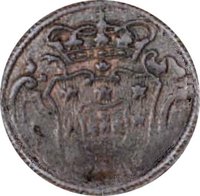
Obverse
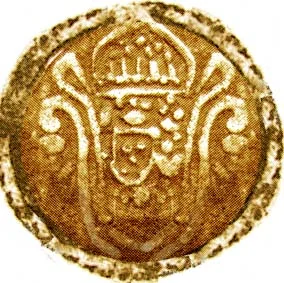
Description:
Gomes/2013: Jo.53.01-53.07. Considered from Diu until 1988.
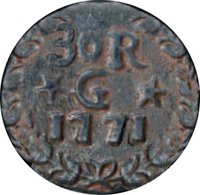
Reverse
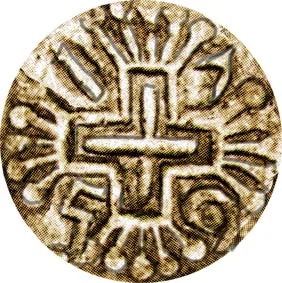
Inscription:
1 7
5 9
5 9
Edge
Mintings
| Year | Mint Mark | Mintage | Quality | Collection |
|---|---|---|---|---|
| 1758 | — | — | ||
| 1759 | — | — | ||
| 1764 | — | — | ||
| 1765 | — | — | ||
| 1766 | — | — | ||
| 1771 | — | — |
Historical background
In 1758, the currency situation in Portuguese India was a complex tapestry of local, regional, and international coins, reflecting the territory's position as a commercial crossroads and its diminished economic power. The official currency was the Portuguese real, but its circulation and authority were limited. The most dominant and trusted currency in daily trade, especially in Goa, was the Silver Rupia (Xerafim), which was often stamped with a local countermark ("GOA") to validate its use within the territory. This practice itself highlighted the lack of sufficient minted specie from Lisbon and the reliance on coins produced by other powers, particularly the Mughal Empire and various Indian princely states.
The monetary landscape was further complicated by the widespread use of the Gold Pagoda, originating from the neighbouring Kingdom of Mysore and other South Indian states, for larger transactions and trade. Additionally, a plethora of other coins, including Spanish and Austrian silver dollars (pieces of eight), Dutch guilders, and various Indian and Persian issues, circulated freely in the ports. This created a chaotic system where exchange rates fluctuated based on the intrinsic silver or gold content of each coin, the reputation of its mint, and local demand, requiring money changers (sarafs) to be essential figures in the marketplace.
This monetary fragmentation was symptomatic of the broader decline of the Portuguese Estado da Índia in the mid-18th century. While the Marquis of Pombal's reforms were beginning in mainland Portugal, his centralized economic policies had yet to firmly reshape the distant Indian possessions. The local administration in Goa struggled to impose monetary order, and the persistent trade deficits with other Indian regions drained silver from the territory. Thus, in 1758, the currency system was less a symbol of Portuguese sovereignty and more a pragmatic, ad-hoc adaptation to local market forces and the reality of Portuguese India's embeddedness within the vibrant and competitive economies of the Indian Ocean world.
The monetary landscape was further complicated by the widespread use of the Gold Pagoda, originating from the neighbouring Kingdom of Mysore and other South Indian states, for larger transactions and trade. Additionally, a plethora of other coins, including Spanish and Austrian silver dollars (pieces of eight), Dutch guilders, and various Indian and Persian issues, circulated freely in the ports. This created a chaotic system where exchange rates fluctuated based on the intrinsic silver or gold content of each coin, the reputation of its mint, and local demand, requiring money changers (sarafs) to be essential figures in the marketplace.
This monetary fragmentation was symptomatic of the broader decline of the Portuguese Estado da Índia in the mid-18th century. While the Marquis of Pombal's reforms were beginning in mainland Portugal, his centralized economic policies had yet to firmly reshape the distant Indian possessions. The local administration in Goa struggled to impose monetary order, and the persistent trade deficits with other Indian regions drained silver from the territory. Thus, in 1758, the currency system was less a symbol of Portuguese sovereignty and more a pragmatic, ad-hoc adaptation to local market forces and the reality of Portuguese India's embeddedness within the vibrant and competitive economies of the Indian Ocean world.
✨ Legendary