

½ atiá – Portuguese India
Add to wishlist
India
Context
Years: 1756–1768
Country: India
Issuer: Portuguese India
Issuing organization: Casa da Moeda de Diu
Ruler: Joseph I
Currency:
(1706—1880)
Subdivision: ½ atiá = ⅛ Tanga
Demonetized: Yes
Material
Diameter: 20 mm
Weight: 4.4 g
Shape: Irregular round
Composition: Copper
Magnetic: No
Technique: Hammered
References
KM: #
Numista: #49257
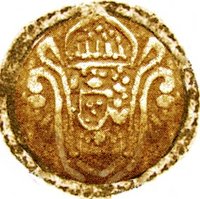
Obverse
Description:
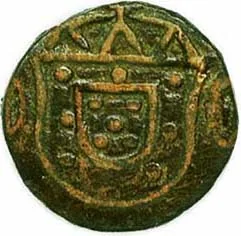
King's Arms divides mint mark.
Inscription:
D - O
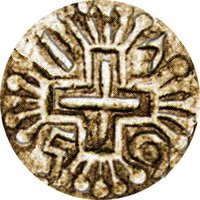
Reverse
Description:
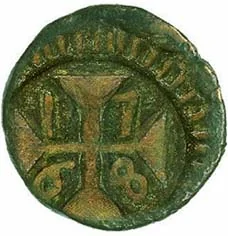
Military Order of Christ cross, dated corners.
Inscription:
1 7
6 8
6 8
Edge
Categories
| Symbols> Coat of Arms |
| Symbol> Cross |
Mintings
| Year | Mint Mark | Mintage | Quality | Collection |
|---|---|---|---|---|
| 1756 | D-O | — | ||
| 1767 | D-O | — | ||
| 1768 | D-O | — |
Historical background
In 1756, the currency situation in Portuguese India was a complex tapestry of official and unofficial systems, reflecting both the colony's diminished economic power and its integration into vibrant regional trade networks. The official currency, issued by the Casa da Moeda (Mint) in Goa, was based on the Portuguese réis, with the xerafim (equivalent to 300 réis) as a key unit of account. However, these coins, including the silver rupia and the gold cruzado, often suffered from debasement and were insufficient in quantity to meet the demands of commerce. The Portuguese state's chronic financial difficulties, exacerbated by the costs of maintaining its far-flung empire, led to frequent monetary instability and a reliance on imported bullion, primarily from Brazil.
In practice, the bustling trade of Goa, Damão, and Diu was dominated by a multitude of foreign coins, making the ports a numismatic bazaar. The most important and trusted currency was the silver Mughal rupee, particularly those minted in Surat, which served as the de facto standard for high-value transactions. Alongside these, a plethora of other coins circulated freely, including Venetian ducats, Ottoman sequins, Spanish-American pesos (often called "Patacas"), and various Indian and Persian issues. This reliance on external currencies underscored Portugal's loss of commercial hegemony and the pragmatic adaptation of its enclaves to the economic realities of the Indian Ocean, where merchant trust in a coin's intrinsic silver or gold content mattered more than the issuing authority.
The resulting monetary environment was one of calculated complexity. Exchange rates between these various coins, the official Portuguese issues, and units of account like the tangas (1/3 of a xerafim) fluctuated based on metallic purity, weight, and local demand. This system created opportunities for money changers (sarafs) but also posed significant challenges for administration and tax collection. For the Portuguese administration in 1756, this fragmented currency landscape was a constant reminder of its precarious position—politically subordinate to the rising power of the Maratha Confederacy and economically dependent on the very trade networks it could no longer fully control.
In practice, the bustling trade of Goa, Damão, and Diu was dominated by a multitude of foreign coins, making the ports a numismatic bazaar. The most important and trusted currency was the silver Mughal rupee, particularly those minted in Surat, which served as the de facto standard for high-value transactions. Alongside these, a plethora of other coins circulated freely, including Venetian ducats, Ottoman sequins, Spanish-American pesos (often called "Patacas"), and various Indian and Persian issues. This reliance on external currencies underscored Portugal's loss of commercial hegemony and the pragmatic adaptation of its enclaves to the economic realities of the Indian Ocean, where merchant trust in a coin's intrinsic silver or gold content mattered more than the issuing authority.
The resulting monetary environment was one of calculated complexity. Exchange rates between these various coins, the official Portuguese issues, and units of account like the tangas (1/3 of a xerafim) fluctuated based on metallic purity, weight, and local demand. This system created opportunities for money changers (sarafs) but also posed significant challenges for administration and tax collection. For the Portuguese administration in 1756, this fragmented currency landscape was a constant reminder of its precarious position—politically subordinate to the rising power of the Maratha Confederacy and economically dependent on the very trade networks it could no longer fully control.
✨ Legendary