

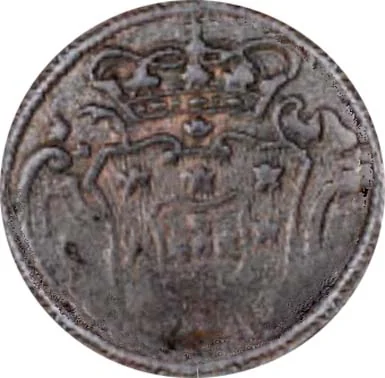
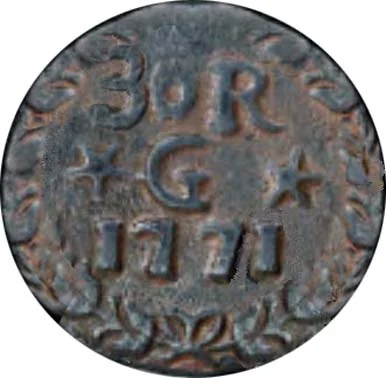
½ Tanga – Portuguese India
India
Context
Years: 1759–1778
Country: India 
Issuer: Portuguese India
Ruler: Joseph I
Currency:
(1706—1880)
Demonetized: Yes
Material
Diameter: 33 mm
Weight: 20 g
Shape: Irregular round
Composition: Copper
Magnetic: No
Technique: Hammered
References
KM: #Click to copy to clipboard135
Numista: #49251
Mints
| Name | Mark |
|---|---|
| Goa | — |
Mintings
| Year | Mint Mark | Mintage | Quality | Collection |
|---|---|---|---|---|
| 1759 | — | — | ||
| 1762 | G | — | ||
| 1763 | G | — | ||
| 1764 | G | — | ||
| 1766 | G | — | ||
| 1768 | G | — | ||
| 1769 | G | — | ||
| 1770 | G | — | ||
| 1771 | G | — | ||
| 1773 | G | — | ||
| 1774 | G | — | ||
| 1776 | G | — | ||
| 1778 | G | — |
Historical background
In 1759, the currency situation in Portuguese India was characterized by a complex and fragmented monetary landscape, reflecting both its colonial administration and its deep integration into regional trade networks. The official currency was the Portuguese real, with higher denominations like the cruzado and xerafim, but these coins circulated alongside a vast array of foreign and historic currencies. Most prevalent were gold mohurs and silver rupees from the neighboring Maratha Empire and other Indian powers, alongside older Portuguese issues and even coins from other European trading companies. This created a chaotic system where exchange rates fluctuated constantly, and transactions required expert knowledge of the weight, purity, and origin of each coin.
This monetary pluralism was a direct result of Goa's role as a commercial hub. The Portuguese administration lacked both the political authority and the bullion reserves to impose a single, uniform currency across its territories, which by then were largely reduced to Goa, Daman, and Diu. Consequently, the economy operated on a de facto system of commodity money, where the intrinsic metallic value of a coin was paramount. The xerafim, a silver coin minted locally in Goa, served as a key accounting unit, but its value was officially pegged to the rupee, underscoring the dominance of Indian currencies in everyday trade. The Portuguese state often collected taxes in rupees, further legitimizing their use.
The situation was further complicated by chronic shortages of specie and widespread debasement. To finance its deficits and military expenses, the Estado da Índia frequently reduced the silver content in its own coinage, eroding public trust. This debasement, combined with the influx of foreign coins of varying quality, led to persistent inflation and economic instability. Therefore, in 1759, the monetary system was not one of sovereign control but a precarious and negotiated equilibrium, dependent on the ebb and flow of regional commerce and the fragile credibility of the colonial mint.
This monetary pluralism was a direct result of Goa's role as a commercial hub. The Portuguese administration lacked both the political authority and the bullion reserves to impose a single, uniform currency across its territories, which by then were largely reduced to Goa, Daman, and Diu. Consequently, the economy operated on a de facto system of commodity money, where the intrinsic metallic value of a coin was paramount. The xerafim, a silver coin minted locally in Goa, served as a key accounting unit, but its value was officially pegged to the rupee, underscoring the dominance of Indian currencies in everyday trade. The Portuguese state often collected taxes in rupees, further legitimizing their use.
The situation was further complicated by chronic shortages of specie and widespread debasement. To finance its deficits and military expenses, the Estado da Índia frequently reduced the silver content in its own coinage, eroding public trust. This debasement, combined with the influx of foreign coins of varying quality, led to persistent inflation and economic instability. Therefore, in 1759, the monetary system was not one of sovereign control but a precarious and negotiated equilibrium, dependent on the ebb and flow of regional commerce and the fragile credibility of the colonial mint.
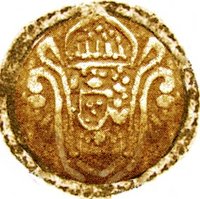
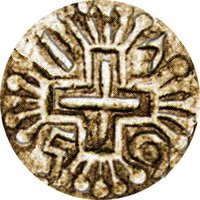
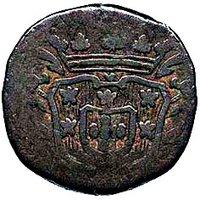
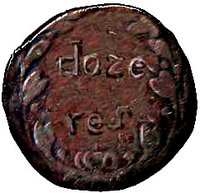
💎 Extremely Rare