

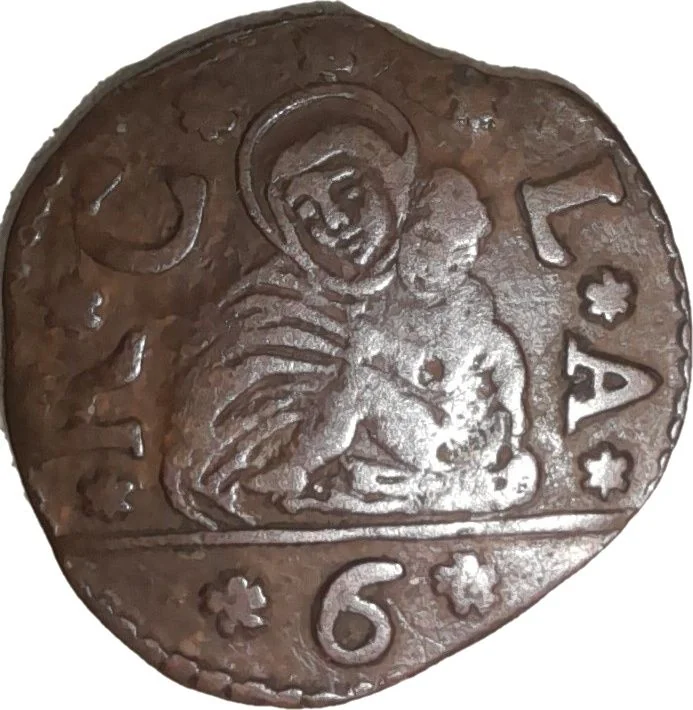
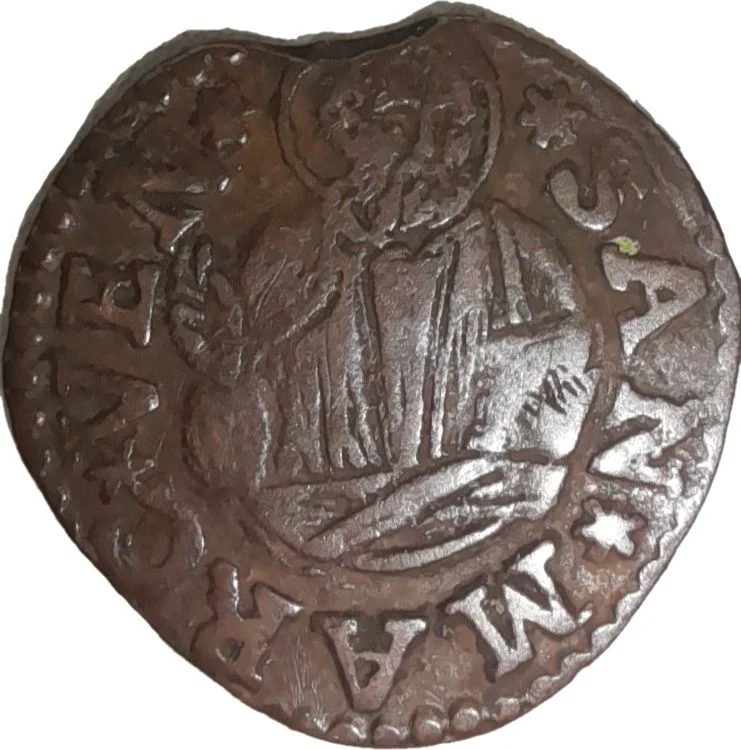
6 Bagattini – Venice
Italy

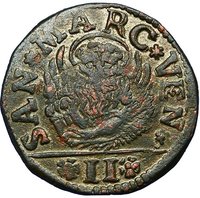
Obverse
Description:
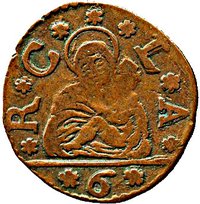
Madonna and Child at right, R.C.-L.A. arc above, '6' in exergue.
Inscription:
*R*C***L*A*
*6*
*6*
Script: Latin
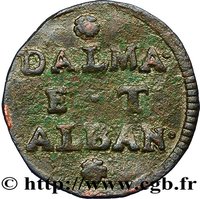
Reverse
Edge
Mints
| Name | Mark |
|---|---|
| Venice | — |
Mintings
| Year | Mint Mark | Mintage | Quality | Collection |
|---|---|---|---|---|
| 1680 | — | — |
Historical background
In 1680, the currency situation in the Republic of Venice was one of managed complexity, reflecting both its historic commercial prestige and the mounting financial pressures of the late 17th century. The city operated on a bimetallic system, but its defining feature was the co-existence of two parallel monetary standards: one for heavy, high-value "bank money" and another for everyday circulating coinage. The ducato (ducat) reigned supreme as the stable unit of account for large trade, contracts, and the ledger books of the famed Rialto Bank (Banco Giro, established in 1619). This "bank money" existed primarily as credit entries, insulated from the physical degradation of coins. Alongside it, the lira (plural: lire), subdivided into 20 soldi or 240 denari, served as the unit for the actual silver and billon coins in public circulation.
However, this system was under significant strain. Decades of warfare, particularly the prolonged and costly conflict with the Ottoman Empire over Crete (1645-1669), had drained Venetian reserves and led to repeated debasements of the silver-based coinage. The scudo and the smaller soldi coins were often minted with less precious metal than their face value proclaimed, leading to inflation in everyday prices and a growing distrust in pocket change. This created a persistent gap between the stable value of the "ducato di banco" and the fluctuating, lower value of the "ducato di moneta" in physical coins—a premium known as the agio.
Consequently, Venice in 1680 was a society acutely aware of monetary duality. Merchants and the state itself transacted in reliable bank credit, while the populace contended with a mix of underweight domestic coins and a flood of diverse foreign currencies from across the Mediterranean and Europe that filled the void. The government engaged in constant, though often reactive, attempts to regulate the exchange rates between these monies and to recall and remint debased coinage, seeking to protect both its fiscal integrity and the solvency of its vital merchant class. The currency landscape was thus a fragile equilibrium, balancing the ghost of past financial dominance against the realities of imperial decline and economic competition.
However, this system was under significant strain. Decades of warfare, particularly the prolonged and costly conflict with the Ottoman Empire over Crete (1645-1669), had drained Venetian reserves and led to repeated debasements of the silver-based coinage. The scudo and the smaller soldi coins were often minted with less precious metal than their face value proclaimed, leading to inflation in everyday prices and a growing distrust in pocket change. This created a persistent gap between the stable value of the "ducato di banco" and the fluctuating, lower value of the "ducato di moneta" in physical coins—a premium known as the agio.
Consequently, Venice in 1680 was a society acutely aware of monetary duality. Merchants and the state itself transacted in reliable bank credit, while the populace contended with a mix of underweight domestic coins and a flood of diverse foreign currencies from across the Mediterranean and Europe that filled the void. The government engaged in constant, though often reactive, attempts to regulate the exchange rates between these monies and to recall and remint debased coinage, seeking to protect both its fiscal integrity and the solvency of its vital merchant class. The currency landscape was thus a fragile equilibrium, balancing the ghost of past financial dominance against the realities of imperial decline and economic competition.
⭐ Somewhat Rare