

½ soldo – Venice
Add to wishlist
Italy
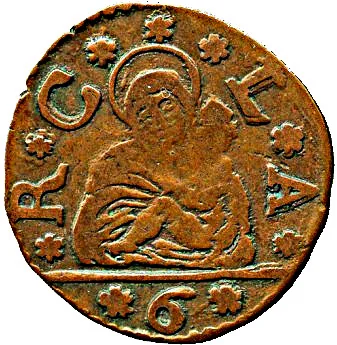
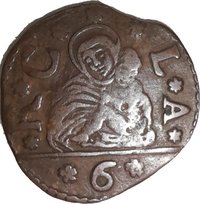
Obverse
Description:
Half-length Madonna and Child facing right, arching R.C.-L.A. above, '6' in exergue.
Inscription:
R C L A
6
6
Script: Latin
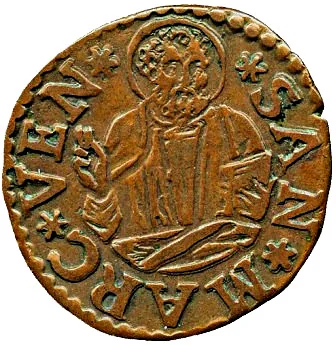
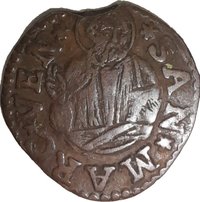
Reverse
Description:
Half-length portrait of St. Mark.
Inscription:
SANCT(VS) * MARC(VS) * V(E)(N)(E)(T) *
Script: Latin
Edge
Mints
| Name | Mark |
|---|---|
| Venice | — |
Mintings
| Year | Mint Mark | Mintage | Quality | Collection |
|---|---|---|---|---|
| 1619 | — | — |
Historical background
In 1619, Venice’s currency situation was defined by a severe and protracted crisis known as the "War of the Mint" (Guerra della Moneta). The heart of the problem was a drastic divergence between the value of silver and gold coins in circulation. The state’s official lira di piccoli (the unit of account) was tied to the silver-based ducato coin, but the actual silver content of smaller coins had been repeatedly debased over decades to fund Venice’s costly wars and the lavish construction of palaces. This created a classic "bad money drives out good" scenario, where full-weight silver coins were hoarded or exported, leaving the economy awash in poor-quality, lightweight coinage.
This monetary instability had corrosive effects on daily life and commerce. Prices and wages, often set in the unstable lira di piccoli, became unpredictable, harming the city’s labourers and poor. Meanwhile, international trade, the lifeblood of the Republic, was conducted in reliable gold scudi or foreign full-weight silver coins, creating a damaging dual-currency system. Merchants and the wealthy protected themselves by dealing in sound foreign currency, while the local economy suffered from the inflationary spiral caused by the debased coinage, eroding public trust in the state’s financial management.
The crisis reached a political climax in the years leading up to 1619, prompting intense debate within the Venetian Senate. Reformers, led by the future Doge Antonio Priuli, argued for a radical "re-coinage" to restore the silver standard and stabilize the lira. Their opponents, often large debtors and those benefiting from the status quo, resisted. In 1619 itself, the Senate was actively grappling with these proposals, and the decision to implement the major monetary reform of 1620—which created a new silver ducatone and re-established a credible link between coin and account—was being fiercely negotiated, making it a pivotal year in Venetian financial history.
This monetary instability had corrosive effects on daily life and commerce. Prices and wages, often set in the unstable lira di piccoli, became unpredictable, harming the city’s labourers and poor. Meanwhile, international trade, the lifeblood of the Republic, was conducted in reliable gold scudi or foreign full-weight silver coins, creating a damaging dual-currency system. Merchants and the wealthy protected themselves by dealing in sound foreign currency, while the local economy suffered from the inflationary spiral caused by the debased coinage, eroding public trust in the state’s financial management.
The crisis reached a political climax in the years leading up to 1619, prompting intense debate within the Venetian Senate. Reformers, led by the future Doge Antonio Priuli, argued for a radical "re-coinage" to restore the silver standard and stabilize the lira. Their opponents, often large debtors and those benefiting from the status quo, resisted. In 1619 itself, the Senate was actively grappling with these proposals, and the decision to implement the major monetary reform of 1620—which created a new silver ducatone and re-established a credible link between coin and account—was being fiercely negotiated, making it a pivotal year in Venetian financial history.
⭐ Rare