

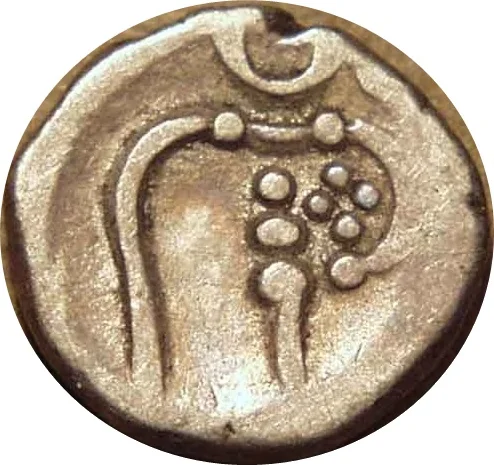

Obverse
Description:
Shell
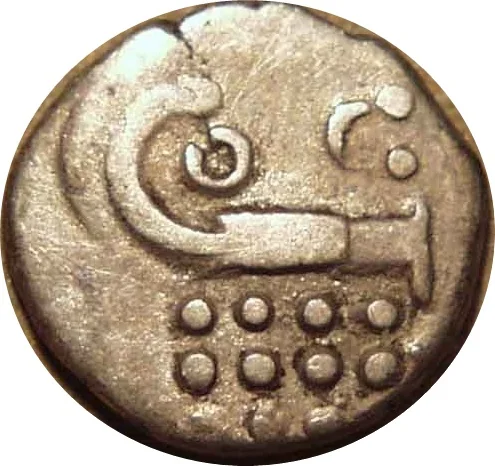
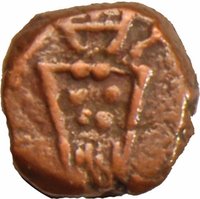
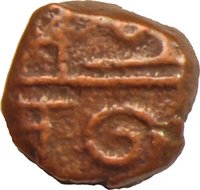
Reverse
Description:
“Lazy J” (degenerate boar) with dots below, o.c. (Oostindische Compagnie) above.
Edge
Plain
Mints
| Name | Mark |
|---|---|
| Negapatnam | — |
Mintings
| Year | Mint Mark | Mintage | Quality | Collection |
|---|---|---|---|---|
| — | — | — |
Historical background
In 1675, the currency situation in Dutch India, administered by the Vereenigde Oostindische Compagnie (VOC), was characterized by a complex and often chaotic multiplicity of coins. The VOC’s primary hub was the port of Cochin in Malabar, with other key settlements like Nagapattinam on the Coromandel Coast. The Company did not impose a single unified currency but operated within a pre-existing Asian monetary ecosystem dominated by silver. The most important coin in regional trade was the Spanish silver real, often minted into "pieces of eight," which served as the de facto international currency. Alongside these, a plethora of other coins circulated, including Portuguese xerafins, various Indian gold pagodas and silver rupees, and Japanese koban. This diversity created significant challenges for accounting and trade.
The VOC’s main objective was to channel this monetary flow to its advantage, particularly to procure spices like pepper, cinnamon, and cardamom for export to Europe. To standardize transactions, the Company established a system of negotiepenningen (trade money) – not physical coins but bookkeeping units used in its ledgers. The most common unit was the fanam, with a fixed value set against the silver real. However, the actual value of physical coins fluctuated based on silver content, wear, and local market demand, leading to constant disputes and arbitrage. The VOC often found itself struggling to attract sufficient silver coinage to its territories to pay for goods and maintain its military presence, competing with Indian merchants and other European companies.
Consequently, the monetary landscape was one of pragmatic adaptation rather than control. The VOC occasionally minted its own local coins, like the copper duits for small-scale transactions, but these were limited in scope. The real power lay in the Company’s ability to set exchange rates between the various physical coins and its own accounting units, a practice that could be manipulated for profit but also risked alienating local traders. Thus, in 1675, the currency situation was a fragile and negotiated order, underpinning the VOC’s commercial empire but perpetually vulnerable to shortages, counterfeiting, and the sheer complexity of the Indian Ocean’s bullion-driven economy.
The VOC’s main objective was to channel this monetary flow to its advantage, particularly to procure spices like pepper, cinnamon, and cardamom for export to Europe. To standardize transactions, the Company established a system of negotiepenningen (trade money) – not physical coins but bookkeeping units used in its ledgers. The most common unit was the fanam, with a fixed value set against the silver real. However, the actual value of physical coins fluctuated based on silver content, wear, and local market demand, leading to constant disputes and arbitrage. The VOC often found itself struggling to attract sufficient silver coinage to its territories to pay for goods and maintain its military presence, competing with Indian merchants and other European companies.
Consequently, the monetary landscape was one of pragmatic adaptation rather than control. The VOC occasionally minted its own local coins, like the copper duits for small-scale transactions, but these were limited in scope. The real power lay in the Company’s ability to set exchange rates between the various physical coins and its own accounting units, a practice that could be manipulated for profit but also risked alienating local traders. Thus, in 1675, the currency situation was a fragile and negotiated order, underpinning the VOC’s commercial empire but perpetually vulnerable to shortages, counterfeiting, and the sheer complexity of the Indian Ocean’s bullion-driven economy.

💎 Extremely Rare