

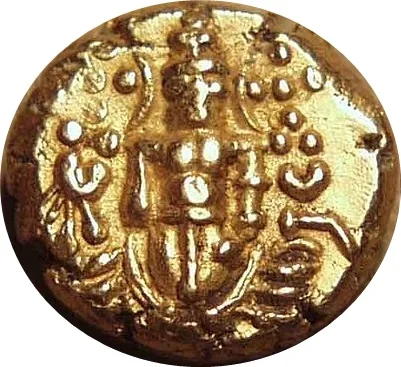

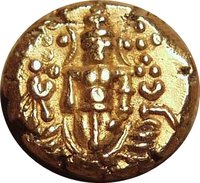

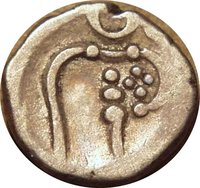
Obverse
Description:
Lord Venkateswara standing, flanked by chakras.
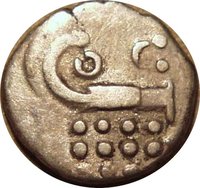
Reverse
Description:
Granulated dot field
Edge
Plain
Mintings
| Year | Mint Mark | Mintage | Quality | Collection |
|---|---|---|---|---|
| — | — | — |
Historical background
In the 1670s, the currency situation in Dutch India, centered on the Vereenigde Oost-Indische Compagnie (VOC) headquarters in Batavia (modern-day Jakarta), was characterized by a complex and often chaotic multiplicity of coins. The VOC's primary need was a reliable and abundant medium of exchange to finance its intra-Asian trade network, purchase spices, and pay its soldiers and employees. To meet this demand, the Company relied heavily on importing vast quantities of silver, primarily in the form of Spanish Reales (pieces of eight) and Mexican Reals, which were highly valued across Asia. These coins, along with Japanese koban gold coins and various Indian and Persian gold mohurs and silver rupees, circulated widely in VOC territories.
However, this created a persistent monetary crisis. The intrinsic value of these silver coins often exceeded their official face value in the VOC's accounting system, leading to their immediate export by merchants for profit in neighboring regions. This chronic shortage of circulating coinage forced the VOC to take extraordinary measures. In the 1640s, they had already introduced the duit, a small copper coin intended for local small-scale transactions, but by the 1670s, the shortage of silver was so acute that the Company began issuing creditbrieven (paper credit notes). These were early forms of negotiable paper money, a necessity born of desperation to keep the local economy functioning without sufficient physical specie.
Thus, the monetary landscape was a fragile hybrid system. High-value interregional trade was conducted in a bewildering array of full-bodied foreign silver and gold coins, while the local economy in Batavia and its dependencies increasingly relied on low-value copper duiten and experimental paper promises. The VOC's constant struggle was to prevent the flight of silver, stabilize exchange rates between dozens of coin types, and maintain its own creditworthiness—a challenging task that made the 1670s a period of significant financial innovation under pressure, laying groundwork for more formalized currency systems in the following decades.
However, this created a persistent monetary crisis. The intrinsic value of these silver coins often exceeded their official face value in the VOC's accounting system, leading to their immediate export by merchants for profit in neighboring regions. This chronic shortage of circulating coinage forced the VOC to take extraordinary measures. In the 1640s, they had already introduced the duit, a small copper coin intended for local small-scale transactions, but by the 1670s, the shortage of silver was so acute that the Company began issuing creditbrieven (paper credit notes). These were early forms of negotiable paper money, a necessity born of desperation to keep the local economy functioning without sufficient physical specie.
Thus, the monetary landscape was a fragile hybrid system. High-value interregional trade was conducted in a bewildering array of full-bodied foreign silver and gold coins, while the local economy in Batavia and its dependencies increasingly relied on low-value copper duiten and experimental paper promises. The VOC's constant struggle was to prevent the flight of silver, stabilize exchange rates between dozens of coin types, and maintain its own creditworthiness—a challenging task that made the 1670s a period of significant financial innovation under pressure, laying groundwork for more formalized currency systems in the following decades.
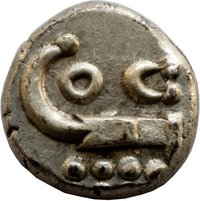
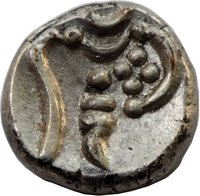
✨ Legendary