

1 cash – Dutch India
Add to wishlist
India
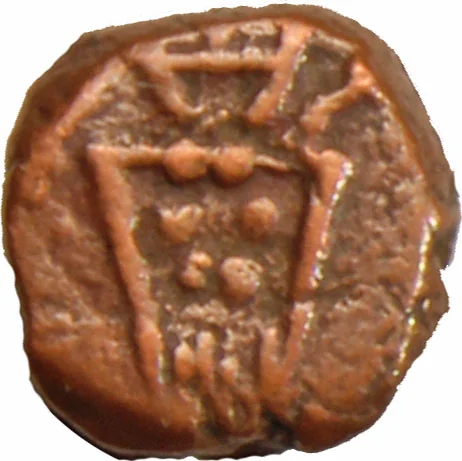
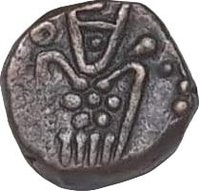
Obverse
Description:
Kali deity figure, stylized.
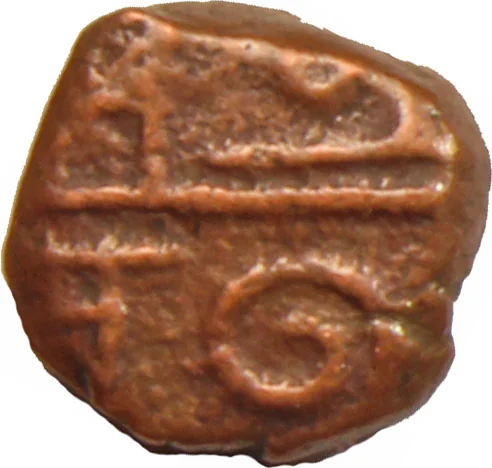
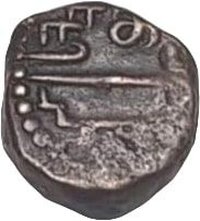
Reverse
Description:
Pudu / cher / i
Edge
Plain
Mints
| Name | Mark |
|---|---|
| Pondicherry | — |
Mintings
| Year | Mint Mark | Mintage | Quality | Collection |
|---|---|---|---|---|
| — | — | — |
Historical background
In 1693, the currency system of Dutch India, administered by the Vereenigde Oostindische Compagnie (VOC) from its headquarters in Batavia (modern-day Jakarta), was a complex and often problematic bimetallic system. The VOC's primary goal was to extract profit and facilitate trade across its vast Asian network, which required a stable and reliable medium of exchange. The system officially revolved around Dutch silver coins, like the rijksdaalder and leeuwendaalder, and various Asian gold and silver coins, but in practice, it was dominated by the Spanish silver real, or "piece of eight." This coin, minted in the Americas, was the de facto international trade currency, and the VOC's own trade and account books were largely denominated in it.
However, the colony faced chronic shortages of official coinage, leading to widespread circulation of debased, clipped, and counterfeit coins. To address this, the VOC frequently issued decrees setting official exchange rates between the myriad coins in use, but these often failed to reflect market realities. A more significant and disruptive practice was the VOC's own periodic recall and devaluation of coins. The Company would call in all circulating coins, melt them down, and reissue them with a higher stamped value, a process known as "enhancement." This was a form of seigniorage that generated short-term revenue for the cash-strapped Company but eroded public trust and caused economic instability.
Consequently, the monetary landscape was fragmented and inefficient. Alongside official coins, a vibrant market existed for Japanese koban gold coins, Indian mohurs and pagodas, and local copper doits for small change. The constant flux and uncertainty hindered local commerce and created opportunities for arbitrage by merchants and money-changers. Thus, in 1693, the currency situation was characterized by a tension between the VOC's need for fiscal control and the practical demands of a diverse, multi-currency trading empire, resulting in a system that was both a necessary tool for regional commerce and a source of persistent economic friction.
However, the colony faced chronic shortages of official coinage, leading to widespread circulation of debased, clipped, and counterfeit coins. To address this, the VOC frequently issued decrees setting official exchange rates between the myriad coins in use, but these often failed to reflect market realities. A more significant and disruptive practice was the VOC's own periodic recall and devaluation of coins. The Company would call in all circulating coins, melt them down, and reissue them with a higher stamped value, a process known as "enhancement." This was a form of seigniorage that generated short-term revenue for the cash-strapped Company but eroded public trust and caused economic instability.
Consequently, the monetary landscape was fragmented and inefficient. Alongside official coins, a vibrant market existed for Japanese koban gold coins, Indian mohurs and pagodas, and local copper doits for small change. The constant flux and uncertainty hindered local commerce and created opportunities for arbitrage by merchants and money-changers. Thus, in 1693, the currency situation was characterized by a tension between the VOC's need for fiscal control and the practical demands of a diverse, multi-currency trading empire, resulting in a system that was both a necessary tool for regional commerce and a source of persistent economic friction.
🌟 Limited