

1 Liard – Spanish Netherlands
Netherlands
Context
Years: 1639–1666
Country: Netherlands 
Issuer: Spanish Netherlands
Ruler: Philip IV
Currency:
(1506—1713)
Demonetized: Yes
Material
References
KM: #Click to copy to clipboard61
Numista: #48525
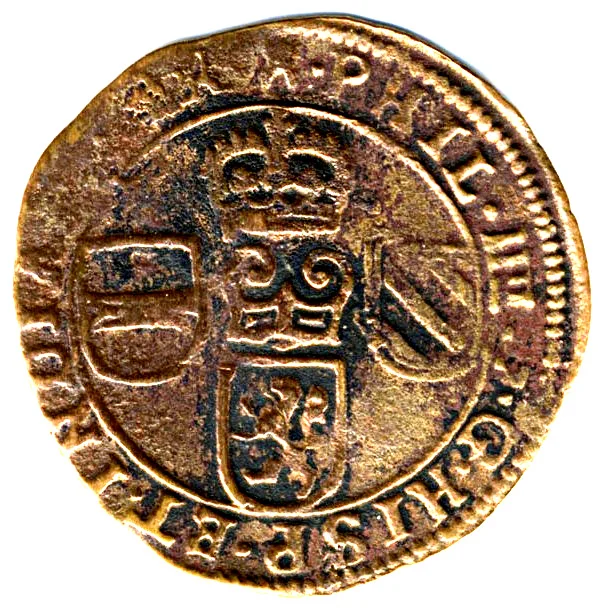
Obverse
Description:
A crowned firesteel encircled by a cross of arms: Austria (left), Burgundy (right), and Brabant (below).
Inscription:
PHIL. IIII. D.G. HISP. ET INDIAR. REX.
Script: Latin
Reverse
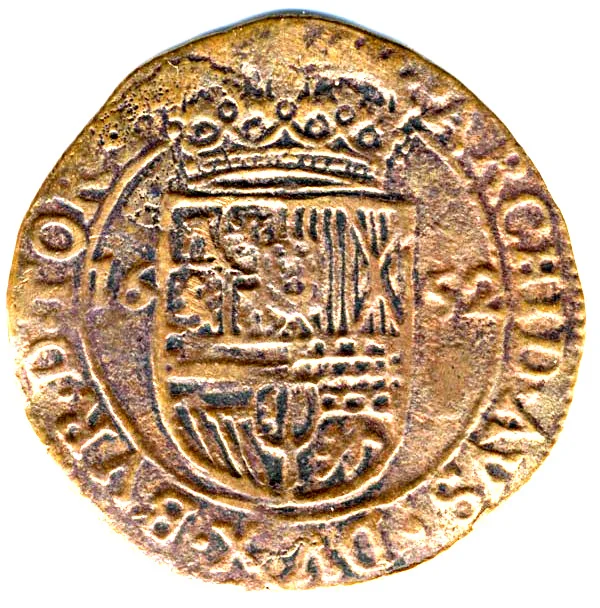
Description:
Coat of arms splits date.
Inscription:
ARCHID. AVS. DVX. BVRG. D. TOR. c.
16 52
16 52
Script: Latin
Edge
Plain
Mints
| Name | Mark |
|---|---|
| Tournai | — |
Mintings
| Year | Mint Mark | Mintage | Quality | Collection |
|---|---|---|---|---|
| 1639 | — | — | ||
| 1643 | — | — | ||
| 1644 | — | — | ||
| 1645 | — | — | ||
| 1646 | — | — | ||
| 1647 | — | — | ||
| 1648 | — | — | ||
| 1649 | — | — | ||
| 1650 | — | — | ||
| 1651 | — | — | ||
| 1652 | — | — | ||
| 1653 | — | — | ||
| 1654 | — | — | ||
| 1655 | — | — | ||
| 1656 | — | — | ||
| 1657 | — | — | ||
| 1658 | — | — | ||
| 1659 | — | — | ||
| 1660 | — | — | ||
| 1664 | — | — | ||
| 1665 | — | — | ||
| 1666 | — | — |
Historical background
In 1639, the Spanish Netherlands was in the midst of the Eighty Years' War, a protracted conflict for independence fought against the Spanish Habsburg monarchy. The region's economy, once the commercial heart of Northern Europe, was severely strained by the immense costs of continuous warfare, military occupations, and the blockade of the River Scheldt, which had crippled the vital port of Antwerp. This fiscal pressure manifested in a chaotic and debased currency system, where the authorities frequently resorted to manipulating coinage to fund the army, leading to a severe loss of public trust.
The currency situation was characterized by a proliferation of different coins in circulation, including domestic issues, foreign currencies, and numerous clipped or counterfeit pieces. Most damaging were the repeated official devaluations, where the government would suddenly increase the face value of specific coins (like the patagon or ducaton) by royal decree to generate short-term liquidity for the treasury. This practice, while providing immediate cash for soldiers' pay, caused rapid inflation, distorted prices, and encouraged hoarding of older, intrinsically valuable coins (Gresham's Law). Merchants and cities struggled with unpredictable exchange rates, harming commerce and sowing widespread economic uncertainty.
Consequently, 1639 fell within a period of intense monetary instability. The Habsburg authorities, under the governance of Cardinal-Infante Ferdinand, were caught in a vicious cycle: military necessity demanded financial expedients that undermined the economy, which in turn reduced long-term tax revenues. This background of monetary chaos contributed to the general war-weariness and economic decline of the Spanish Netherlands, contrasting sharply with the growing financial strength and stability of the rebel Dutch Republic to the north.
The currency situation was characterized by a proliferation of different coins in circulation, including domestic issues, foreign currencies, and numerous clipped or counterfeit pieces. Most damaging were the repeated official devaluations, where the government would suddenly increase the face value of specific coins (like the patagon or ducaton) by royal decree to generate short-term liquidity for the treasury. This practice, while providing immediate cash for soldiers' pay, caused rapid inflation, distorted prices, and encouraged hoarding of older, intrinsically valuable coins (Gresham's Law). Merchants and cities struggled with unpredictable exchange rates, harming commerce and sowing widespread economic uncertainty.
Consequently, 1639 fell within a period of intense monetary instability. The Habsburg authorities, under the governance of Cardinal-Infante Ferdinand, were caught in a vicious cycle: military necessity demanded financial expedients that undermined the economy, which in turn reduced long-term tax revenues. This background of monetary chaos contributed to the general war-weariness and economic decline of the Spanish Netherlands, contrasting sharply with the growing financial strength and stability of the rebel Dutch Republic to the north.
⭐ Somewhat Rare