

1 Sovereign – Spanish Netherlands
Netherlands
Context
Years: 1648–1665
Country: Netherlands 
Issuer: Spanish Netherlands
Ruler: Philip IV
Currency:
(1506—1713)
Demonetized: Yes
Material
Diameter: 30 mm
Weight: 5.54 g
Gold weight: 5.09 g
Shape: Irregular round
Composition: 91.9% Gold
Magnetic: No
Technique: Hammered
Alignment: Coin alignment
flip
References
KM: #Click to copy to clipboard77.1/2
Numista: #61015
Value
Bullion value: $849.21
Obverse
Description:
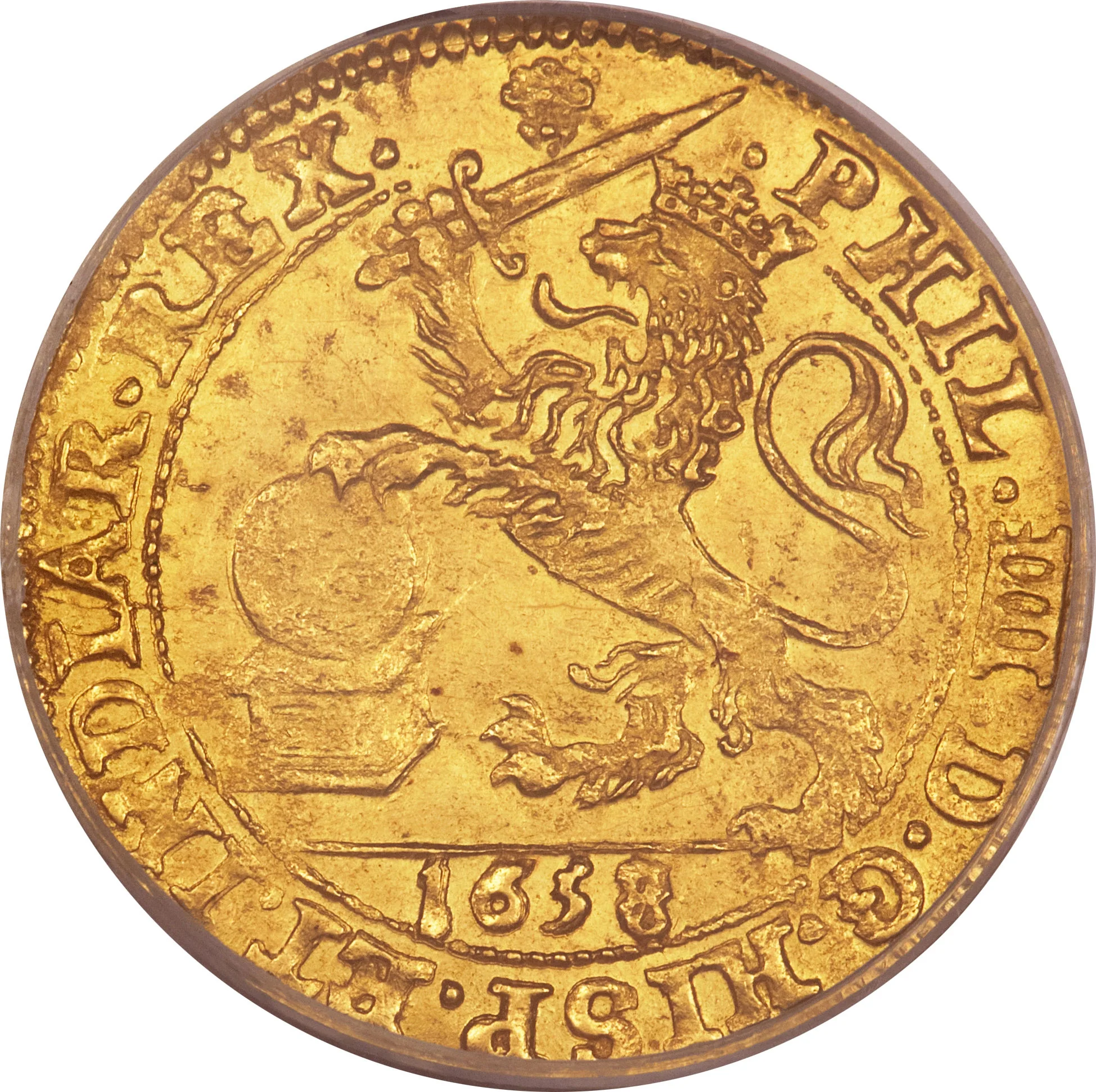
Lion left, rampant with sword and paw on globe. Date below, mint mark above.
Inscription:
· PHIL · III · D · G · HISP · ET · INDIAR · REX ·
Script: Latin
Reverse
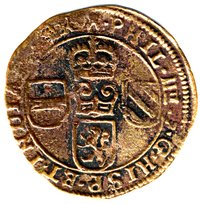
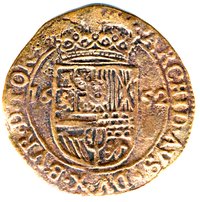
Description:
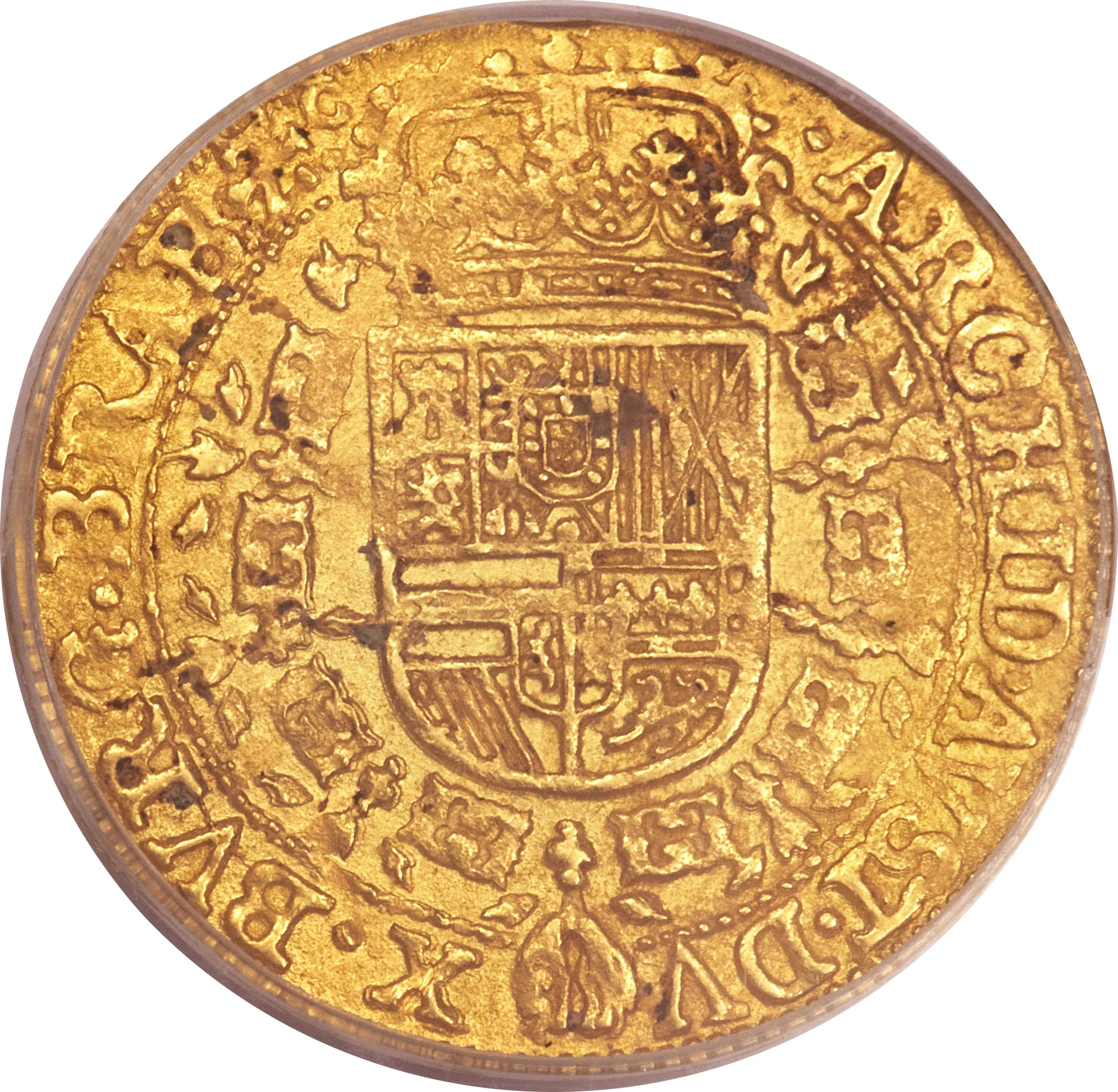
Shield crowned, encircled by the Golden Fleece.
Inscription:
·ARCHID·AVST·DVX·BVRG·BRAB·Zc
Script: Latin
Edge
Mints
| Name | Mark |
|---|---|
| Antwerp | Hand |
| Royal Mint of Belgium | Head |
Mintings
| Year | Mint Mark | Mintage | Quality | Collection |
|---|---|---|---|---|
| 1648 | — | — | ||
| 1649 | — | — | ||
| 1650 | — | — | ||
| 1651 | — | — | ||
| 1652 | — | — | ||
| 1652 | — | — | BU | |
| 1653 | — | — | BU | |
| 1653 | — | — | ||
| 1654 | — | — | ||
| 1655 | — | — | ||
| 1656 | — | — | ||
| 1657 | — | — | ||
| 1658 | — | — | ||
| 1659 | — | — | ||
| 1660 | — | — | ||
| 1661 | — | — | ||
| 1662 | — | — | ||
| 1663 | — | — | ||
| 1664 | — | — | ||
| 1665 | — | — |
Historical background
Following the 1648 Peace of Münster, which recognized Dutch independence and ended the Eighty Years' War, the Spanish Netherlands faced a complex and destabilized monetary situation. The region was severed from the robust financial systems of the Dutch Republic, particularly the Bank of Amsterdam, while remaining under the fiscal pressures of the Spanish Crown, which was frequently bankrupt from wider European conflicts. This created a vacuum filled by a chaotic circulation of hundreds of different coin types. These included not only official Spanish reales and provincial issues from Brabant or Flanders, but also a flood of foreign coins from neighboring states like France and the German principalities, as well as clipped, worn, and counterfeit pieces.
The core problem was a severe shortage of high-quality, full-weight specie. Following Gresham's Law, "bad money drives out good," as merchants and citizens hoarded newer, purer coins for their intrinsic metal value or for international trade, leaving the debased and worn coins in daily circulation. This led to chronic uncertainty in commerce, as the value of any transaction depended on constantly negotiating the actual metallic worth of the proffered coins. The lack of a uniform, trusted currency stifled economic recovery from the long war and hampered efficient taxation, further weakening the central authority of the governor in Brussels.
Local authorities attempted to address the crisis by issuing periodic placards (ordinances) that set official exchange rates for the myriad of coins, often attempting to overvalue Spanish currency to benefit the royal treasury. However, these decrees were largely ineffective and frequently ignored, as market rates based on bullion content always prevailed. The monetary fragmentation persisted as a symptom of the region's broader political and economic limbo—no longer part of a unified Netherlands economy and yet a strained, peripheral territory of a distant Spanish empire—and would only begin to find resolution under later Austrian rule in the 18th century.
The core problem was a severe shortage of high-quality, full-weight specie. Following Gresham's Law, "bad money drives out good," as merchants and citizens hoarded newer, purer coins for their intrinsic metal value or for international trade, leaving the debased and worn coins in daily circulation. This led to chronic uncertainty in commerce, as the value of any transaction depended on constantly negotiating the actual metallic worth of the proffered coins. The lack of a uniform, trusted currency stifled economic recovery from the long war and hampered efficient taxation, further weakening the central authority of the governor in Brussels.
Local authorities attempted to address the crisis by issuing periodic placards (ordinances) that set official exchange rates for the myriad of coins, often attempting to overvalue Spanish currency to benefit the royal treasury. However, these decrees were largely ineffective and frequently ignored, as market rates based on bullion content always prevailed. The monetary fragmentation persisted as a symptom of the region's broader political and economic limbo—no longer part of a unified Netherlands economy and yet a strained, peripheral territory of a distant Spanish empire—and would only begin to find resolution under later Austrian rule in the 18th century.
✨ Legendary