

2 Sovereigns – Spanish Netherlands
Netherlands
Context
Years: 1638–1657
Country: Netherlands 
Issuer: Spanish Netherlands
Ruler: Philip IV
Currency:
(1506—1713)
Demonetized: Yes
Material
Diameter: 36 mm
Weight: 11.08 g
Gold weight: 10.49 g
Shape: Irregular round
Composition: 94.7% Gold
Magnetic: No
Technique: Hammered
Alignment: Coin alignment
flip
References
KM: #Click to copy to clipboard55
Numista: #358770
Value
Bullion value: $1747.94
Obverse
Description:
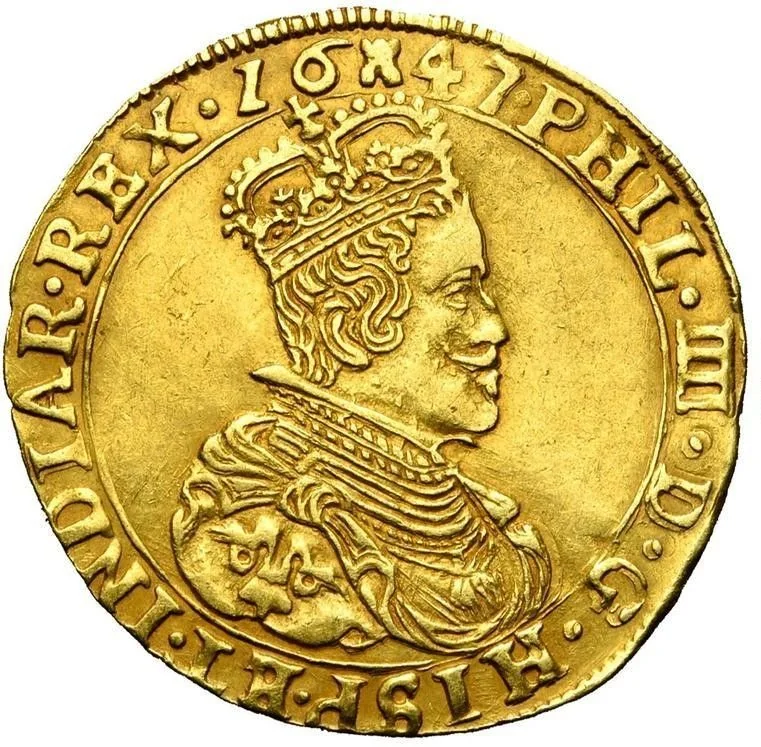
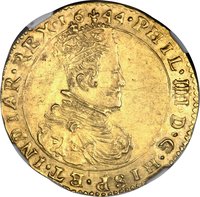
Philip IV, crowned bust right. Date above mint mark.
Inscription:
PHIL · IIII · D · G · HISP · ET · INDIAR · REX
Script: Latin
Reverse
Description:
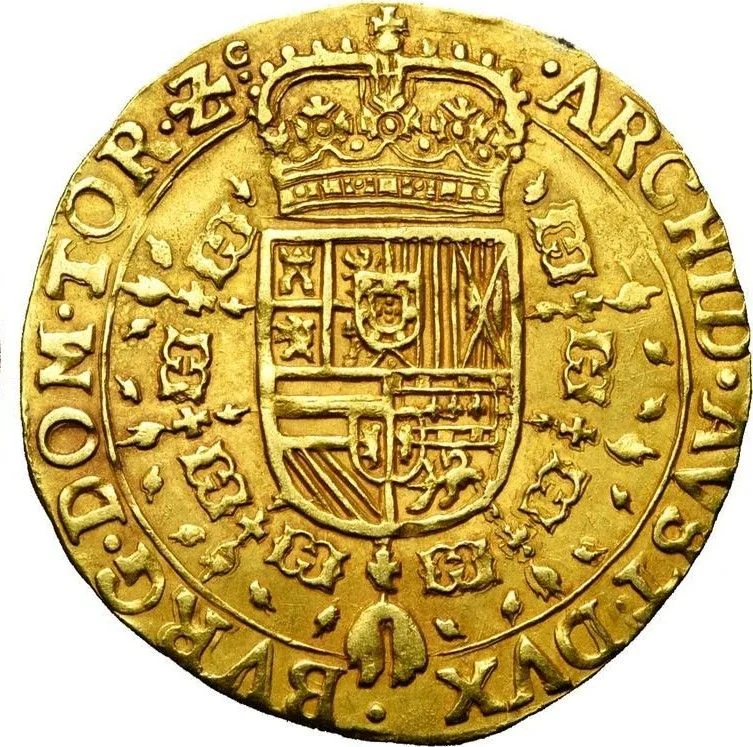
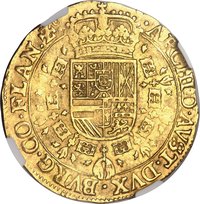
Shield crowned and encircled by the Golden Fleece.
Inscription:
ARCHID · AVST · DVX · BVRG · DOM · TOR · Zc
Script: Latin
Edge
Mints
| Name | Mark |
|---|---|
| Tournai | — |
Mintings
| Year | Mint Mark | Mintage | Quality | Collection |
|---|---|---|---|---|
| 1638 | — | — | ||
| 1639 | — | — | ||
| 1643 | — | — | ||
| 1644 | — | — | ||
| 1645 | — | — | ||
| 1646 | — | — | ||
| 1647 | — | — | ||
| 1650 | — | — | ||
| 1651 | — | — | ||
| 1657 | — | — |
Historical background
In 1638, the Spanish Netherlands was grappling with a severe and protracted monetary crisis, a direct consequence of the ongoing Eighty Years' War (1568-1648) against the Dutch Republic. The region's economy was strained by the immense costs of maintaining a large standing army, leading the Spanish Crown to repeatedly debase the coinage. By lowering the silver content in coins like the patagon and real, authorities sought to create more money from the same amount of bullion, but this eroded public trust and sparked rampant inflation. The circulation of these "light" coins alongside older, full-weight pieces and a multitude of foreign currencies created a chaotic and unstable monetary environment.
This situation was exacerbated by the aggressive economic policies of the Dutch Republic, which controlled the vital Scheldt River estuary, strangling the commerce of Antwerp. Furthermore, the Dutch minted vast quantities of inferior-quality coins, known as Lion Daalders and Rijksdaalders, and intentionally flooded the Spanish Netherlands with them. This practice, combined with the outflow of full-weight Spanish coins to pay for imports, led to Gresham's Law in action: "bad money drives out good." High-quality coins were hoarded or exported, leaving the populace to conduct daily business with a depreciating and unreliable currency, which crippled trade and sowed social discontent.
Recognizing the economic paralysis, the Habsburg authorities in Brussels made a significant attempt at reform in 1638. They introduced new, high-quality silver coins, such as the Albertin and the Philippusdaalder, in an effort to restore confidence and drive out the debased currency. However, this measure proved insufficient without addressing the root causes: the relentless fiscal demands of the war and the lack of control over monetary borders. The reform provided only temporary relief, and the underlying currency instability persisted, reflecting the broader struggle of the Spanish Habsburgs to maintain their embattled territories in the face of military and economic pressure.
This situation was exacerbated by the aggressive economic policies of the Dutch Republic, which controlled the vital Scheldt River estuary, strangling the commerce of Antwerp. Furthermore, the Dutch minted vast quantities of inferior-quality coins, known as Lion Daalders and Rijksdaalders, and intentionally flooded the Spanish Netherlands with them. This practice, combined with the outflow of full-weight Spanish coins to pay for imports, led to Gresham's Law in action: "bad money drives out good." High-quality coins were hoarded or exported, leaving the populace to conduct daily business with a depreciating and unreliable currency, which crippled trade and sowed social discontent.
Recognizing the economic paralysis, the Habsburg authorities in Brussels made a significant attempt at reform in 1638. They introduced new, high-quality silver coins, such as the Albertin and the Philippusdaalder, in an effort to restore confidence and drive out the debased currency. However, this measure proved insufficient without addressing the root causes: the relentless fiscal demands of the war and the lack of control over monetary borders. The reform provided only temporary relief, and the underlying currency instability persisted, reflecting the broader struggle of the Spanish Habsburgs to maintain their embattled territories in the face of military and economic pressure.
✨ Legendary