

7 kreuzers – Hungary
Add to wishlist
Hungary
Context
Years: 1754–1765
Issuer: Hungary
Ruler: Maria Theresa
Currency:
(1754—1857)
Demonetized: Yes
Total mintage: 3,438,000
Material
References
KM: #
Numista: #48212
Value
Bullion value: $8.30
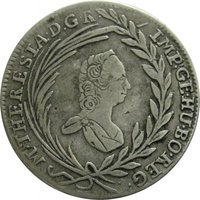
Obverse
Description:
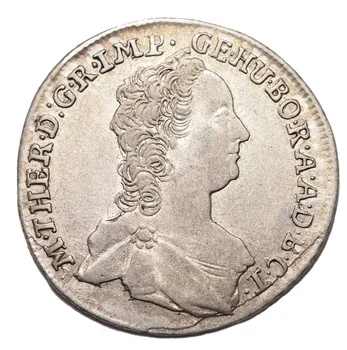
Small right-facing curly bust
Inscription:
M . THER . D : G . R . IMP . GE . HU . BO . R . A . A . D . B . C . T .
Script: Latin
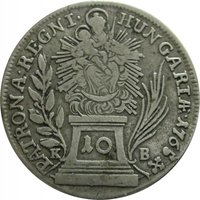
Reverse
Description:
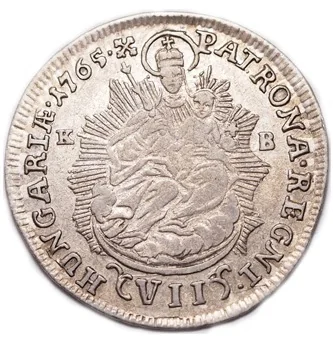
Madonna and child seated on crescent; value VII in cartouche below splits mintmark.
Inscription:
PATRONA·REGNI·HUNGARIÆ
(VII)
K B
(VII)
K B
Script: Latin
Edge
Plain
Mints
| Name | Mark |
|---|---|
| Kremnica | K B |
Mintings
| Year | Mint Mark | Mintage | Quality | Collection |
|---|---|---|---|---|
| 1754 | K | 22,000 | ||
| 1755 | K | 27,000 | ||
| 1757 | K | 38,000 | ||
| 1758 | K | 55,000 | ||
| 1759 | K | — | ||
| 1760 | K | 186,000 | ||
| 1763 | K | 523,000 | ||
| 1764 | K | 958,000 | ||
| 1765 | K | 1,629,000 |
Historical background
In 1754, the currency situation in the Kingdom of Hungary, then part of the Habsburg Monarchy, was characterized by a complex and unstable bimetallic system. The official currency was based on the Conventionsthaler (or Konventionsthaler), a large silver coin introduced across the Habsburg lands in 1753. This reform aimed to standardize the monetary system, setting a fixed silver-to-gold ratio. In practice, however, Hungary also widely used the Hungarian forint (gulden) and krajcár, with 1 forint = 60 krajcár, and 1 Conventionsthaler = 2 forints. The system was administratively cumbersome and struggled with the perennial early-modern problem of ensuring sufficient small-denomination coins for daily trade.
The monetary landscape was further complicated by the widespread circulation of older, debased coins and foreign currency, particularly from neighboring Ottoman and Polish territories. This created persistent confusion in exchange rates and hampered commerce. Furthermore, Hungary's economy was still largely agrarian, with significant regional disparities, meaning that the sophisticated imperial currency system often did not align neatly with local economic realities. The state's chronic need for revenue, especially to finance the monarchy's military engagements, created underlying pressure that threatened the stability of the new standard.
Ultimately, the 1754 situation represented a moment of attempted imperial consolidation rather than true stability. The Conventionsthaler standard was a top-down reform that had not yet fully permeated the Hungarian economy. While it provided a new official framework, the coexistence of old and new coins, along with external currencies, meant that monetary transactions remained a tangled affair. This instability would continue to challenge economic administration until more comprehensive reforms were enacted under Maria Theresa and her successors later in the century.
The monetary landscape was further complicated by the widespread circulation of older, debased coins and foreign currency, particularly from neighboring Ottoman and Polish territories. This created persistent confusion in exchange rates and hampered commerce. Furthermore, Hungary's economy was still largely agrarian, with significant regional disparities, meaning that the sophisticated imperial currency system often did not align neatly with local economic realities. The state's chronic need for revenue, especially to finance the monarchy's military engagements, created underlying pressure that threatened the stability of the new standard.
Ultimately, the 1754 situation represented a moment of attempted imperial consolidation rather than true stability. The Conventionsthaler standard was a top-down reform that had not yet fully permeated the Hungarian economy. While it provided a new official framework, the coexistence of old and new coins, along with external currencies, meant that monetary transactions remained a tangled affair. This instability would continue to challenge economic administration until more comprehensive reforms were enacted under Maria Theresa and her successors later in the century.
💎 Extremely Rare