

1 Kreuzer – Hungary
Hungary
Context
Years: 1753–1760
Issuer: Hungary 
Ruler: Maria Theresa
Currency:
(1526—1754)
Demonetized: Yes
Total mintage: 2,080,000
Material
References
KM: #Click to copy to clipboard363
Numista: #48192
Value
Bullion value: $2.24
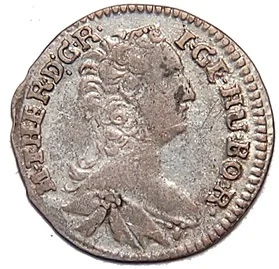
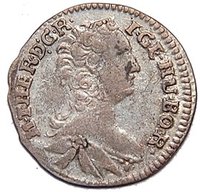
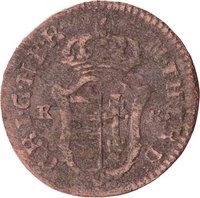
Obverse
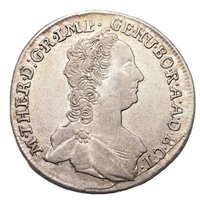
Description:
Mature bust facing right. Legend begins below.
Inscription:
M · THER · D · G · R · I · GE · HU BO · R ·
Script: Latin
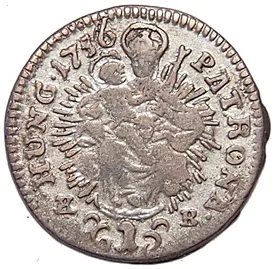
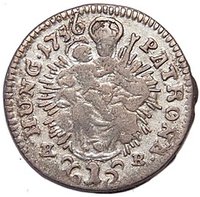
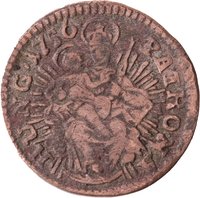
Reverse
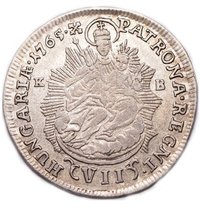
Description:
Madonna and Child, right arm. Value in frame.
Inscription:
PATRONA · HUNG · 1758
Script: Latin
Edge
Plain
Mints
| Name | Mark |
|---|---|
| Kremnica | K B |
Mintings
| Year | Mint Mark | Mintage | Quality | Collection |
|---|---|---|---|---|
| 1753 | K | — | ||
| 1756 | K | 1,084,000 | ||
| 1757 | K | 63,000 | ||
| 1758 | K | 455,000 | ||
| 1759 | K | 266,000 | ||
| 1760 | H | — | ||
| 1760 | K | 212,000 |
Historical background
In 1753, the currency situation in the Habsburg-ruled Kingdom of Hungary was defined by a complex and unstable monetary system, still grappling with the aftermath of the costly War of the Austrian Succession (1740-1748). The state treasury in Vienna, burdened by war debt, had resorted to the debasement of coinage—reducing the precious metal content—to generate revenue. This led to a circulation of coins, particularly the silver Conventionsthaler and its fractional Kreuzer denominations, with intrinsic value lower than their face value, causing inflation and undermining public trust in the currency.
The monetary landscape was further complicated by the simultaneous circulation of older, higher-quality coins alongside the new, debased issues. This created a classic case of Gresham's Law, where "bad money drives out good," as people hoarded the older, purer coins and used the newer, inferior ones for daily transactions. Furthermore, a variety of other currencies, including Turkish ducats and coins from neighboring German states, circulated freely, adding to the confusion and hindering domestic trade and tax collection.
In response to this disorder, Empress Maria Theresa's government was in the early stages of implementing monetary reforms centered on the Conventionsthaler standard, established across the Habsburg monarchy in 1753. The aim was to standardize coinage and stabilize the currency, but the process was gradual. Thus, in 1753, Hungary found itself in a transitional period, caught between the lingering instability of wartime finance and the nascent, centralized efforts to impose order and credibility on the monetary system from Vienna.
The monetary landscape was further complicated by the simultaneous circulation of older, higher-quality coins alongside the new, debased issues. This created a classic case of Gresham's Law, where "bad money drives out good," as people hoarded the older, purer coins and used the newer, inferior ones for daily transactions. Furthermore, a variety of other currencies, including Turkish ducats and coins from neighboring German states, circulated freely, adding to the confusion and hindering domestic trade and tax collection.
In response to this disorder, Empress Maria Theresa's government was in the early stages of implementing monetary reforms centered on the Conventionsthaler standard, established across the Habsburg monarchy in 1753. The aim was to standardize coinage and stabilize the currency, but the process was gradual. Thus, in 1753, Hungary found itself in a transitional period, caught between the lingering instability of wartime finance and the nascent, centralized efforts to impose order and credibility on the monetary system from Vienna.
💎 Extremely Rare