

3 Kreuzer – Hungary
Hungary
Context

Material
References
KM: #Click to copy to clipboard393
Numista: #48205
Value
Bullion value: $4.74
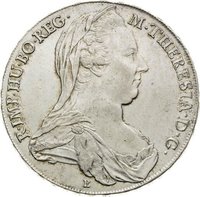
Obverse
Description:
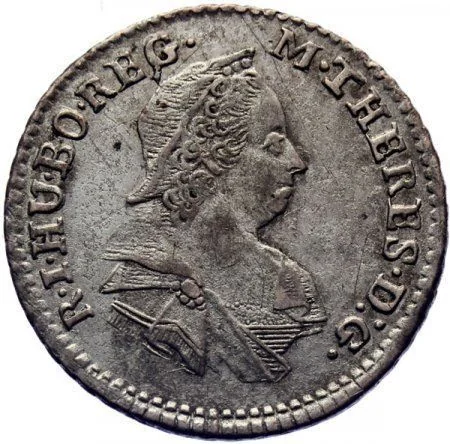
Older right-facing bust, plain veil. Legend begins at top.
Inscription:
M · THERES · D · G · R · I · HU · BO · REG ·
Script: Latin
Reverse
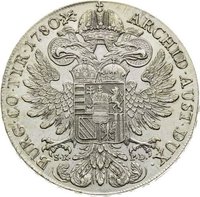
Description:
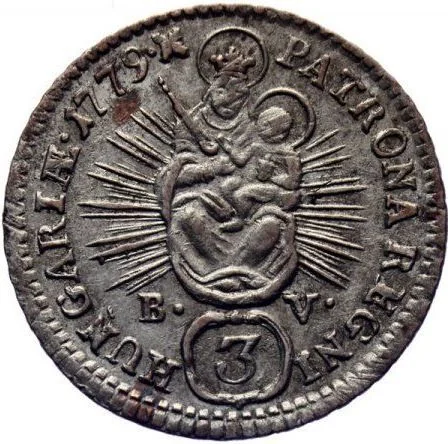
Madonna and child seated on crescent; no inner circle. Mint master's mark and value (3) in cartouche below.
Inscription:
PATRONA · REGNI · HUNGARIÆ · 1779 · X
Script: Latin
Edge
Plain
Mints
| Name | Mark |
|---|---|
| Baia Mare | — |
Mintings
| Year | Mint Mark | Mintage | Quality | Collection |
|---|---|---|---|---|
| 1779 | B. | — | ||
| 1779 | I.B. | — |
Historical background
In 1779, the currency situation in the Habsburg Monarchy, including Hungary, was defined by the aftermath of the costly Seven Years' War (1756-1763) and the ongoing financial reforms of Empress Maria Theresa. The state treasury was deeply depleted, leading to a chronic shortage of specie (gold and silver coin). To finance state expenditures, the court in Vienna had increasingly resorted to issuing paper money, known as Bancozettel, from the state-owned Vienna City Bank. While not legal tender in the traditional sense, these notes were used for state payments and began circulating widely, creating a de facto paper currency alongside a strained metallic coinage system.
Within Hungary, this created a complex monetary environment. The kingdom still operated under its own traditional monetary system, with the silver forint (florin) as the key unit of account. However, the actual circulation consisted of a confusing mix of domestic and foreign silver and gold coins, alongside the increasingly prevalent Vienna paper notes. A significant problem was the discrepancy between the official face value of the Bancozettel and their market value in silver, as public trust in the paper money fluctuated. This led to agio (premium) payments, where transactions often required an additional sum if settled in paper rather than coveted specie.
Empress Maria Theresa and her advisors, notably Chancellor Kaunitz, were actively working to stabilize this situation. The years leading up to 1779 saw efforts to centralize financial administration and control the money supply. A pivotal reform was the Currency Patent of 1762, which officially recognized the Bancozettel for certain payments and attempted to fix their exchange rate, laying the groundwork for a state-managed fiduciary currency. Therefore, by 1779, Hungary was in a transitional period, caught between its historic metallic standards and the early modern state's necessary but precarious experiment with paper finance, all under the centralizing pressure from Vienna to manage the monarchy's collective debt.
Within Hungary, this created a complex monetary environment. The kingdom still operated under its own traditional monetary system, with the silver forint (florin) as the key unit of account. However, the actual circulation consisted of a confusing mix of domestic and foreign silver and gold coins, alongside the increasingly prevalent Vienna paper notes. A significant problem was the discrepancy between the official face value of the Bancozettel and their market value in silver, as public trust in the paper money fluctuated. This led to agio (premium) payments, where transactions often required an additional sum if settled in paper rather than coveted specie.
Empress Maria Theresa and her advisors, notably Chancellor Kaunitz, were actively working to stabilize this situation. The years leading up to 1779 saw efforts to centralize financial administration and control the money supply. A pivotal reform was the Currency Patent of 1762, which officially recognized the Bancozettel for certain payments and attempted to fix their exchange rate, laying the groundwork for a state-managed fiduciary currency. Therefore, by 1779, Hungary was in a transitional period, caught between its historic metallic standards and the early modern state's necessary but precarious experiment with paper finance, all under the centralizing pressure from Vienna to manage the monarchy's collective debt.
✨ Legendary