

1 Kreuzer – Hungary
Hungary

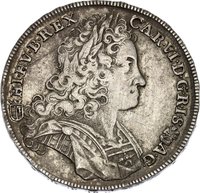
Obverse
Description:
Laureate bust right, breaking legend. Denomination (1) at shoulder. No inner circle.
Inscription:
CAR · VI · D · G · R · I · S · A · G · H · (1) HV · B · REX ·
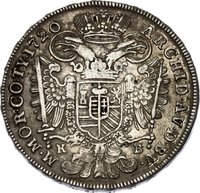
Reverse
Description:
Crowned Madonna in mandorla on a crescent, holding child and scepter, breaking inner pearl circle. Double-crowned Hungarian shield below. Mintmark N B divided, date divided by crown.
Inscription:
PATRONA · HVNGARIÆ · 17 16
Edge
Plain
Mintings
| Year | Mint Mark | Mintage | Quality | Collection |
|---|---|---|---|---|
| 1721 | — | — | ||
| 1724 | — | — |
Historical background
In 1721, the currency situation in the Kingdom of Hungary, then part of the Habsburg Monarchy, was characterized by profound instability and debasement, a direct legacy of the Rákóczi War of Independence (1703-1711). The prolonged conflict had devastated the economy and led to the rampant minting of depreciated coins, particularly the so-called kriegsgeld (war money), to finance military expenditures. By the war's end, the currency system was in chaos, with a severe lack of high-value, full-weight coins in circulation and public trust in the monetary system severely eroded.
The Habsburg government in Vienna, seeking to consolidate control and stabilize the realm's finances, initiated a sweeping currency reform. This process, which was ongoing in 1721, involved the recall and reminting of the debased copper and silver coins into new, standardized issues according to the official Conventionsmünze standard used across the Habsburg lands. The aim was to unify the monetary system, restore the intrinsic value of coinage, and facilitate tax collection and trade. However, this recoinage was a complex and gradual process, meaning that in 1721, old, lightweight coins still circulated alongside the new, creating confusion and multiple exchange rates.
Consequently, the everyday economic reality for Hungarians in 1721 was one of hardship and uncertainty. The withdrawal of old coinage often occurred at unfavourable rates, effectively functioning as a hidden tax that burdened the population, particularly the peasantry and smaller merchants. While the reform laid the necessary groundwork for long-term stability, its immediate effect was a contraction in the money supply and sluggish economic activity, as the kingdom struggled to recover from war under a monetary system in deliberate, but painful, transition.
The Habsburg government in Vienna, seeking to consolidate control and stabilize the realm's finances, initiated a sweeping currency reform. This process, which was ongoing in 1721, involved the recall and reminting of the debased copper and silver coins into new, standardized issues according to the official Conventionsmünze standard used across the Habsburg lands. The aim was to unify the monetary system, restore the intrinsic value of coinage, and facilitate tax collection and trade. However, this recoinage was a complex and gradual process, meaning that in 1721, old, lightweight coins still circulated alongside the new, creating confusion and multiple exchange rates.
Consequently, the everyday economic reality for Hungarians in 1721 was one of hardship and uncertainty. The withdrawal of old coinage often occurred at unfavourable rates, effectively functioning as a hidden tax that burdened the population, particularly the peasantry and smaller merchants. While the reform laid the necessary groundwork for long-term stability, its immediate effect was a contraction in the money supply and sluggish economic activity, as the kingdom struggled to recover from war under a monetary system in deliberate, but painful, transition.

✨ Legendary