

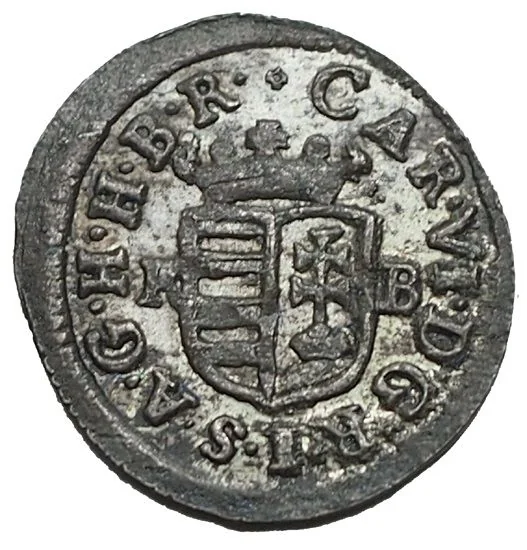

Obverse
Description:
KB mintmark divides crowned Hungarian arms, breaking inscription. No inner circle.
Inscription:
CAR · VI · D · G · R · I · S · A · G · H · H · B · R·
Script: Latin
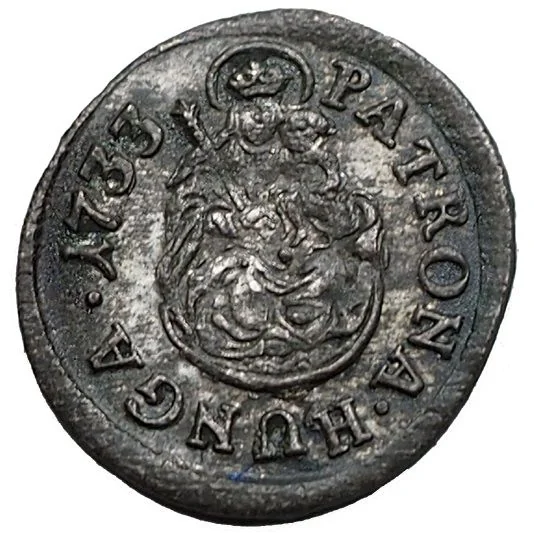
Reverse
Description:
Crowned Madonna holding child on left arm and scepter in right, with surrounding inscription. No pearl circle.
Inscription:
PATRONA · HVNGA · 1733
Script: Latin
Edge
Plain
Mints
| Name | Mark |
|---|---|
| Kremnica | KB |
Mintings
| Year | Mint Mark | Mintage | Quality | Collection |
|---|---|---|---|---|
| 1733 | K | — | ||
| 1734 | — | — | ||
| 1734 | KB | — |
Historical background
In 1733, the currency situation in the Kingdom of Hungary, then part of the Habsburg Monarchy, was characterized by significant instability and debasement. This was a direct consequence of the costly wars fought by the Habsburgs, particularly the War of the Spanish Succession (1701-1714) and the ongoing War of the Polish Succession (1733-1735). To finance these military campaigns, the state resorted to minting coins with a reduced precious metal content, especially the small-denomination krajcár (kreuzer), which was essential for everyday transactions. This practice led to a severe loss of public trust, as the intrinsic value of coins fell far below their face value, causing price inflation and economic hardship for the common population.
The monetary chaos was exacerbated by the circulation of a wide variety of coins from different regions and eras. Alongside the debased domestic currency, older, full-value silver thalers (like the Löwenthaler) and foreign coins remained in use, creating a complex and inefficient multi-currency system. People hoarded older, purer coins, following Gresham's Law where "bad money drives out good," which further strained the economy. This environment also fostered widespread counterfeiting, adding to the confusion and devaluation.
While the Habsburg court in Vienna was aware of the problems, comprehensive reform was slow. The period was one of transition leading towards more systematic changes later in the 1730s under Empress Maria Theresa, who would eventually implement standardized coinage. Therefore, in 1733, Hungary's currency system remained in a troubled state, defined by inflationary pressure, a loss of confidence in small change, and the financial strains of imperial warfare, all of which burdened the kingdom's economy and its people.
The monetary chaos was exacerbated by the circulation of a wide variety of coins from different regions and eras. Alongside the debased domestic currency, older, full-value silver thalers (like the Löwenthaler) and foreign coins remained in use, creating a complex and inefficient multi-currency system. People hoarded older, purer coins, following Gresham's Law where "bad money drives out good," which further strained the economy. This environment also fostered widespread counterfeiting, adding to the confusion and devaluation.
While the Habsburg court in Vienna was aware of the problems, comprehensive reform was slow. The period was one of transition leading towards more systematic changes later in the 1730s under Empress Maria Theresa, who would eventually implement standardized coinage. Therefore, in 1733, Hungary's currency system remained in a troubled state, defined by inflationary pressure, a loss of confidence in small change, and the financial strains of imperial warfare, all of which burdened the kingdom's economy and its people.

💎 Extremely Rare