

4 reales – Peru
Add to wishlist
Peru
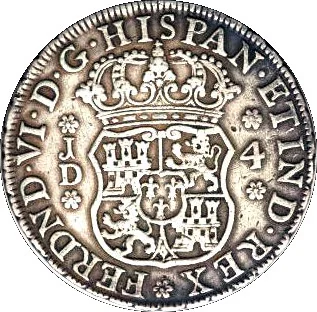
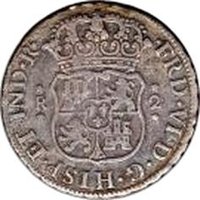
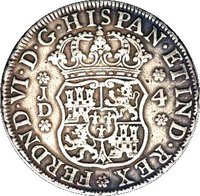
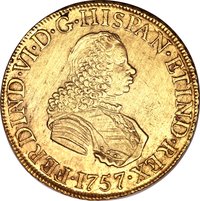
Obverse
Description:
Peru's crowned coat of arms.
Inscription:
FERDND • VI • D • G • HISPAN • ETIND • REX
Script: Latin
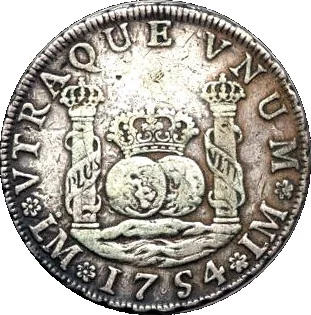
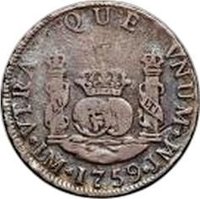
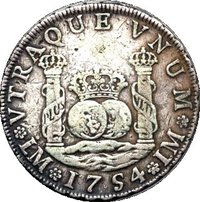
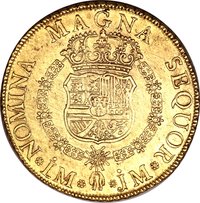
Reverse
Description:
Crowned pillars and globes flanking a date.
Inscription:
VTRAQUE VNUM
LIMA 1753 IM
LIMA 1753 IM
Script: Latin
Edge
Mints
| Name | Mark |
|---|---|
| Lima | (LIMA) |
Mintings
| Year | Mint Mark | Mintage | Quality | Collection |
|---|---|---|---|---|
| 1752 | LIMA | — | ||
| 1753 | LIMA | — | ||
| 1754 | LIMA | — | ||
| 1755 | LIMA | — | ||
| 1756 | LIMA | — | ||
| 1757 | LIMA | — | ||
| 1758 | LIMA | — | ||
| 1759 | LIMA | — | ||
| 1760 | LIMA | — |
Historical background
In 1752, the currency situation in the Kingdom of Peru, a vast Spanish viceroyalty encompassing much of South America, was defined by a severe and chronic shortage of official coinage. The economy relied heavily on the legendary silver from mines like Potosí (in present-day Bolivia), which was minted into pesos at royal mints in Lima, Potosí, and later Santiago. However, a significant portion of this silver was legally shipped to Spain as royal revenue or was smuggled out through contraband, leaving the local economy starved of circulating medium. This scarcity was exacerbated by the Spanish Crown's mercantilist policies that restricted trade and hindered the inflow of coins from other regions.
To facilitate everyday transactions, people across the viceroyalty resorted to a chaotic system of substitutes and credit. In major cities like Lima, merchants and traders used libranzas (bills of exchange) and relied on extensive personal credit networks. In more remote areas, particularly in the highlands, barter remained common, and even coca leaves sometimes served as a de facto commodity currency. The most widespread unofficial solution, however, was the use of moneda macuquina – crudely cut and irregular silver coins that were often clipped or debased. While officially frowned upon, this "cob" coinage was tolerated out of necessity, circulating alongside the more uniform "milled" coins produced by the mints after 1751.
The year 1752 fell within a period of attempted reform. The new Bourbon monarchs in Spain were seeking to centralize control and modernize the empire's finances. Just a year prior, in 1751, the Potosí mint had introduced more advanced machinery to produce uniform, milled-edge coins (known as columnarios or "pillar dollars") to combat fraud. However, the benefits of this technological upgrade were not yet fully realized across the vast territory in 1752. The fundamental structural issues—silver outflow, mercantilist restrictions, and the sheer geographic scale of the viceroyalty—meant that the currency shortage persisted, creating an economy divided between a formal, coin-based system and a pervasive informal one reliant on credit and crude silver.
To facilitate everyday transactions, people across the viceroyalty resorted to a chaotic system of substitutes and credit. In major cities like Lima, merchants and traders used libranzas (bills of exchange) and relied on extensive personal credit networks. In more remote areas, particularly in the highlands, barter remained common, and even coca leaves sometimes served as a de facto commodity currency. The most widespread unofficial solution, however, was the use of moneda macuquina – crudely cut and irregular silver coins that were often clipped or debased. While officially frowned upon, this "cob" coinage was tolerated out of necessity, circulating alongside the more uniform "milled" coins produced by the mints after 1751.
The year 1752 fell within a period of attempted reform. The new Bourbon monarchs in Spain were seeking to centralize control and modernize the empire's finances. Just a year prior, in 1751, the Potosí mint had introduced more advanced machinery to produce uniform, milled-edge coins (known as columnarios or "pillar dollars") to combat fraud. However, the benefits of this technological upgrade were not yet fully realized across the vast territory in 1752. The fundamental structural issues—silver outflow, mercantilist restrictions, and the sheer geographic scale of the viceroyalty—meant that the currency shortage persisted, creating an economy divided between a formal, coin-based system and a pervasive informal one reliant on credit and crude silver.
✨ Legendary