

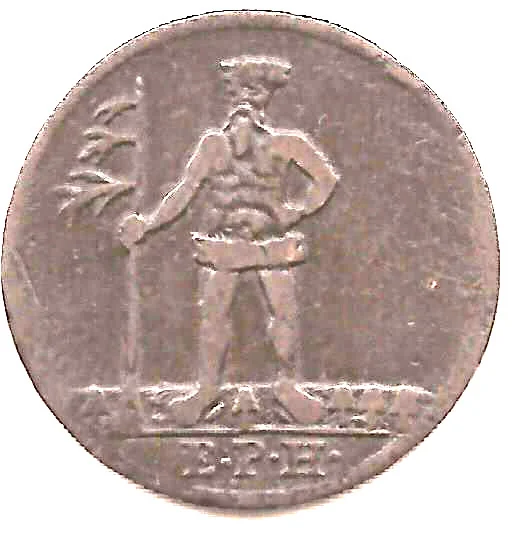
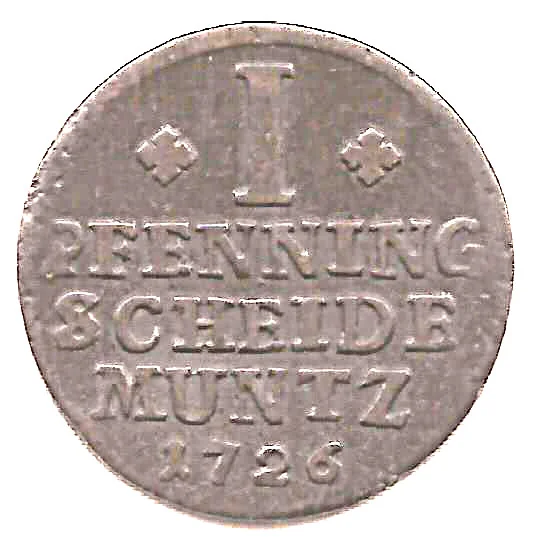
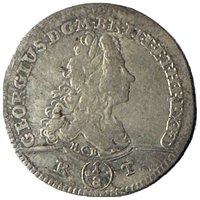
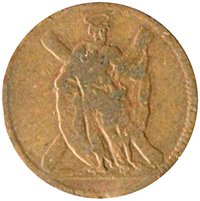
Obverse
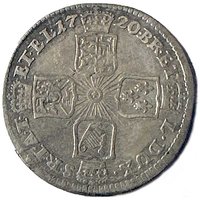
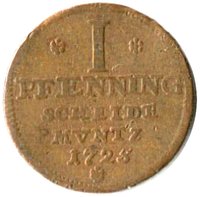
Reverse
Edge
Plain
Mints
| Name | Mark |
|---|---|
| Zellerfeld | — |
Mintings
| Year | Mint Mark | Mintage | Quality | Collection |
|---|---|---|---|---|
| 1724 | — | — | ||
| 1725 | — | — | ||
| 1726 | — | — |
Historical background
In 1724, the currency situation in the Duchy of Brunswick-Lüneburg, specifically the Principality of Calenberg (with its capital in Hanover), was characterized by significant complexity and instability. The Holy Roman Empire was a mosaic of over 300 states, each with the right to mint coinage, leading to a chaotic system where numerous foreign and domestic coins circulated simultaneously. Within Calenberg-Hannover, this meant a proliferation of Reichsthalers, Gute Groschen, Mariengroschen, and smaller Pfennig coins, alongside currencies from neighboring states like Brunswick-Wolfenbüttel and electoral Brandenburg. The intrinsic value of these coins, based on their silver content, often differed from their official face value, creating ripe conditions for arbitrage and economic distortion.
This monetary fragmentation was actively addressed by the ruling prince, George Louis, who had become King of Great Britain in 1714. His administration, led by ministers in Hanover, recognized that a unreliable currency hampered trade, tax collection, and state finance. Consequently, the early 1720s saw concerted efforts to reform and standardize the coinage. A key step was the attempted enforcement of the Reichsmünzfuß (Imperial minting standard) of 1736, which aimed to standardize the silver content of the Reichsthaler. While full implementation was a prolonged struggle, the year 1724 falls within a period of active state intervention to curb debasement, control minting, and move toward a more uniform and trustworthy monetary system within their territories.
The situation was further influenced by Hanover's personal union with Great Britain. While the British subsidy to Hanover was reduced after 1720, the connection integrated the principality into broader European finance and trade networks. This exposed the local economy to larger monetary flows and likely increased the pressure to establish a stable currency to facilitate commerce and credit. Thus, in 1724, the currency landscape was one in transition—caught between the legacy of imperial disarray and the concerted, though challenging, efforts of the Hanoverian state to impose order, stability, and uniformity for the sake of economic and fiscal strength.
This monetary fragmentation was actively addressed by the ruling prince, George Louis, who had become King of Great Britain in 1714. His administration, led by ministers in Hanover, recognized that a unreliable currency hampered trade, tax collection, and state finance. Consequently, the early 1720s saw concerted efforts to reform and standardize the coinage. A key step was the attempted enforcement of the Reichsmünzfuß (Imperial minting standard) of 1736, which aimed to standardize the silver content of the Reichsthaler. While full implementation was a prolonged struggle, the year 1724 falls within a period of active state intervention to curb debasement, control minting, and move toward a more uniform and trustworthy monetary system within their territories.
The situation was further influenced by Hanover's personal union with Great Britain. While the British subsidy to Hanover was reduced after 1720, the connection integrated the principality into broader European finance and trade networks. This exposed the local economy to larger monetary flows and likely increased the pressure to establish a stable currency to facilitate commerce and credit. Thus, in 1724, the currency landscape was one in transition—caught between the legacy of imperial disarray and the concerted, though challenging, efforts of the Hanoverian state to impose order, stability, and uniformity for the sake of economic and fiscal strength.
💎 Extremely Rare