

Obverse
Description:
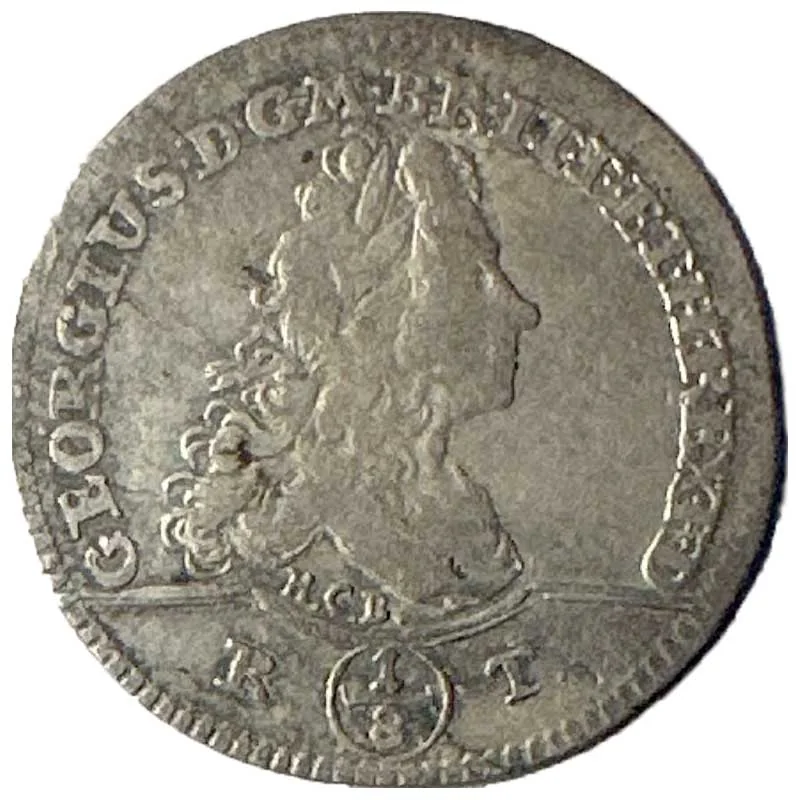
Duke George I facing right, laureate and draped, with denomination below and legend around.
Inscription:
GEORGIUS.D.G.M.BRIT.F.ET.H.REX.F.D
H.C.B.
R 1/8 T.
H.C.B.
R 1/8 T.
Script: Latin
Reverse
Description:
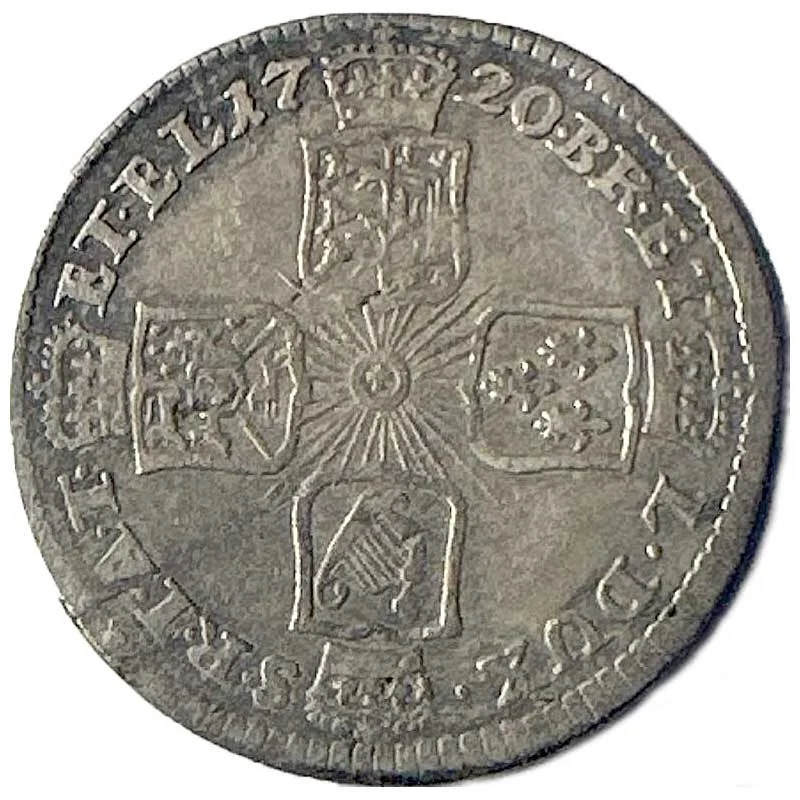
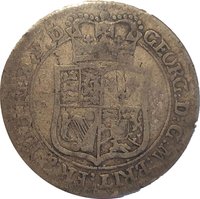
Crowned cruciform shields around a central Garter star; date above, legend around.
Inscription:
S.R.I.A.T. ET.EL.17 20.BR.ET L.DUX.
Script: Latin
Edge
Plain
Mints
| Name | Mark |
|---|---|
| Zellerfeld | — |
Mintings
| Year | Mint Mark | Mintage | Quality | Collection |
|---|---|---|---|---|
| 1720 | — | — |
Historical background
In 1720, the currency situation in the Duchy of Brunswick-Lüneburg, specifically the Principality of Calenberg (with its capital in Hanover), was one of profound instability and complexity, a direct legacy of the Great Northern War (1700-1721). The war had drained state coffers, leading the Hanoverian government, under Elector George Louis (who had also become King of Great Britain in 1714), to finance conflict largely through the debasement of coinage. This resulted in a proliferation of inferior, low-weight coins circulating alongside older, full-value Reichsthaler, creating a chaotic monetary environment where the intrinsic metal value of a coin often differed drastically from its face value.
The core of the problem was the widespread circulation of the Klippe, a debased silver coin minted in large quantities from 1700 onward. By 1720, these coins had severely depreciated, causing inflation, hampering trade, and creating public mistrust. The situation was exacerbated by the presence of various other currencies from neighboring German states and the use of accounting units like the Reichsthaler and Gute Groschen, which complicated all financial transactions. This "monetary confusion" (Münzverwirrung) placed a significant burden on the local economy and the populace.
Recognizing the crisis, the Hanoverian government was actively moving toward a major monetary reform, which would culminate in the landmark Münzordnung (Coinage Ordinance) of 1724. Therefore, the year 1720 represents a pivotal point of acute distress just prior to decisive action. The state was laying the groundwork to recall the debased coins, re-establish a stable silver standard based on the Reichsthaler, and restore confidence, a necessary step for a principality whose ruler now sat on the British throne and required a solvent and orderly fiscal base.
The core of the problem was the widespread circulation of the Klippe, a debased silver coin minted in large quantities from 1700 onward. By 1720, these coins had severely depreciated, causing inflation, hampering trade, and creating public mistrust. The situation was exacerbated by the presence of various other currencies from neighboring German states and the use of accounting units like the Reichsthaler and Gute Groschen, which complicated all financial transactions. This "monetary confusion" (Münzverwirrung) placed a significant burden on the local economy and the populace.
Recognizing the crisis, the Hanoverian government was actively moving toward a major monetary reform, which would culminate in the landmark Münzordnung (Coinage Ordinance) of 1724. Therefore, the year 1720 represents a pivotal point of acute distress just prior to decisive action. The state was laying the groundwork to recall the debased coins, re-establish a stable silver standard based on the Reichsthaler, and restore confidence, a necessary step for a principality whose ruler now sat on the British throne and required a solvent and orderly fiscal base.
✨ Legendary