

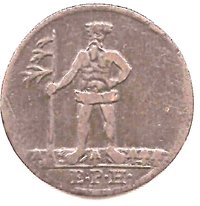
Obverse
Description:
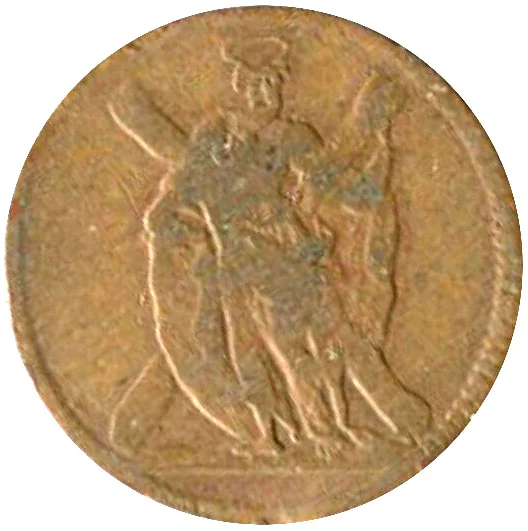
St. Andrew holding his cross.
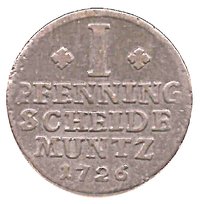
Reverse
Description:
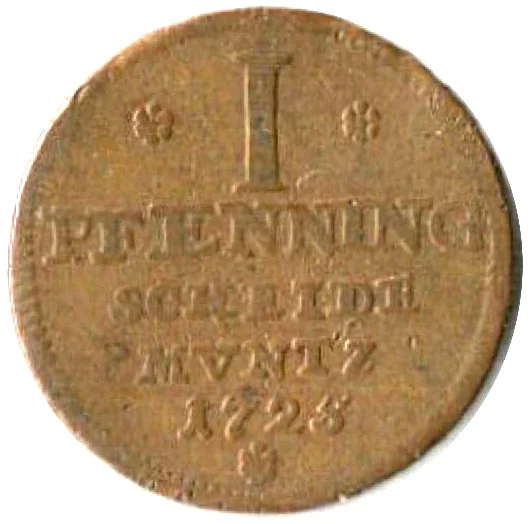
Denomination and date in five lines.
Inscription:
*I*
PFENNING
SCHEIDE
MVNTZ
1725
*
PFENNING
SCHEIDE
MVNTZ
1725
*
Script: Latin
Edge
Plain
Mintings
| Year | Mint Mark | Mintage | Quality | Collection |
|---|---|---|---|---|
| 1725 | — | — | ||
| 1726 | — | — |
Historical background
In 1725, the currency situation in the Duchy of Brunswick-Lüneburg, specifically the Principality of Calenberg (with its capital in Hanover), was complex and challenging, reflecting the fragmented political landscape of the Holy Roman Empire. The territory operated within a multi-layered monetary system. While it issued its own silver Thaler coins, it also remained part of the northern German Reichsthaler zone, a theoretical imperial standard, and concurrently used Gute Groschen for smaller, everyday transactions. This created a constant tension between local minting rights and the broader, often unstable, imperial monetary framework.
The period was marked by significant currency debasement and instability. Following the expensive wars of the late 17th and early 18th centuries, many German states, including Hanover, had resorted to reducing the silver content in their coinage to fund state expenditures. This led to a proliferation of inferior coins and a loss of public trust. Furthermore, the territory was flooded with foreign and often debased coins from neighboring states, a common problem given the hundreds of active mints within the Empire, which complicated trade and devalued sound local currency.
Recognizing the economic damage, the Hanoverian authorities under the Elector George I (who was also King of Great Britain) were engaged in ongoing efforts to restore monetary order. These efforts focused on controlling the minting process, attempting to regulate the circulation of foreign coin, and striving to align the Hanoverian Thaler with reliable trade coins like the Reichsthaler. This struggle for monetary stability was a key administrative concern, aiming to secure state revenue, facilitate commerce, and strengthen the principality's economic foundation in an era of competitive state-building.
The period was marked by significant currency debasement and instability. Following the expensive wars of the late 17th and early 18th centuries, many German states, including Hanover, had resorted to reducing the silver content in their coinage to fund state expenditures. This led to a proliferation of inferior coins and a loss of public trust. Furthermore, the territory was flooded with foreign and often debased coins from neighboring states, a common problem given the hundreds of active mints within the Empire, which complicated trade and devalued sound local currency.
Recognizing the economic damage, the Hanoverian authorities under the Elector George I (who was also King of Great Britain) were engaged in ongoing efforts to restore monetary order. These efforts focused on controlling the minting process, attempting to regulate the circulation of foreign coin, and striving to align the Hanoverian Thaler with reliable trade coins like the Reichsthaler. This struggle for monetary stability was a key administrative concern, aiming to secure state revenue, facilitate commerce, and strengthen the principality's economic foundation in an era of competitive state-building.

💎 Extremely Rare