

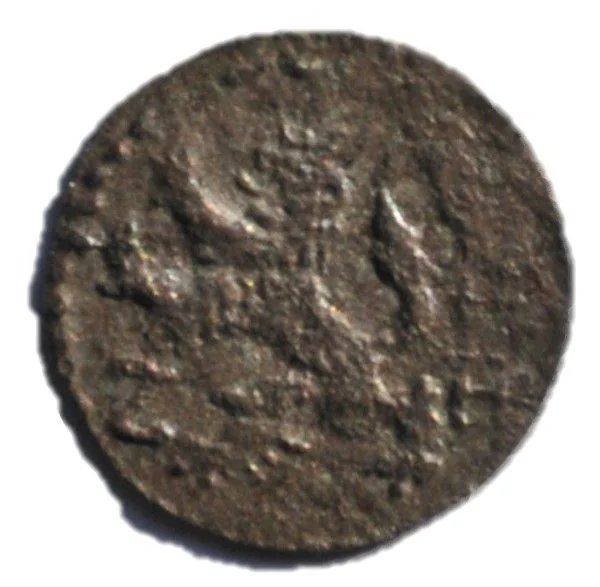
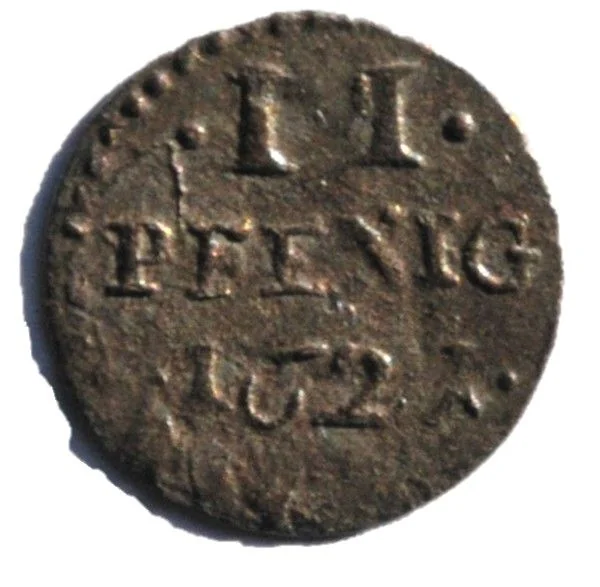
2 Pfennigs – Landgraviate of Hesse-Darmstadt
Context
Years: 1621–1622
Issuer: Landgraviate of Hesse-Darmstadt
Ruler: Louis V
Currency:
(1568—1805)
Demonetized: Yes
Material
References
KM: #Click to copy to clipboard15
Numista: #471335
Value
Bullion value: $0.78
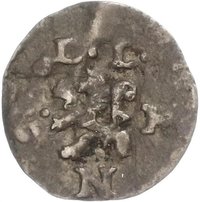
Obverse
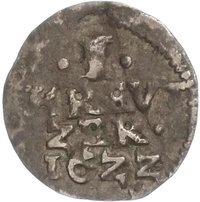
Reverse
Edge
Mints
| Name | Mark |
|---|---|
| Darmstadt | — |
Mintings
| Year | Mint Mark | Mintage | Quality | Collection |
|---|---|---|---|---|
| 1621 | — | — | ||
| 1622 | — | — |
Historical background
In 1621, the Landgraviate of Hesse-Darmstadt, like much of the Holy Roman Empire, was in the throes of a severe monetary crisis known as the Kipper- und Wipperzeit. This period, triggered by the outbreak of the Thirty Years' War in 1618, was characterized by the widespread debasement of coinage. Territorial rulers, facing immense war expenses and a shortage of precious metals, began minting coins with reduced silver content while maintaining their face value, a practice that generated short-term profit but eroded public trust and economic stability.
Landgrave Ludwig V of Hesse-Darmstadt, though generally a prudent ruler, was not immune to these pressures. The need to finance defense, fortifications, and the maintenance of troops forced his mint to participate in the debasement to some degree. The resulting flood of poor-quality coins from Hesse-Darmstadt and neighboring states led to rampant inflation, as merchants and the public quickly hoarded older, full-value coins (good money) and passed on the new, debased ones (bad money), following Gresham's Law.
The consequences for Hesse-Darmstadt's economy and populace were dire. Prices for essential goods soared, causing significant hardship for ordinary citizens and disrupting trade. While imperial ordinances attempted to halt the debasement, effective enforcement was nearly impossible. Thus, in 1621, Hesse-Darmstadt was caught in a destructive cycle of currency manipulation, where the fiscal demands of war directly undermined its monetary integrity and the welfare of its subjects.
Landgrave Ludwig V of Hesse-Darmstadt, though generally a prudent ruler, was not immune to these pressures. The need to finance defense, fortifications, and the maintenance of troops forced his mint to participate in the debasement to some degree. The resulting flood of poor-quality coins from Hesse-Darmstadt and neighboring states led to rampant inflation, as merchants and the public quickly hoarded older, full-value coins (good money) and passed on the new, debased ones (bad money), following Gresham's Law.
The consequences for Hesse-Darmstadt's economy and populace were dire. Prices for essential goods soared, causing significant hardship for ordinary citizens and disrupting trade. While imperial ordinances attempted to halt the debasement, effective enforcement was nearly impossible. Thus, in 1621, Hesse-Darmstadt was caught in a destructive cycle of currency manipulation, where the fiscal demands of war directly undermined its monetary integrity and the welfare of its subjects.
✨ Legendary