

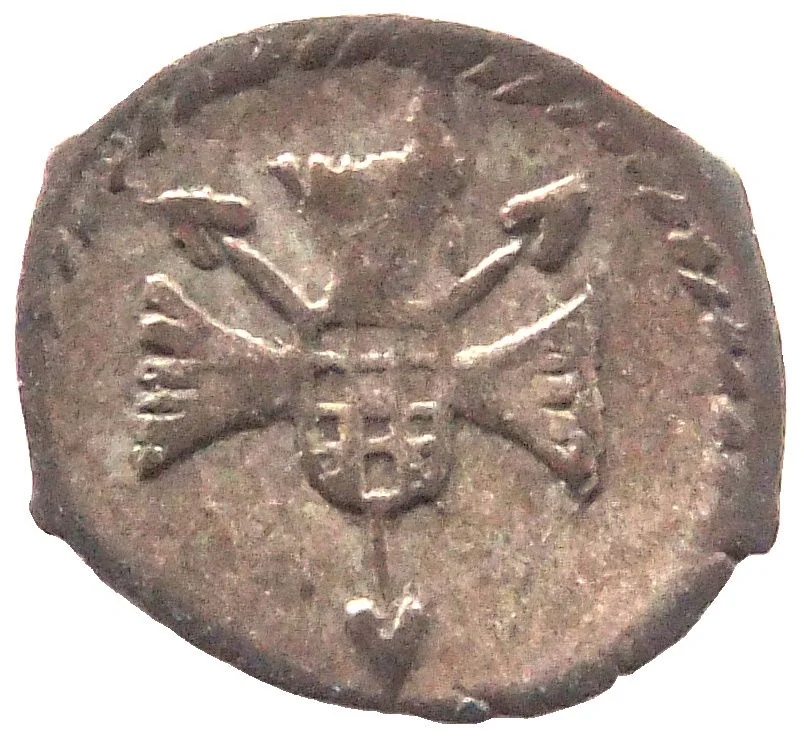
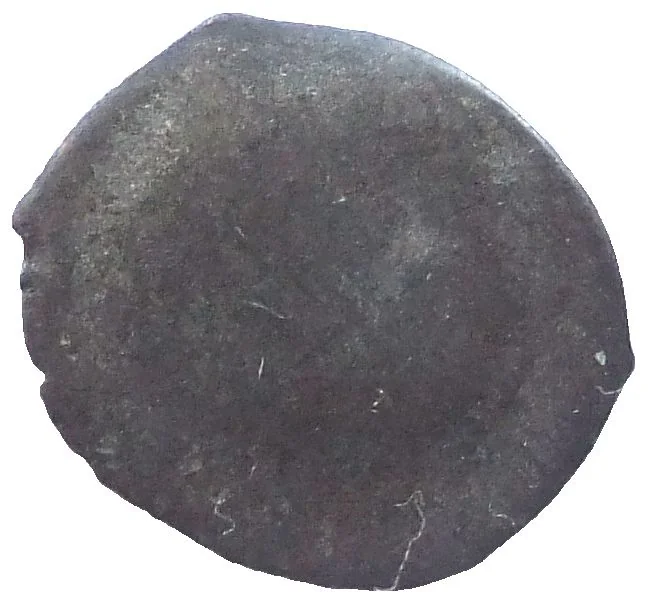
1 Pfennig – Landgraviate of Hesse-Cassel
Context
Material
Diameter: 12.5 mm
Weight: 0.33 g
Silver weight: 0.33 g
Shape: Irregular round
Composition: Silver
Magnetic: No
References
KM: #Click to copy to clipboard22
Numista: #465281
Value
Bullion value: $0.93
Obverse
Description:
Heraldic emblem.
Reverse
Edge
Mints
| Name | Mark |
|---|---|
| Kassel | — |
Mintings
| Year | Mint Mark | Mintage | Quality | Collection |
|---|---|---|---|---|
| — | — | — |
Historical background
In 1676, the currency situation in the Landgraviate of Hesse-Cassel was one of significant strain and complexity, a direct legacy of the Thirty Years' War (1618-1648). The conflict had devastated the region's economy and led to widespread monetary debasement, where the silver content of coins was reduced to fund military expenses. By the 1670s, this resulted in a chaotic mix of circulating coins, including older, full-value Reichstalers, newer debased local issues, and a plethora of foreign currencies from neighboring states, all with fluctuating and unreliable exchange rates. This monetary fragmentation severely hampered trade and created uncertainty for both merchants and the populace.
Landgrave Karl, ruling from 1670 to 1730, recognized this instability as a major obstacle to economic recovery and state power. His response was a sustained policy of monetary reform, aiming to standardize the currency and restore confidence. A pivotal step came in 1675/76 with the issuance of new, high-quality silver coins, notably the Hessen-Casselischer Reichstaler, which adhered closely to the imperial standard. This was an explicit attempt to drive debased money out of circulation and establish a stable, trusted currency under princely authority, central to Karl's broader mercantilist and absolutist ambitions.
However, the success of these reforms in 1676 was still partial and faced considerable challenges. The landgraviate's finances were perpetually stretched by Karl's maintenance of a large, modern standing army—a key source of his political influence and income through the practice of leasing troops to foreign powers. While the new coins improved the monetary standard, the constant pressure of military expenditure required careful treasury management to prevent renewed debasement. Thus, the currency situation in 1676 was at a critical juncture: transitioning from post-war chaos toward greater stability through principled action, yet remaining vulnerable to the landgrave's expensive geopolitical and military priorities.
Landgrave Karl, ruling from 1670 to 1730, recognized this instability as a major obstacle to economic recovery and state power. His response was a sustained policy of monetary reform, aiming to standardize the currency and restore confidence. A pivotal step came in 1675/76 with the issuance of new, high-quality silver coins, notably the Hessen-Casselischer Reichstaler, which adhered closely to the imperial standard. This was an explicit attempt to drive debased money out of circulation and establish a stable, trusted currency under princely authority, central to Karl's broader mercantilist and absolutist ambitions.
However, the success of these reforms in 1676 was still partial and faced considerable challenges. The landgraviate's finances were perpetually stretched by Karl's maintenance of a large, modern standing army—a key source of his political influence and income through the practice of leasing troops to foreign powers. While the new coins improved the monetary standard, the constant pressure of military expenditure required careful treasury management to prevent renewed debasement. Thus, the currency situation in 1676 was at a critical juncture: transitioning from post-war chaos toward greater stability through principled action, yet remaining vulnerable to the landgrave's expensive geopolitical and military priorities.
✨ Legendary