

1 quattrino – Gubbio
Add to wishlist
Italy
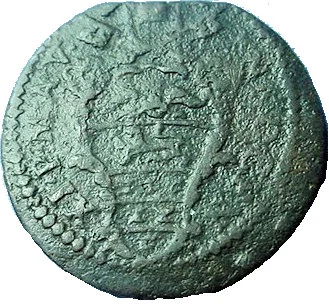
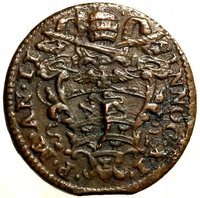
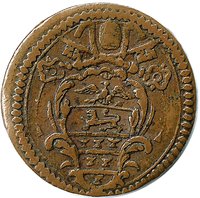
Obverse
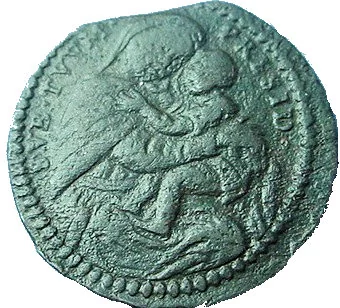
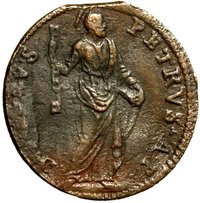
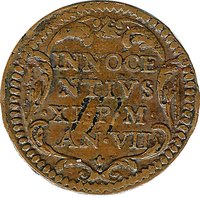
Reverse
Edge
Categories
| Symbols> Coat of Arms |
| Person> Religious figure |
| Symbol> Crown |
Mints
| Name | Mark |
|---|---|
| Gubbio | — |
Mintings
| Year | Mint Mark | Mintage | Quality | Collection |
|---|---|---|---|---|
| 1680 | — | — |
Historical background
In 1680, the Italian city-state of Gubbio, like much of the Papal States under which it fell, operated within a complex and often strained monetary system. The official currency was the Papal scudo, a silver coin, alongside its subdivisions (giuli and baiocchi) and the gold doppia. However, the reality in the marketplace was a cacophony of competing currencies. Centuries-old local coinage from other Italian states, Spanish silver reales from the New World, and even clipped and debased coins from the recent Thirty Years' War circulated freely, their values fluctuating based on metal content and trust. This created a constant challenge for merchants and citizens alike, who needed to assess the true worth of every coin in a transaction.
The monetary situation was further strained by the economic policies of the Papal government in Rome. A chronic shortage of precious metals, combined with the high costs of administering the state and funding architectural projects, often led to official debasement—reducing the silver content in minted coins while proclaiming their face value remained the same. This practice, while providing short-term revenue for the treasury, fueled inflation and eroded public confidence. In Gubbio’s local economy, still heavily rooted in agriculture, wool, and ceramics, this instability made long-term contracts and pricing difficult, privileging savvy money-changers who set up benches (banchi) to trade the myriad of coins.
Consequently, daily commerce in Gubbio relied heavily on a system of barter and small-denomination piccoli coins for everyday purchases, while larger transactions, such as property deals or wholesale goods, were often reckoned in imaginary "money of account" (like the lira), which provided a stable notational standard. Actual payment would then be made in a mix of physical coins, with their values negotiated. Thus, in 1680, a Gubbio citizen lived in a dual monetary world: one of official, often unreliable, coinage decreed by distant Rome, and another of practical, localized exchange managed through tradition, negotiation, and necessity.
The monetary situation was further strained by the economic policies of the Papal government in Rome. A chronic shortage of precious metals, combined with the high costs of administering the state and funding architectural projects, often led to official debasement—reducing the silver content in minted coins while proclaiming their face value remained the same. This practice, while providing short-term revenue for the treasury, fueled inflation and eroded public confidence. In Gubbio’s local economy, still heavily rooted in agriculture, wool, and ceramics, this instability made long-term contracts and pricing difficult, privileging savvy money-changers who set up benches (banchi) to trade the myriad of coins.
Consequently, daily commerce in Gubbio relied heavily on a system of barter and small-denomination piccoli coins for everyday purchases, while larger transactions, such as property deals or wholesale goods, were often reckoned in imaginary "money of account" (like the lira), which provided a stable notational standard. Actual payment would then be made in a mix of physical coins, with their values negotiated. Thus, in 1680, a Gubbio citizen lived in a dual monetary world: one of official, often unreliable, coinage decreed by distant Rome, and another of practical, localized exchange managed through tradition, negotiation, and necessity.
💎 Extremely Rare