

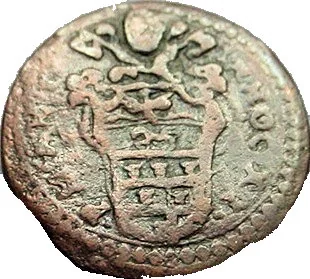
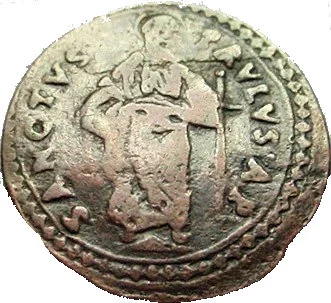
1 quattrino – Gubbio
Add to wishlist
Italy
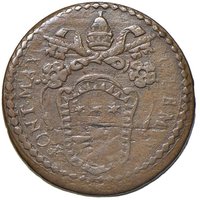
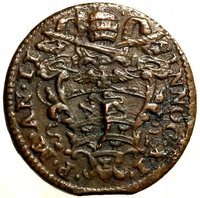
Obverse
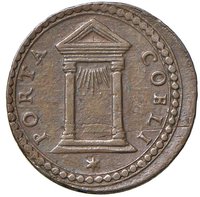
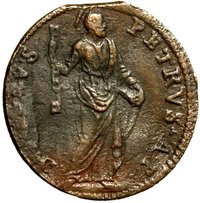
Reverse
Edge
Categories
| Person> Religious figure |
| Symbol> Crown |
| Symbols> Coat of Arms |
| Object> Cold weapons |
Mints
| Name | Mark |
|---|---|
| Gubbio | — |
Mintings
| Year | Mint Mark | Mintage | Quality | Collection |
|---|---|---|---|---|
| 1676 | — | — |
Historical background
In 1676, the currency situation in the Italian city-state of Gubbio, then part of the Papal States, was characterized by significant complexity and debasement. Like much of the peninsula, Gubbio operated within a bimetallic system of gold and silver coins, but the circulating medium was a chaotic mix of local papal issues, older regional coins from defunct mints, and a plethora of foreign currencies, particularly Spanish silver reales and scudi from other Italian states. The value of these coins was not fixed by their precious metal content alone but was also subject to official "cries" or proclamations (grida) that assigned them a fluctuating value in terms of the abstract money of account, the lira, which was used for bookkeeping and contracts.
This period saw persistent inflationary pressure and a chronic shortage of high-quality specie. The Papal government in Rome, engaged in expensive military and building projects, frequently resorted to debasing its own silver coinage, reducing the silver content in coins like the grosso and giulio that circulated in Gubbio. Consequently, older, purer coins were either hoarded or exported, leaving the populace to transact with increasingly inferior money. This "bad money driving out good" (Gresham's Law) eroded public trust and created practical difficulties for merchants and artisans, who had to constantly refer to complex exchange tables to navigate daily trade.
The situation placed a heavy burden on Gubbio's local economy, which was primarily agrarian with a modest wool and pottery trade. Price instability hampered commerce, while tax obligations to the Papal treasury, often demanded in specific coin types, created additional hardship. While the Consiglio Comunale (City Council) had limited authority to set local exchange rates, it could not override papal monetary policy. Thus, in 1676, Gubbio's citizens were navigating an unstable monetary environment where the face value of a coin and its actual worth in the market were increasingly divergent, a source of daily friction and economic uncertainty.
This period saw persistent inflationary pressure and a chronic shortage of high-quality specie. The Papal government in Rome, engaged in expensive military and building projects, frequently resorted to debasing its own silver coinage, reducing the silver content in coins like the grosso and giulio that circulated in Gubbio. Consequently, older, purer coins were either hoarded or exported, leaving the populace to transact with increasingly inferior money. This "bad money driving out good" (Gresham's Law) eroded public trust and created practical difficulties for merchants and artisans, who had to constantly refer to complex exchange tables to navigate daily trade.
The situation placed a heavy burden on Gubbio's local economy, which was primarily agrarian with a modest wool and pottery trade. Price instability hampered commerce, while tax obligations to the Papal treasury, often demanded in specific coin types, created additional hardship. While the Consiglio Comunale (City Council) had limited authority to set local exchange rates, it could not override papal monetary policy. Thus, in 1676, Gubbio's citizens were navigating an unstable monetary environment where the face value of a coin and its actual worth in the market were increasingly divergent, a source of daily friction and economic uncertainty.
💎 Extremely Rare