

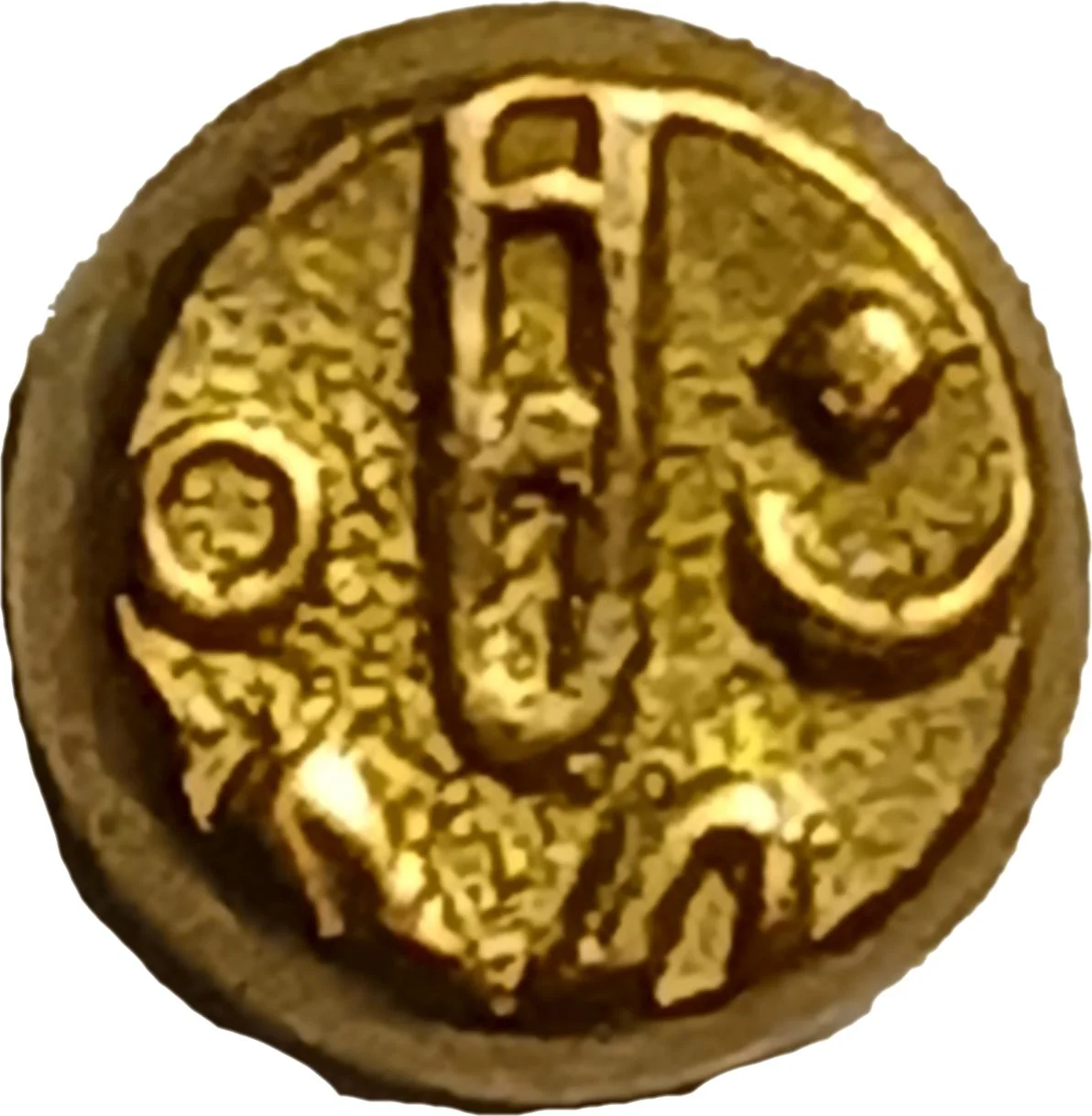


Obverse
Description:
Kali with Tanjore breast rosette, sun left, star and crescent right.
Reverse
Description:
Geometric stylization of the Ranga Rau legend.
Edge
Plain
Mintings
| Year | Mint Mark | Mintage | Quality | Collection |
|---|---|---|---|---|
| 1784 | — | — |
Historical background
In 1657, the currency situation in Dutch India, centered on the Dutch East India Company (VOC) headquarters in Batavia (modern-day Jakarta), was complex and driven by the Company's mercantile needs. The VOC operated a vast intra-Asian trade network, and Batavia functioned as its financial clearinghouse. Consequently, a multitude of coins circulated, including Spanish silver reales (the dominant international trade currency), Japanese silver koban and copper cash, various Indian gold pagodas and silver rupees, and local Malay tin coins. This created a chaotic monetary environment with fluctuating exchange rates, complicating all transactions.
The VOC's primary challenge was a persistent shortage of ready cash, especially small-denomination coins for local payments to soldiers, sailors, and suppliers. To address this, the Company frequently resorted to minting its own low-value copper and tin coins, known as doits, for local use. However, these often suffered from debasement and low public trust. More critically, the VOC struggled to stem the constant outward drain of silver bullion and coins to procure spices and textiles in the archipelago and India, as Europe produced little that Asia desired in exchange. This drain was a perennial concern for the Heren XVII (the Lords Seventeen, the VOC's board of directors) in Amsterdam.
Administratively, the VOC attempted to impose order by setting official exchange rates (tafel) for the various coins against the Dutch guilder and its Batavian accounting unit. Yet, these official rates often conflicted with market values, leading to illicit trade and currency speculation. The situation in 1657 was thus one of managed instability: the Company maintained its crucial trade flows through a pragmatic, if inefficient, acceptance of diverse currencies while battling liquidity shortages and attempting to enforce a centralized monetary policy over a decentralized and resistant Asian market.
The VOC's primary challenge was a persistent shortage of ready cash, especially small-denomination coins for local payments to soldiers, sailors, and suppliers. To address this, the Company frequently resorted to minting its own low-value copper and tin coins, known as doits, for local use. However, these often suffered from debasement and low public trust. More critically, the VOC struggled to stem the constant outward drain of silver bullion and coins to procure spices and textiles in the archipelago and India, as Europe produced little that Asia desired in exchange. This drain was a perennial concern for the Heren XVII (the Lords Seventeen, the VOC's board of directors) in Amsterdam.
Administratively, the VOC attempted to impose order by setting official exchange rates (tafel) for the various coins against the Dutch guilder and its Batavian accounting unit. Yet, these official rates often conflicted with market values, leading to illicit trade and currency speculation. The situation in 1657 was thus one of managed instability: the Company maintained its crucial trade flows through a pragmatic, if inefficient, acceptance of diverse currencies while battling liquidity shortages and attempting to enforce a centralized monetary policy over a decentralized and resistant Asian market.

✨ Legendary