

1 Fanam – Dutch India
India

Obverse
Description:
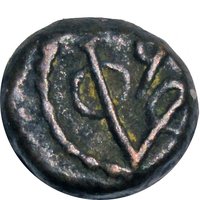
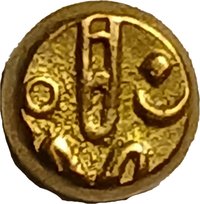
Fallen Kali.
Reverse
Description:
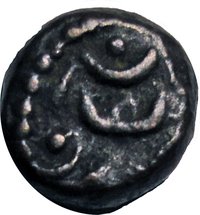
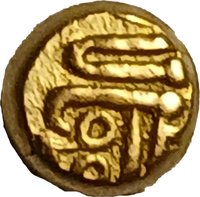
Like Cash KM#35 with Arabic script.
Edge
Mintings
| Year | Mint Mark | Mintage | Quality | Collection |
|---|---|---|---|---|
| — | — | — |
Historical background
In 1646, the currency situation in the Dutch East India Company (VOC) territories in India was complex and driven by the Company's primary goal: profit through trade. The VOC did not seek to impose a uniform Dutch monetary system but rather operated within the vibrant and pre-existing South Asian bullion and coinage markets. The lifeblood of trade was silver, imported in massive quantities from the Americas, Japan, and Europe. This silver, in the form of coins like Spanish Reales and Mexican Pesos, was used to purchase Indian textiles, spices, and other goods, which were then traded across Asia.
The actual circulating medium in Dutch settlements like Pulicat, Cochin, and Nagapatam was a diverse mix of local and foreign coins. The VOC both accepted and issued a variety of gold pagodas, silver fanams, and copper coins, often counterstamping them with the VOC monogram to guarantee their weight and purity within Company territories. However, the value of these coins was not fixed by the VOC alone; it fluctuated based on intrinsic metal content and, crucially, against the ubiquitous Hollandia ducatoon, a large silver coin that served as the key accounting unit for the VOC's inter-Asian trade. Its value in relation to local coins was constantly adjusted by Company factors based on market conditions.
This system was inherently unstable and administratively challenging. The VOC constantly battled currency manipulation, clipping, and the influx of debased coins from neighboring Indian states. Furthermore, a chronic shortage of small-change copper coins for daily transactions plagued local economies. Consequently, 1646 fell within a period of ongoing monetary experimentation, where the VOC attempted to regulate exchange rates and control minting to stabilize its trading operations, but ultimately remained dependent on the ebb and flow of global silver and regional bullion markets to fuel its commercial empire.
The actual circulating medium in Dutch settlements like Pulicat, Cochin, and Nagapatam was a diverse mix of local and foreign coins. The VOC both accepted and issued a variety of gold pagodas, silver fanams, and copper coins, often counterstamping them with the VOC monogram to guarantee their weight and purity within Company territories. However, the value of these coins was not fixed by the VOC alone; it fluctuated based on intrinsic metal content and, crucially, against the ubiquitous Hollandia ducatoon, a large silver coin that served as the key accounting unit for the VOC's inter-Asian trade. Its value in relation to local coins was constantly adjusted by Company factors based on market conditions.
This system was inherently unstable and administratively challenging. The VOC constantly battled currency manipulation, clipping, and the influx of debased coins from neighboring Indian states. Furthermore, a chronic shortage of small-change copper coins for daily transactions plagued local economies. Consequently, 1646 fell within a period of ongoing monetary experimentation, where the VOC attempted to regulate exchange rates and control minting to stabilize its trading operations, but ultimately remained dependent on the ebb and flow of global silver and regional bullion markets to fuel its commercial empire.

✨ Legendary